
全部书籍

专业

应用 关于 Coach 登录 开始阅读

书籍暂未推出简体中文版——当前显示英文版。

Earth and Space Sciences · 术语表

什么是 Crater dating; production and chronology functions; equilibrium density?

又称: crater dating · crater production function · crater chronology function · crater equilibrium density

Definition 26.6 University Earth and Space Sciences — Year 3 · 第 26 章 — Planetary Interiors and Surfaces

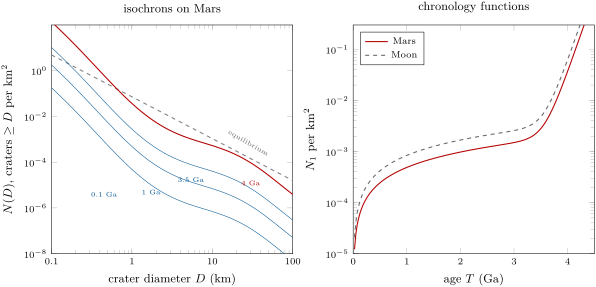
Crater dating is the determination of the age of a surface from the density of its craters. The crater production function is the shape of the size–frequency distribution of the craters a surface acquires, F(D)=N(D)/N(1 km)F(D) = N(D)/N(1\,\mathrm{km}), assumed the same at every age. The crater chronology function N1(T)N_1(T) is the number of craters of 1 km1\,\mathrm{km} and more per unit area accumulated in a time TT. A surface is at the crater equilibrium density for craters of a given size when each new crater erases, on average, as many old ones as it adds: their number no longer grows.
Left: isochrons of Mars, the cumulative densities of craters on surfaces 0.1, 1, 3.5 and 4 billion years old, with the equilibrium density (dashed), which caps every count: on a surface 4 billion years old the craters smaller than about 0.7\, km are at equilibrium and no longer record the age. Right: the chronology functions of Mars and of the Moon, the number of craters of 1\, km and more per square kilometre against the age of the surface.
Left: isochrons of Mars, the cumulative densities of craters on surfaces 0.1, 1, 3.5 and 4 billion years old, with the equilibrium density (dashed), which caps every count: on a surface 4 billion years old the craters smaller than about 0.7 km0.7\,\mathrm{km} are at equilibrium and no longer record the age. Right: the chronology functions of Mars and of the Moon, the number of craters of 1 km1\,\mathrm{km} and more per square kilometre against the age of the surface.
在原文中阅读 →