
সব বই

পেশাদার

1 Markets I: The Ecosystem and Exchange-Traded Marketsবাজার অনলাইন 2 Markets II: Rates, FX and Creditবাজার অনলাইন 3 Markets III: Commodities, Energy and Cryptoবাজার অনলাইন 4 Quantitative Methodsপদ্ধতি অনলাইন 5 Derivatives and Volatilityডেরিভেটিভস অনলাইন 6 Rates, Credit, XVA and Riskসুদহার, ঋণ ও ঝুঁকি অনলাইন 7 Research Craft: Predictors, Backtests, Measurement, Portfoliosগবেষণা অনলাইন 8 Strategies I: Equities and Futuresকৌশল অনলাইন 9 Strategies II: Volatility, Relative Value, Macro and the Bank Desksকৌশল অনলাইন 10 Microstructure and Executionএক্সিকিউশন অনলাইন 11 Market Making and High-Frequency Tradingমার্কেট মেকিং অনলাইন 12 Machine Learning for Marketsমেশিন লার্নিং অনলাইন 13 Low-Latency Softwareপ্রযুক্তি অনলাইন 14 Networks, Hardware and Trading Infrastructureপ্রযুক্তি অনলাইন 15 Research, Data and Risk Platformsপ্রযুক্তি অনলাইন 16 The Desk and the Firmপ্রতিষ্ঠান অনলাইন 17 The Industry: Firms, Roles and Careersক্যারিয়ার অনলাইন 18 Interviews I: Maths, Probability and Speedক্যারিয়ার অনলাইন 19 Interviews II: Markets, Trading Games and the Final Roundক্যারিয়ার অনলাইন 20 Interviews III: Codeক্যারিয়ার অনলাইন
অ্যাপ পরিচিতি Coach সাইন ইন পড়া শুরু করো

বইগুলো এখনো বাংলা ভাষায় পাওয়া যায় না — ইংরেজি সংস্করণ দেখানো হচ্ছে।

Earth and Space Sciences · পরিভাষা

Crater dating; production and chronology functions; equilibrium density কী?

অন্য নাম: crater dating · crater production function · crater chronology function · crater equilibrium density

Definition 26.6 University Earth and Space Sciences — Year 3 · অধ্যায় 26 — Planetary Interiors and Surfaces

Crater dating is the determination of the age of a surface from the density of its craters. The crater production function is the shape of the size–frequency distribution of the craters a surface acquires, F(D)=N(D)/N(1 km)F(D) = N(D)/N(1\,\mathrm{km}), assumed the same at every age. The crater chronology function N1(T)N_1(T) is the number of craters of 1 km1\,\mathrm{km} and more per unit area accumulated in a time TT. A surface is at the crater equilibrium density for craters of a given size when each new crater erases, on average, as many old ones as it adds: their number no longer grows.
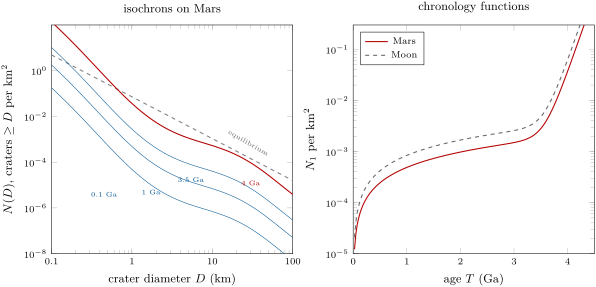
Left: isochrons of Mars, the cumulative densities of craters on surfaces 0.1, 1, 3.5 and 4 billion years old, with the equilibrium density (dashed), which caps every count: on a surface 4 billion years old the craters smaller than about 0.7\, km are at equilibrium and no longer record the age. Right: the chronology functions of Mars and of the Moon, the number of craters of 1\, km and more per square kilometre against the age of the surface.
Left: isochrons of Mars, the cumulative densities of craters on surfaces 0.1, 1, 3.5 and 4 billion years old, with the equilibrium density (dashed), which caps every count: on a surface 4 billion years old the craters smaller than about 0.7 km0.7\,\mathrm{km} are at equilibrium and no longer record the age. Right: the chronology functions of Mars and of the Moon, the number of craters of 1 km1\,\mathrm{km} and more per square kilometre against the age of the surface.
প্রসঙ্গসহ পড়ো →