
সব বই

পেশাদার

1 Markets I: The Ecosystem and Exchange-Traded Marketsবাজার অনলাইন 2 Markets II: Rates, FX and Creditবাজার অনলাইন 3 Markets III: Commodities, Energy and Cryptoবাজার অনলাইন 4 Quantitative Methodsপদ্ধতি অনলাইন 5 Derivatives and Volatilityডেরিভেটিভস অনলাইন 6 Rates, Credit, XVA and Riskসুদহার, ঋণ ও ঝুঁকি অনলাইন 7 Research Craft: Predictors, Backtests, Measurement, Portfoliosগবেষণা অনলাইন 8 Strategies I: Equities and Futuresকৌশল অনলাইন 9 Strategies II: Volatility, Relative Value, Macro and the Bank Desksকৌশল অনলাইন 10 Microstructure and Executionএক্সিকিউশন অনলাইন 11 Market Making and High-Frequency Tradingমার্কেট মেকিং অনলাইন 12 Machine Learning for Marketsমেশিন লার্নিং অনলাইন 13 Low-Latency Softwareপ্রযুক্তি অনলাইন 14 Networks, Hardware and Trading Infrastructureপ্রযুক্তি অনলাইন 15 Research, Data and Risk Platformsপ্রযুক্তি অনলাইন 16 The Desk and the Firmপ্রতিষ্ঠান অনলাইন 17 The Industry: Firms, Roles and Careersক্যারিয়ার অনলাইন 18 Interviews I: Maths, Probability and Speedক্যারিয়ার অনলাইন 19 Interviews II: Markets, Trading Games and the Final Roundক্যারিয়ার অনলাইন 20 Interviews III: Codeক্যারিয়ার অনলাইন
অ্যাপ পরিচিতি Coach সাইন ইন পড়া শুরু করো

বইগুলো এখনো বাংলা ভাষায় পাওয়া যায় না — ইংরেজি সংস্করণ দেখানো হচ্ছে।

Earth and Space Sciences · পরিভাষা

Cumulate; layered intrusion কী?

অন্য নাম: cumulate · layered intrusion

Definition 8.10 University Earth and Space Sciences — Year 2 · অধ্যায় 8 — Magmatic Differentiation

A cumulate is an igneous rock formed by the accumulation of crystals (the cumulus crystals) from a magma, together with the minerals later grown from the liquid trapped between them (the intercumulus material); its composition is that of crystals plus a little liquid, not that of any magma. A layered intrusion is a large, slowly cooled body of mafic or ultramafic cumulates arranged in layers, recording the fractional crystallisation of the magma that filled it.
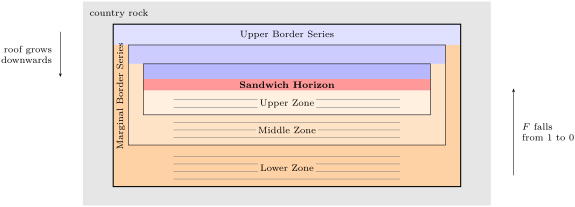
A layered intrusion of the Skaergaard type (schematic, not to scale). Cumulates grew inwards from all sides of the chamber at the same time: the Layered Series on the floor (orange, with layering), the Marginal Border Series on the walls and the Upper Border Series under the roof (blue), each with the same succession of zones. They met at the Sandwich Horizon, where the last liquid crystallised.
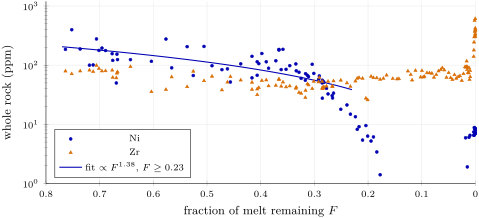
Nickel and zirconium in 134 cumulates of the reference section of the Skaergaard Layered Series against the fraction of melt remaining (data of Tegner and others, 2023, CC BY 4.0). Nickel, compatible, falls by a factor of thirty; zirconium, incompatible, stays low until the very last cumulates. The line is the least-squares fit of Ni on F over the Lower and Middle Zones.
Nickel and zirconium in 134 cumulates of the reference section of the Skaergaard Layered Series against the fraction of melt remaining (data of Tegner and others, 2023, CC BY 4.0). Nickel, compatible, falls by a factor of thirty; zirconium, incompatible, stays low until the very last cumulates. The line is the least-squares fit of ln⁡Ni\ln \mathrm{Ni} on ln⁡F\ln F over the Lower and Middle Zones.
প্রসঙ্গসহ পড়ো →