
全部书籍

专业

应用 关于 Coach 登录 开始阅读

书籍暂未推出简体中文版——当前显示英文版。

Earth and Space Sciences · 术语表

什么是 Cumulate; layered intrusion?

又称: cumulate · layered intrusion

Definition 8.10 University Earth and Space Sciences — Year 2 · 第 8 章 — Magmatic Differentiation

A cumulate is an igneous rock formed by the accumulation of crystals (the cumulus crystals) from a magma, together with the minerals later grown from the liquid trapped between them (the intercumulus material); its composition is that of crystals plus a little liquid, not that of any magma. A layered intrusion is a large, slowly cooled body of mafic or ultramafic cumulates arranged in layers, recording the fractional crystallisation of the magma that filled it.
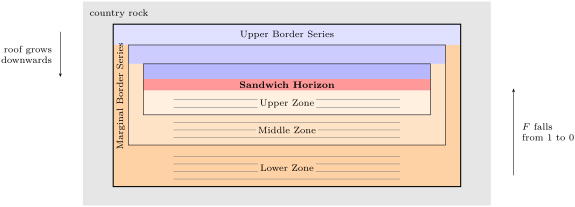
A layered intrusion of the Skaergaard type (schematic, not to scale). Cumulates grew inwards from all sides of the chamber at the same time: the Layered Series on the floor (orange, with layering), the Marginal Border Series on the walls and the Upper Border Series under the roof (blue), each with the same succession of zones. They met at the Sandwich Horizon, where the last liquid crystallised.
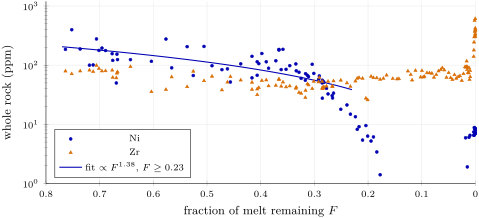
Nickel and zirconium in 134 cumulates of the reference section of the Skaergaard Layered Series against the fraction of melt remaining (data of Tegner and others, 2023, CC BY 4.0). Nickel, compatible, falls by a factor of thirty; zirconium, incompatible, stays low until the very last cumulates. The line is the least-squares fit of Ni on F over the Lower and Middle Zones.
Nickel and zirconium in 134 cumulates of the reference section of the Skaergaard Layered Series against the fraction of melt remaining (data of Tegner and others, 2023, CC BY 4.0). Nickel, compatible, falls by a factor of thirty; zirconium, incompatible, stays low until the very last cumulates. The line is the least-squares fit of ln⁡Ni\ln \mathrm{Ni} on ln⁡F\ln F over the Lower and Middle Zones.
在原文中阅读 →