
All books

Professional

Apps About Coach Log in Start reading

Earth and Space Sciences · Glossary

What is Cyclone, anticyclone?

Also known as: cyclone · anticyclone

Definition 28.10 University Earth and Space Sciences — Year 1 · Chapter 28 — The General Circulation of the Atmosphere

A cyclone is a large-scale circulation of winds around a centre of low pressure, a depression; an anticyclone is a circulation around a centre of high pressure. A cyclone turns anticlockwise in the Northern Hemisphere and clockwise in the Southern; an anticyclone the other way round.
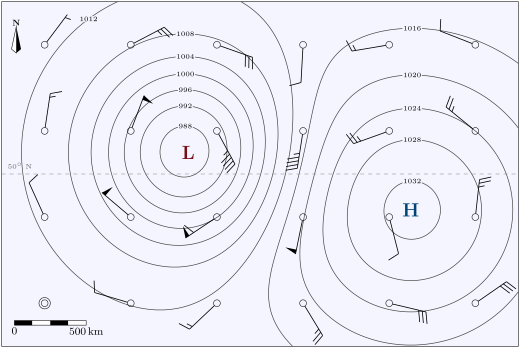
An invented sea-level pressure map near 50 N (isobars every 4\, hPa; central pressures 986\, hPa and 1033\, hPa). Each barb points into the geostrophic wind at its station, the staff towards where the wind comes from; a full feather is 10\, kn, a half feather 5\, kn, a pennant 50\, kn (1\, kn = 0.514\, m/ s). The winds turn anticlockwise round the low and clockwise round the high, and are strongest where the isobars crowd between the two, reaching 36\, m/ s.
An invented sea-level pressure map near 50∘50{}^{\circ} N (isobars every 4 hPa4\,\mathrm{hPa}; central pressures 986 hPa986\,\mathrm{hPa} and 1033 hPa1033\,\mathrm{hPa}). Each barb points into the geostrophic wind at its station, the staff towards where the wind comes from; a full feather is 10 kn10\,\mathrm{kn}, a half feather 5 kn5\,\mathrm{kn}, a pennant 50 kn50\,\mathrm{kn} (1 kn1\,\mathrm{kn} = 0.514 m/s0.514\,\mathrm{m}/\mathrm{s}). The winds turn anticlockwise round the low and clockwise round the high, and are strongest where the isobars crowd between the two, reaching 36 m/s36\,\mathrm{m}/\mathrm{s}.
Read in context →