
সব বই

পেশাদার

1 Markets I: The Ecosystem and Exchange-Traded Marketsবাজার অনলাইন 2 Markets II: Rates, FX and Creditবাজার অনলাইন 3 Markets III: Commodities, Energy and Cryptoবাজার অনলাইন 4 Quantitative Methodsপদ্ধতি অনলাইন 5 Derivatives and Volatilityডেরিভেটিভস অনলাইন 6 Rates, Credit, XVA and Riskসুদহার, ঋণ ও ঝুঁকি অনলাইন 7 Research Craft: Predictors, Backtests, Measurement, Portfoliosগবেষণা অনলাইন 8 Strategies I: Equities and Futuresকৌশল অনলাইন 9 Strategies II: Volatility, Relative Value, Macro and the Bank Desksকৌশল অনলাইন 10 Microstructure and Executionএক্সিকিউশন অনলাইন 11 Market Making and High-Frequency Tradingমার্কেট মেকিং অনলাইন 12 Machine Learning for Marketsমেশিন লার্নিং অনলাইন 13 Low-Latency Softwareপ্রযুক্তি অনলাইন 14 Networks, Hardware and Trading Infrastructureপ্রযুক্তি অনলাইন 15 Research, Data and Risk Platformsপ্রযুক্তি অনলাইন 16 The Desk and the Firmপ্রতিষ্ঠান অনলাইন 17 The Industry: Firms, Roles and Careersক্যারিয়ার অনলাইন 18 Interviews I: Maths, Probability and Speedক্যারিয়ার অনলাইন 19 Interviews II: Markets, Trading Games and the Final Roundক্যারিয়ার অনলাইন 20 Interviews III: Codeক্যারিয়ার অনলাইন
অ্যাপ পরিচিতি Coach সাইন ইন পড়া শুরু করো

বইগুলো এখনো বাংলা ভাষায় পাওয়া যায় না — ইংরেজি সংস্করণ দেখানো হচ্ছে।

Earth and Space Sciences · পরিভাষা

Dew point কী?

Definition 4.2 High School Earth and Space Sciences · অধ্যায় 4 — Why Clouds Form

The dew point of air is the temperature to which it must be cooled, keeping its water content and its pressure, to become saturated.
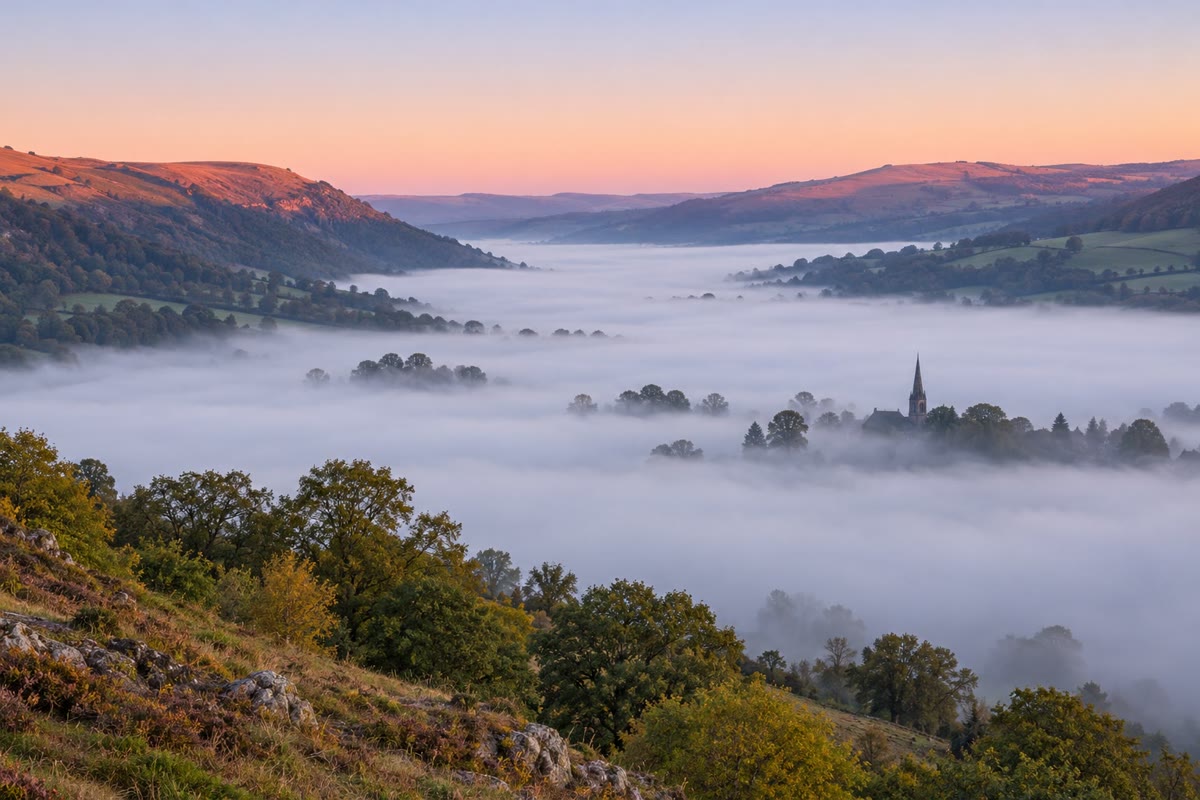
Fog filling a valley at dawn. During the clear night the ground cooled, the cold air drained down into the valley, and there it cooled below its dew point.

উদাহরণ

Example 4.4 (A summer morning)

At 20∘C20{}^{\circ}\mathrm{C} the air contains 11.4 g/kg11.4\,\mathrm{g}/\mathrm{kg}. The saturation content at 20∘C20{}^{\circ}\mathrm{C} is 14.7 g/kg14.7\,\mathrm{g}/\mathrm{kg}, so the relative humidity is 11.4/14.7≈78 %11.4/14.7 \approx 78\,\%. The saturation content is 11.4 g/kg11.4\,\mathrm{g}/\mathrm{kg} at 16∘C16{}^{\circ}\mathrm{C}: that is the dew point. In the afternoon, the same air warmed to 28∘C28{}^{\circ}\mathrm{C} (saturation content 24.1 g/kg24.1\,\mathrm{g}/\mathrm{kg}) has a relative humidity of only 47 %47\,\% — with exactly the same water in it.

Example 4.9 (An afternoon cumulus)

In the afternoon of Example 4.4, the air at the ground is at 28∘C28{}^{\circ}\mathrm{C} with a dew point of 16∘C16{}^{\circ}\mathrm{C}. Rising bubbles become saturated at 125×12=1500 m125 \times 12 = 1500\,\mathrm{m}: the cumulus have their flat bases about 1.5 km1.5\,\mathrm{km} up. In the morning, at 20∘C20{}^{\circ}\mathrm{C}, the same air would have condensed at only 125×4=500 m125 \times 4 = 500\,\mathrm{m}: cloud bases rise through the day as the ground warms.

Example 4.13 (The warm dry wind of the lee side)

Air at sea level at 20∘C20{}^{\circ}\mathrm{C}, with a dew point of 12∘C12{}^{\circ}\mathrm{C}, is driven over a ridge 2500 m2500\,\mathrm{m} high. It becomes saturated at 125×8=1000 m125 \times 8 = 1000\,\mathrm{m}, at about 10∘C10{}^{\circ}\mathrm{C}. From there to the crest it cools at the saturated rate, to about 2∘C2{}^{\circ}\mathrm{C}, and loses as rain about a third of its water (from 8.78.7 to 6.0 g/kg6.0\,\mathrm{g}/\mathrm{kg}). Coming down the other side it warms at the dry rate over 2.5 km2.5\,\mathrm{km}: it reaches the plain at about 27∘C27{}^{\circ}\mathrm{C}, seven degrees warmer than it started, with a relative humidity of about 27 %27\,\%. Such warm, dry winds blow in the lee of many mountain ranges.

প্রসঙ্গসহ পড়ো →