
全部书籍

专业

应用 关于 Coach 登录 开始阅读

书籍暂未推出简体中文版——当前显示英文版。

Earth and Space Sciences · 术语表

什么是 Dyke; sill; pluton?

又称: intrusion · dyke · sill · pluton

Definition 17.8 High School Earth and Space Sciences · 第 17 章 — Igneous Rocks

An intrusion is a body of igneous rock that crystallised inside other rocks. A dyke is a sheet of igneous rock that cuts across the layers or structures of the rocks it intrudes; a sill is a sheet that lies parallel to the layers, between them. A pluton is a large intrusion of any shape, formed at depth; many plutons joined together form a batholith (Chapter 22).
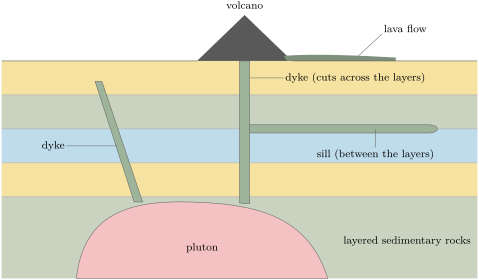
Intrusions (a drawing, not to scale). A pluton crystallises at depth; dykes cut across the layers of the rocks above it, one of them feeding a volcano; a sill spreads between two layers. Only erosion of the rocks above lays these bodies bare at the surface.
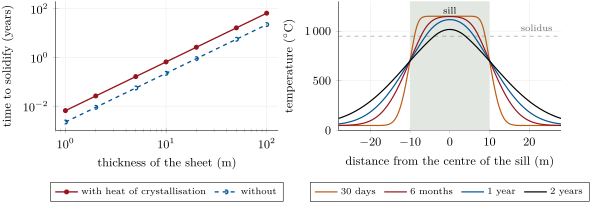
A sheet of basaltic magma cooling by conduction (computed model). Left: the time it takes to solidify, against its thickness, on logarithmic axes: a straight line of slope 2, the time growing as the square of the thickness. Right: temperatures across a sill 20\, m thick (shaded), intruded at 1150 C into rock at 50 C. The edges fall below the solidus at once, the centre only after about two and a half years.
A sheet of basaltic magma cooling by conduction (computed model). Left: the time it takes to solidify, against its thickness, on logarithmic axes: a straight line of slope 2, the time growing as the square of the thickness. Right: temperatures across a sill 20 m20\,\mathrm{m} thick (shaded), intruded at 1150∘C1150{}^{\circ}\mathrm{C} into rock at 50∘C50{}^{\circ}\mathrm{C}. The edges fall below the solidus at once, the centre only after about two and a half years.
在原文中阅读 →