High School Earth and Space Sciences · De la 2de à la Terminale
17Igneous Rocks
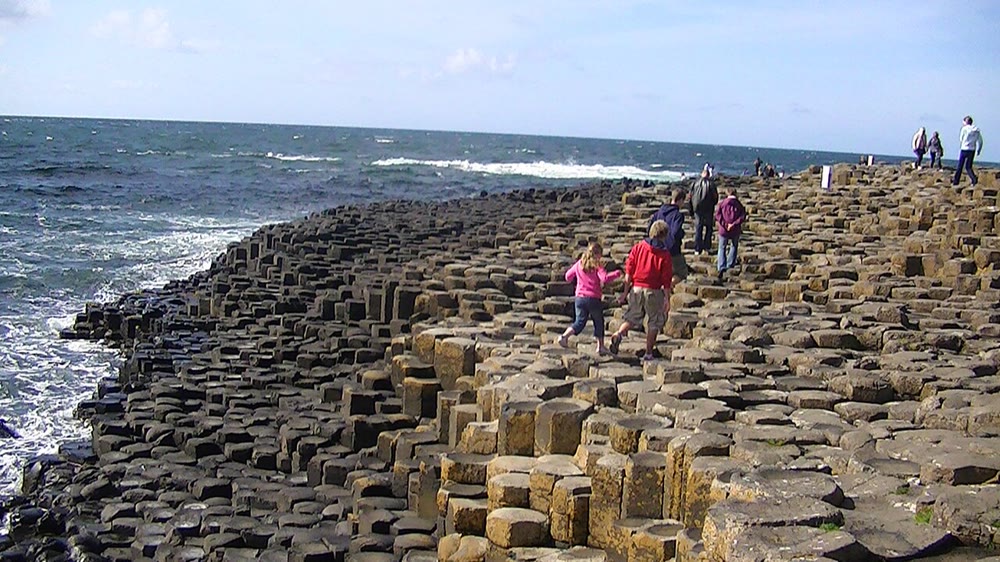
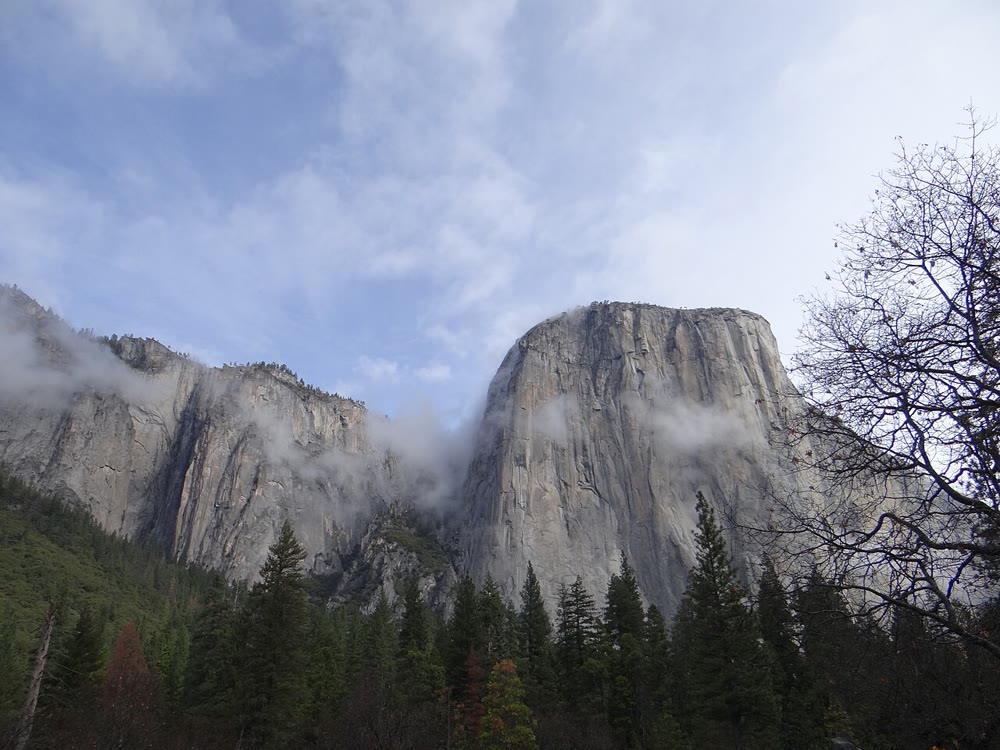
On the north coast of Ireland, stone columns packed side by side step down into the sea: the Giant’s Causeway, a basalt that cooled from a lava. In Yosemite, in California, the granite wall of El Capitan rises some above the valley floor, a single body of coarse-grained rock. Both crystallised from magma. The basalt cooled at the surface, its crystals too small to see; the granite cooled deep below ground, its crystals large enough to see, and it is visible today only because the rocks above it have been worn away. This chapter reads in a rock’s grains how fast, and how deep, it cooled.
You already know
Magma is molten rock beneath the surface; it erupts as lava, gently or explosively (Book 1, grade 7). An igneous rock is one formed when molten rock cools and becomes solid (Book 1, grade 6). Basalt is a dark volcanic rock, granite a light rock made of feldspar, quartz and mica (Book 1, grade 6). Mantle peridotite melts partly as it rises beneath a ridge, giving the basalt and gabbro of the oceanic crust (Chapter 14). The rock-forming silicates are olivine, pyroxenes, amphiboles, micas, feldspars and quartz; the feldspars are potassium feldspar and plagioclase, a series from calcium-rich to sodium-rich (Chapter 16). Heat spreads by conduction over a distance of about in a time , where is the thermal diffusivity (Chapter 15).
17.1 Volcanic and plutonic rocks
Definition 17.1 (Volcanic rock; plutonic rock)
An igneous rock, formed by the crystallisation of a magma, is volcanic (or extrusive) when the magma solidified at the Earth’s surface, as a lava, and plutonic (or intrusive) when it crystallised at depth, inside other rocks.
The difference shows in the size of the crystals. A crystal grows by adding atoms taken from the liquid around it, and that takes time. At the surface, a lava loses its heat to the air or water fast: material erupted into air or water cools in seconds, a lava flow in days to weeks. Deep down the surrounding rocks are hot and the magma loses its heat slowly: a shallow intrusion cools in months to years, a large deep one may take millions of years. Fast cooling gives many small crystals, or none at all; slow cooling gives fewer, much larger ones.
Definition 17.2 (Texture)
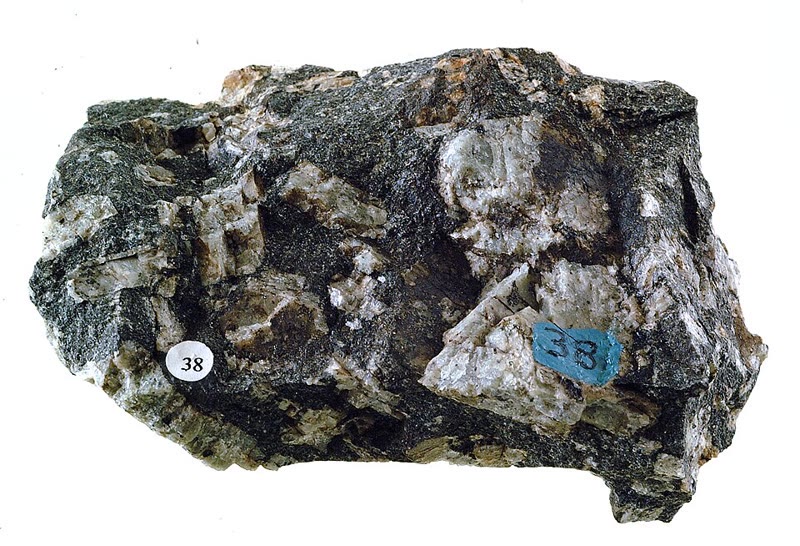
The texture of a rock is the size, shape and arrangement of its grains. An igneous rock is glassy when it has no crystals, fine-grained when its crystals are too small to be told apart with the naked eye, and coarse-grained when they can all be seen.
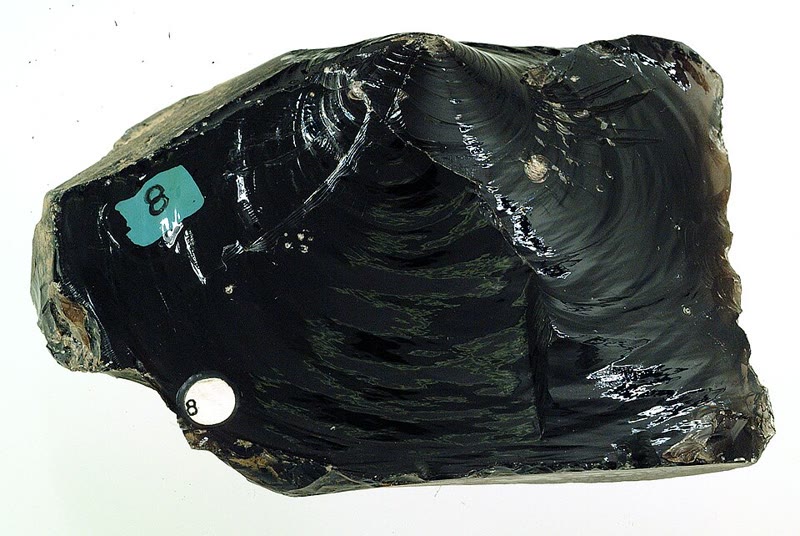
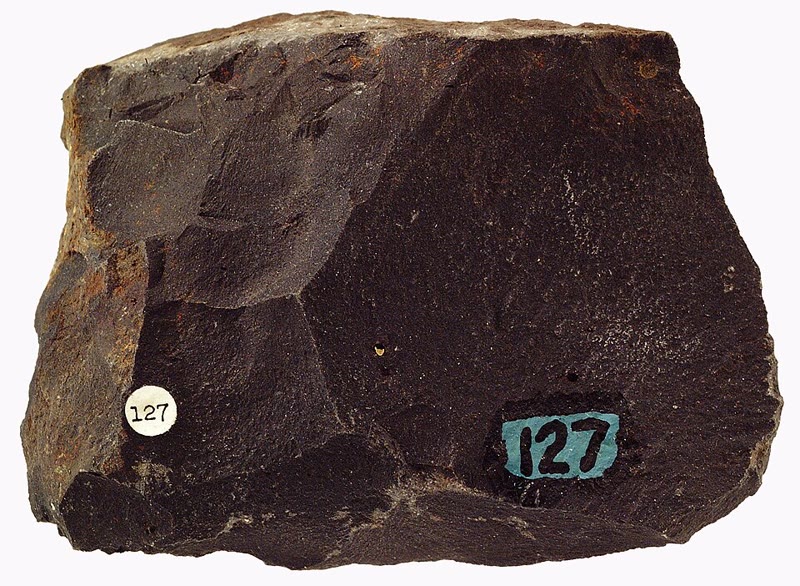
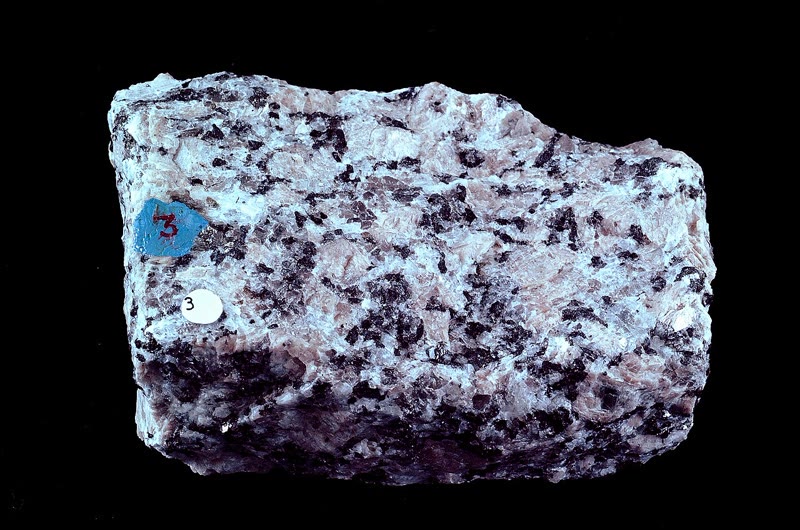
A lava quenched before any crystal can grow becomes a glass: obsidian, black and glassy, breaks with the conchoidal fracture of a bottle. Basalt is fine-grained: in the hand its minerals cannot be identified, and even in thin section the crystals are small (the basalt of Chapter 16). Granite, gabbro and diorite are coarse-grained: every grain shows.
Definition 17.3 (Phenocryst; porphyritic)
A phenocryst is a large crystal set in a mass of much smaller crystals or glass, the groundmass. A rock with phenocrysts is porphyritic.
A porphyritic texture records two stages of cooling: first slow, at depth, while the phenocrysts grew in a magma that was still mostly liquid; then fast, when the magma rose and erupted, or was injected into cold rock, and the rest of the liquid froze into the groundmass.
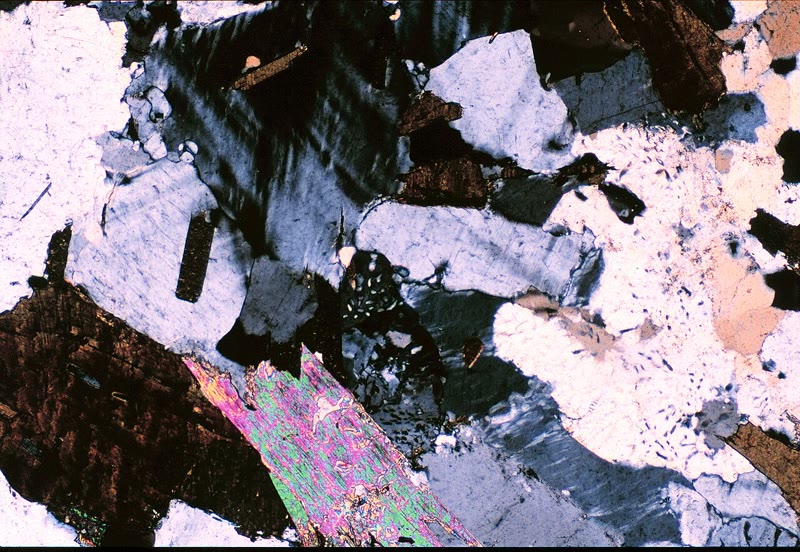
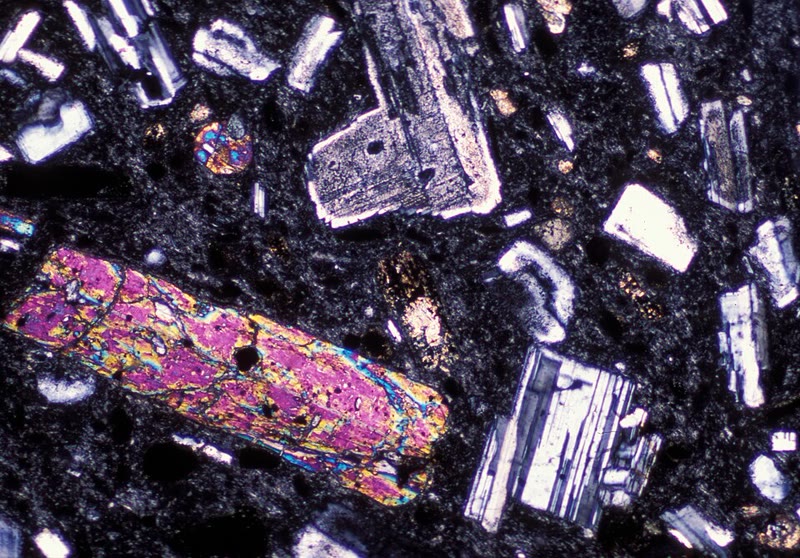
17.2 Naming igneous rocks
The second key to an igneous rock is its chemistry, and above all its content of silica, , which ranges in common magmas from about to about of the mass.
Definition 17.4 (Mafic; intermediate; felsic)
A magma, or the rock it forms, is mafic when it holds about to and is rich in iron, magnesium and calcium; intermediate between and ; felsic when it holds about to and is poor in iron, magnesium and calcium but rich in sodium and potassium.
Each kind of magma gives two rocks, one volcanic and fine-grained, one plutonic and coarse-grained, with the same chemistry. Basalt and gabbro are the mafic pair, met with the oceanic crust; granite is the felsic plutonic rock. Three names complete the set.
Definition 17.5 (Andesite; diorite; rhyolite)
Andesite and diorite are the volcanic and the plutonic rock of intermediate composition, made mostly of plagioclase with amphibole or pyroxene. Rhyolite is the volcanic rock of felsic composition, the fine-grained equivalent of granite.
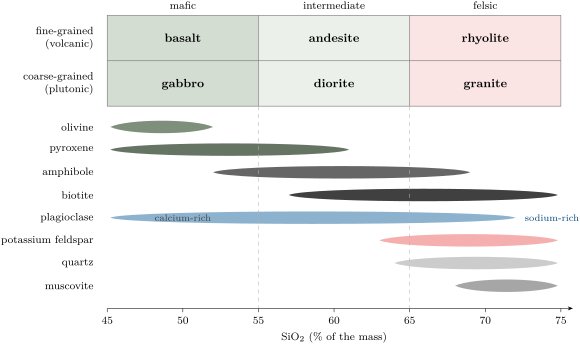
Method 17.6 (Naming an igneous rock)
- Look at the texture: glassy, fine-grained or coarse-grained; porphyritic or not. Fine-grained or glassy means volcanic (or a small, quickly cooled intrusion); coarse-grained means plutonic.
- Identify the minerals that can be seen (Method 16.4): quartz and potassium feldspar point to felsic, amphibole with plagioclase to intermediate, olivine and pyroxene to mafic. In a fine-grained rock, use the phenocrysts, the colour of the groundmass — dark for mafic, light for felsic — as a hint, or a chemical analysis.
- Read the name at the crossing of the row and the column of the chart.
Example 17.7 (Two basalts)
A dark rock from a lava flow is fine-grained throughout; another, from the same volcano, shows green grains of olivine a few millimetres across in a dark groundmass. Both are mafic and fine-grained: both are basalts. The second is a porphyritic basalt: its olivine grew first, slowly, in the magma below the volcano, before the lava erupted and froze around it.
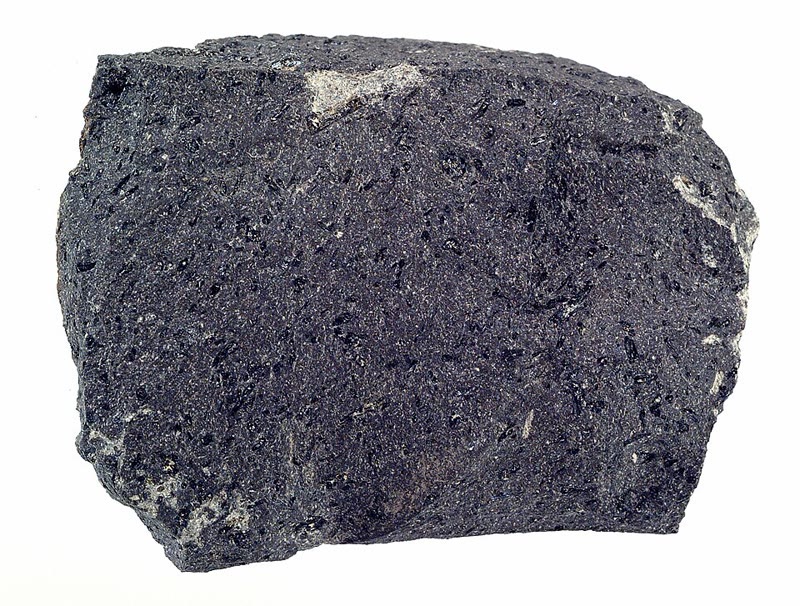
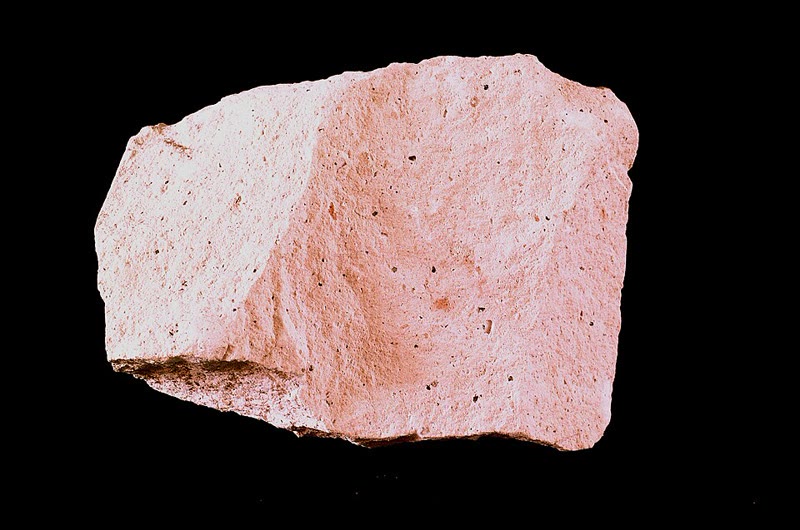
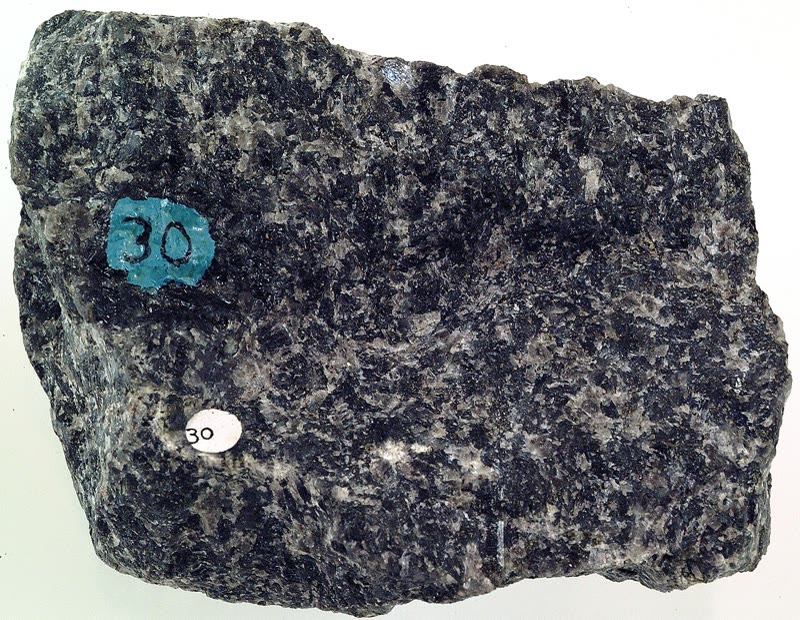
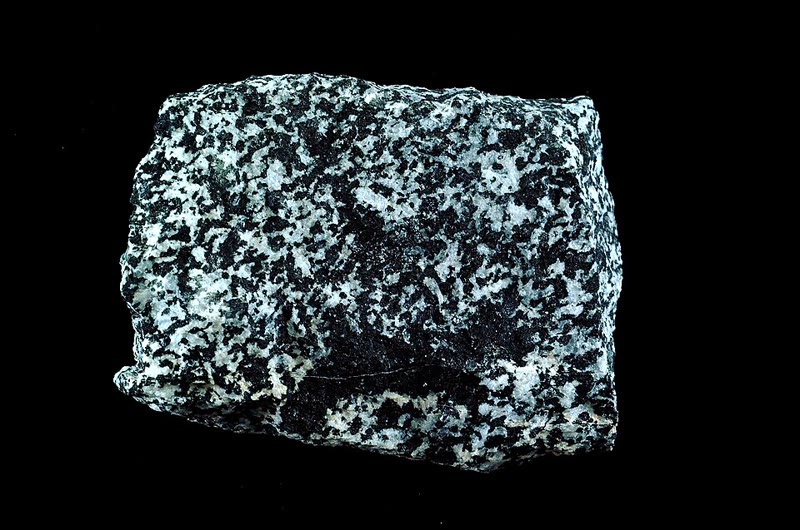
17.3 The order of crystallisation
A magma does not freeze at one temperature, as water does. Its minerals appear one after another as it cools, each in its own range of temperature, so that a cooling magma can hold crystals and still be mostly liquid.
History — Bowen’s experiments
Norman L. Bowen (1887–1956) joined the Geophysical Laboratory of the Carnegie Institution in Washington in 1912. Working mostly with basaltic magmas, he melted a rock in a furnace, let it cool slowly to a chosen temperature so that some minerals formed, then quenched it, cooling it so fast that the remaining liquid became a glass. Under the microscope, the crystals showed which minerals had formed above that temperature. Repeated at lower and lower temperatures, the experiment gave the order in which the minerals appear. Bowen published this order as a reaction series in 1922 and his book The Evolution of the Igneous Rocks in 1928.
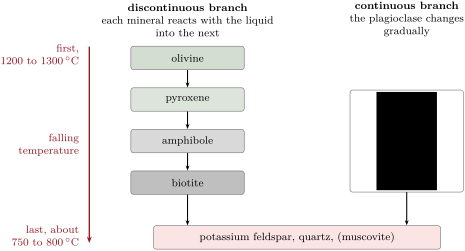
The word reaction matters. Olivine is stable at high temperature only: as the magma cools, olivine crystals react with silica in the liquid and turn into pyroxene,
and so on down the branch, as long as silica remains in the liquid. Along the other branch, plagioclase crystals keep growing, but each new layer is richer in sodium than the last: a plagioclase crystal can be zoned, from a calcium-rich core to a sodium-rich rim, like the plagioclase phenocrysts of the andesite above.
The series explains the chart. A mafic magma runs out of silica early: it crystallises olivine, pyroxene and calcium-rich plagioclase, and gives a gabbro if it cools slowly underground, a basalt if it cools fast at the surface. Only a magma rich in silica goes on to the end of the series and forms potassium feldspar and quartz: the minerals of granite and rhyolite. How a magma changes its composition on the way, when its early crystals are separated from the liquid, is the subject of the second university year.
17.4 Intrusions
Magma rises because it is less dense than the rocks around it, forcing its way into fractures and widening them. Much of it never reaches the surface: it crystallises in the crust as intrusions, which are seen only once erosion has removed the rocks above.
Definition 17.8 (Dyke; sill; pluton)
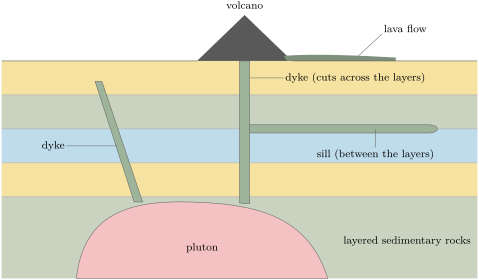
An intrusion is a body of igneous rock that crystallised inside other rocks. A dyke is a sheet of igneous rock that cuts across the layers or structures of the rocks it intrudes; a sill is a sheet that lies parallel to the layers, between them. A pluton is a large intrusion of any shape, formed at depth; many plutons joined together form a batholith (Chapter 22).
Dykes are commonly less than wide and sills less than thick; a sill is usually fed by a dyke. Shallow dykes and sills cool fast: they are fine-grained, sometimes porphyritic. Against the cold rock they intrude, their edges cool fastest of all and are even finer grained than their centre: a chilled margin, the mark of a body that was hot when it came into place. The Sierra Nevada of California, where Yosemite lies, is a batholith: the granitic rocks whose density was measured in Chapter 16 come from about two hundred of its plutons.
How long does an intrusion take to crystallise? Consider a sheet of magma — a dyke or a sill — of thickness , losing its heat by conduction into the rock on both sides. The only quantities that set the pace are the thickness , in metres, and the thermal diffusivity , in ; the only time that can be built from them is .
Proposition 17.9 (The cooling time of a sheet of magma)
A sheet of magma of thickness that cools by conduction solidifies in a time
where is the thermal diffusivity of the rocks and a number set by the temperatures of the magma and of the surrounding rock and by the heat released as the magma crystallises. Doubling the thickness multiplies the time by four. (Admitted; the value of comes from a computed model.)
For a basaltic magma intruded at into rock at , which crystallises completely at and releases of heat for each cubic metre that crystallises, with , the model gives . A sheet thick then solidifies in about ten days, a sill thick in about two and a half years, one thick in about sixty-five years. Without the heat of crystallisation, the times would be three times shorter: crystallising magma keeps itself warm.
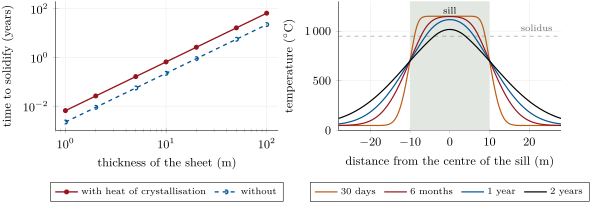
The model also shows the chilled margin forming. The rock at the contact jumps at once to about , far below the solidus: the first centimetres of the sill freeze within a day, while its centre stays liquid for years. Real intrusions are more complicated — the properties of rocks change with temperature, water circulates, a deep pluton sits in rock that is already hot and may be fed again and again — which is why large deep intrusions take far longer to cool than the law, with a cold host, would suggest.
17.5 Exercises
Exercise 17.1 ★
Define a volcanic rock and a plutonic rock. Give the three pairs of volcanic and plutonic rocks of the same composition, from mafic to felsic.
Solution
Solution of Exercise 17.1.
A volcanic rock formed from a magma that solidified at the surface, as a lava; a plutonic rock crystallised at depth, inside other rocks. Pairs: basalt and gabbro (mafic), andesite and diorite (intermediate), rhyolite and granite (felsic).
Exercise 17.2 ★
Match each rock to its texture — glassy, fine-grained, coarse-grained, porphyritic: (1) obsidian; (2) granite; (3) a basalt with green olivine crystals a few millimetres across in a dark groundmass; (4) a basalt in which no mineral can be seen.
Solution
Solution of Exercise 17.2.
(1) Glassy. (2) Coarse-grained. (3) Porphyritic (olivine phenocrysts in a fine groundmass). (4) Fine-grained.
Exercise 17.3 ★
Three magmas contain , and . Classify each, and name the rock each gives when it cools slowly at depth.
Exercise 17.4 ★
Define a dyke, a sill and a pluton. On the drawing of intrusions in this chapter, which body fed the volcano?
Solution
Solution of Exercise 17.4.
A dyke is a sheet of igneous rock that cuts across the layers of the rocks it intrudes; a sill is a sheet parallel to the layers, between them; a pluton is a large intrusion of any shape formed at depth. The vertical dyke that rises from the pluton fed the volcano.
Exercise 17.5 ★
In Bowen’s reaction series, which mineral forms first, and which minerals form last? How does plagioclase change as the magma cools?
Solution
Solution of Exercise 17.5.
Olivine forms first; potassium feldspar, quartz and sometimes muscovite last. Plagioclase starts rich in calcium and becomes richer and richer in sodium as the magma cools.
Exercise 17.6 ★★
Two rocks are analysed (mass percentages). Rock A: 74, 14, 3, 3, 0.5, 5, 4. Rock B: 47, 14, 8, 10, 8, 1, 2. (1) Classify each. (2) Check your answer with the other oxides. (3) Rock A is fine-grained: name it. Rock B is coarse-grained: name it.
Exercise 17.7 ★★
A dyke thick solidifies in about ten days. Using the proposition on the cooling time, how long does a dyke of the same magma take if it is thick? A sill thick? One thick?
Solution
Solution of Exercise 17.7.
The time grows as the square of the thickness. : days. : days, about 2.7 years. : days, about 270 years.
Exercise 17.8 ★★
(1) Show that is a time. (2) Compute it for and , in seconds and in years (). (3) With , how long does the sill take to solidify?
Solution
Solution of Exercise 17.8.
(1) divided by gives seconds. (2) , that is years. (3) years.
Exercise 17.9 ★★
A rock shows blocky plagioclase crystals about a centimetre long in a groundmass whose grains cannot be seen. Describe its texture, and tell the story of its cooling in two stages.
Solution
Solution of Exercise 17.9.
It is porphyritic: plagioclase phenocrysts in a fine-grained groundmass. First the magma cooled slowly at depth, and the plagioclase crystals grew large while most of the magma stayed liquid; then it rose and cooled fast, and the remaining liquid crystallised as the fine groundmass.
Exercise 17.10 ★★
Olivine reacts with silica in the liquid: . (1) Check that the equation is balanced. (2) With the molar masses () and (), what mass of silica does of olivine take from the liquid? (3) Why does a magma poor in silica keep its olivine?
Solution
Solution of Exercise 17.10.
(1) Left: 2 Mg, 2 Si, 6 O; right: 2 Mg, 2 Si, 6 O. (2) of olivine is mol, which takes as many moles of silica: . (3) With no silica left in the liquid, the reaction cannot go on: the olivine stays.
Exercise 17.11 ★★
A sill thick and in area cools from to . (1) Its heat capacity is per cubic metre and per degree: what heat does it lose by cooling? (2) It also releases per cubic metre as it crystallises: what heat is that? (3) Compare the two.
Solution
Solution of Exercise 17.11.
(1) , . (2) , . (3) The heat of crystallisation is about a third of the heat lost by cooling, a quarter of the total: enough to slow the freezing a great deal, because it is all released above the solidus.
Exercise 17.12 ★★★
In the computed model of a sill thick, the rock from the contact falls below the solidus after about days, the rock from the contact after about 545 days, and the centre after about 950 days. (1) Where in the sill do you expect the smallest crystals, and where the largest? (2) Is the rate at which the solid layer grows constant? (3) Why is the sill fine-grained even at its centre, compared with a granite?
Solution
Solution of Exercise 17.12.
(1) The smallest crystals at the contact, which froze within a day; the largest at the centre, which stayed liquid for about 950 days. (2) No: the first took about 545 days, the last about 400 days; the front slows down at first, then speeds up near the centre, where the heat leaving through both sides meets. (3) Even at its centre, the sill froze in under three years; a granite with large crystals needs a far longer time.
Exercise 17.13 ★★★
A pluton is thick. (1) Using the proposition and the sill (about 2.6 years), estimate its cooling time. (2) Large deep intrusions are known to take up to millions of years to cool. Give two reasons why the simple law underestimates the time.
Solution
Solution of Exercise 17.13.
(1) The pluton is 100 times thicker: years. (2) For example: a deep pluton sits in rock that is already hot, so it loses heat more slowly than into rock at ; it may be fed by new magma again and again; a pluton is not an infinite sheet; the properties of rock change with temperature.
Exercise 17.14 ★★★
Felsic magmas erupt at about , mafic magmas at about . Using Bowen’s reaction series, explain why a granite contains potassium feldspar, quartz and sodium-rich plagioclase, and no olivine, while a gabbro contains olivine, pyroxene and calcium-rich plagioclase, and no quartz.
Solution
Solution of Exercise 17.14.
A mafic magma is hot and poor in silica: it crystallises the first minerals of the series — olivine, pyroxene, calcium-rich plagioclase — and runs out of silica before quartz can form. A felsic magma is cooler and rich in silica: olivine is not stable in it, and it goes on to the end of the series, forming sodium-rich plagioclase, potassium feldspar and quartz.
Exercise 17.15 ★★★
Material erupted into air cools in seconds, lava flows in days to weeks, shallow intrusions in months to years. (1) Using the proposition, what thickness of sheet solidifies in about a day? (2) A lava flow thick solidifies in about a month: is that consistent with the law for a sheet cooled on both sides? (3) Which texture do you expect in each case?
Solution
Solution of Exercise 17.15.
(1) . (2) The law gives , about two months: the same order as a month (a lava flow also loses heat to the air at its top). (3) Glassy for material erupted into air or water; fine-grained for lava flows and thin sheets; coarser, but still small, for thick shallow intrusions.
17.6 Problem: A Sill and its Crystals
Problem 17.1
Weekend problem — how long a sill takes to freeze
In the wall of a valley, a dark sheet of igneous rock thick lies between two beds of sandstone, parallel to them. Samples are taken from its edge to its centre. At the contact the rock is very fine-grained, almost glassy; inside, its crystals are about ; at the centre, about , and plagioclase and pyroxene can just be told apart with a hand lens.
Part I — The textures.
- Is the sheet a dyke or a sill? Why?
- Describe the texture at the contact and at the centre.
- Why is the rock finest grained at the contact?
- What is this fine-grained edge called, and what does it prove about the sheet’s temperature when it came into place?
- The sheet is fed from below by a vertical sheet of the same rock, thick, cutting across the sandstone. What is it?
Part II — Naming the rock.
- An analysis gives , , and . Is the magma mafic, intermediate or felsic?
- Which minerals do you expect, by Bowen’s series?
- Which name fits the rock of the contact? Which plutonic rock has the same composition?
- Why can one body of magma give rocks with different textures?
- In which order did olivine, pyroxene and plagioclase begin to crystallise?
Part III — The cooling time.
- Compute for the sill, with , in seconds.
- The model gives . Compute the time the sill took to solidify, in seconds, then in years ().
- How long did the feeding sheet, thick, take?
- Without the heat of crystallisation, would be about . How long would the sill take? Why does crystallisation slow the cooling?
- The model gives about days for the rock from the contact. How many times faster did it freeze than the centre?
Part IV — What the crystals tell.
- Lava flows cool in days to weeks, shallow intrusions in months to years. Where does the sill fit?
- A granite with crystals of a centimetre or more cooled far more slowly. Estimate, with the law, the thickness of a sheet that would take a thousand times longer than the sill.
- Why must such a body have formed deep in the crust?
- The sill is seen at the surface today. What must have happened to the rocks that lay above it?
- Conclude: how long did the sill take to solidify?
Solution
Solution of Problem 17.1.
1. A sill: it lies parallel to the beds, between them.
2. At the contact, very fine-grained, almost glassy; at the centre, fine- to medium-grained, the minerals just visible with a lens.
3. The contact lost its heat fastest, into the cold sandstone: the crystals had no time to grow.
4. A chilled margin. It proves that the magma was hot when it came into place, and the sandstone cold.
5. A dyke, the feeder of the sill.
6. Mafic: , rich in iron, magnesium and calcium.
7. Olivine, pyroxene and calcium-rich plagioclase.
8. A basalt; the plutonic rock of the same composition is gabbro.
9. Texture depends on the cooling rate, which differs from the contact to the centre, not on the composition.
10. Olivine first; plagioclase starting at about the same point as pyroxene.
11. .
12. , that is years.
13. , about 9.5 days.
14. , about 0.9 year. Crystallising magma releases heat, which must also be carried away before the magma becomes solid.
15. About 950 days against 0.6 days: about 1600 times faster.
16. About 950 days, some 2.6 years: far longer than a lava flow, within the months to years of shallow intrusions.
17. A thousand times longer needs a thickness times larger: about .
18. Near the surface, a body of magma would erupt, or cool too fast; a large body that cools for a very long time must be deep, in rock that is already hot.
19. They have been worn away by erosion.
20. The sill took about 2.6 years to solidify.