
All books

Professional

Apps About Coach Log in Start reading

Earth and Space Sciences · Glossary

What is Extratropical cyclone; polar-front model; cyclogenesis?

Also known as: extratropical cyclone · polar-front model · cyclogenesis

Definition 22.4 University Earth and Space Sciences — Year 2 · Chapter 22 — Weather Systems

An extratropical cyclone is a cyclone of the middle and high latitudes, often some 2000 km2000\,\mathrm{km} across, which usually contains fronts, a cold front trailing for hundreds of kilometres towards the equator. The polar-front model describes its life as a wave that grows on the polar front, the long front between polar and tropical air. Cyclogenesis is the formation or the intensification of a cyclone.
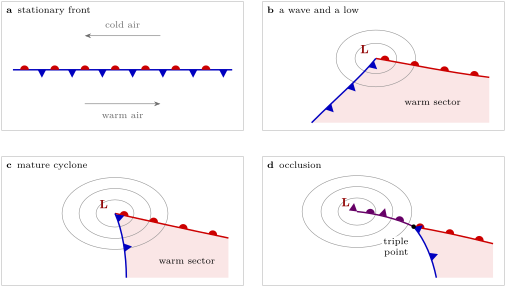
The life of an extratropical cyclone in the polar-front model, Northern Hemisphere, north at the top (schematic): a stationary front (a); a wave with a low at its crest, a warm front and a cold front and the warm sector between them (b); the cold front catches up (c); the occluded front grows from the centre (d). Black ellipses: isobars.
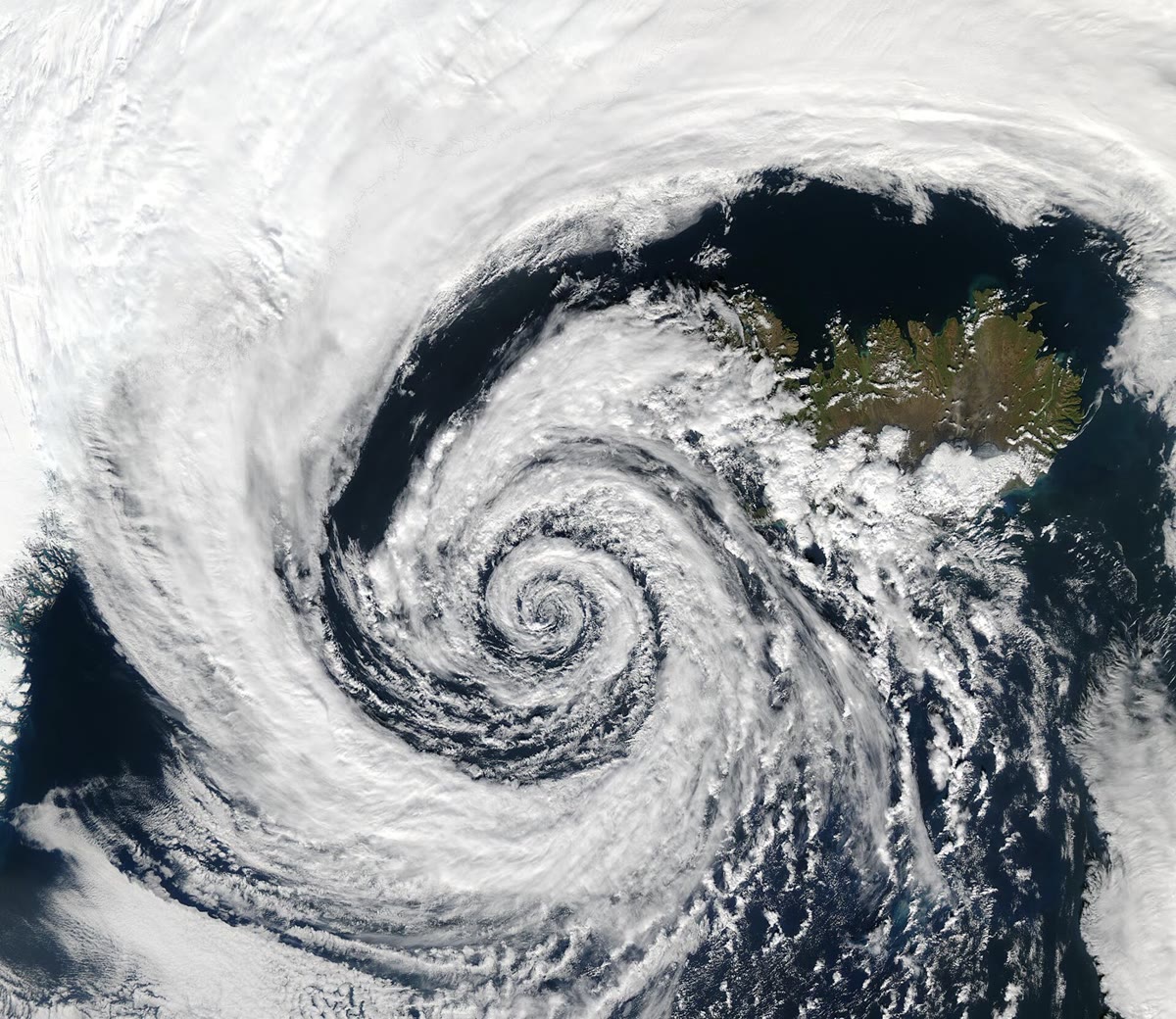
A deep low off the south-west coast of Iceland, 4 September 2003, seen by the MODIS instrument of NASA’s Aqua satellite: the cloud bands spiral into the centre. (NASA Goddard Space Flight Center, MODIS Rapid Response Team, Jacques Descloitres, public domain, via Wikimedia Commons.)
Read in context →