
All books

Professional

Apps About Coach Log in Start reading

Earth and Space Sciences · Glossary

What is Flank collapse; debris avalanche; slump?

Also known as: flank collapse · debris avalanche

Definition 17.2 University Earth and Space Sciences — Year 2 · Chapter 17 — Oceanic Islands

A flank collapse is the failure of a large part of the flank of a volcano, which slides away under its own weight. When the moving mass breaks up and runs out fast, as a flow of blocks and rubble that can travel far beyond the foot of the volcano, it is a debris avalanche. When it moves slowly, as large blocks rotating on faults rooted in a deep décollement and staying near the volcano, it is a slump.
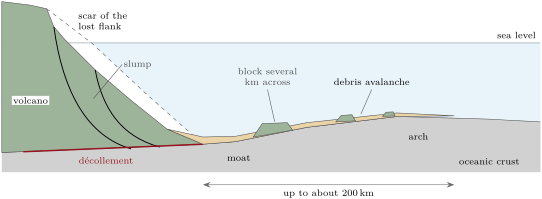
Flank collapse of an oceanic island (schematic, not to scale). Near the volcano, a slump moves slowly as rotating blocks on faults that root in a décollement at the top of the old oceanic crust. A debris avalanche breaks off the flank, leaving a scar, and runs out as a sheet of rubble carrying blocks several kilometres across. The Nuuanu avalanche crossed the moat and climbed onto the arch, more than 200\, km from Oahu.
Flank collapse of an oceanic island (schematic, not to scale). Near the volcano, a slump moves slowly as rotating blocks on faults that root in a décollement at the top of the old oceanic crust. A debris avalanche breaks off the flank, leaving a scar, and runs out as a sheet of rubble carrying blocks several kilometres across. The Nuuanu avalanche crossed the moat and climbed onto the arch, more than 200 km200\,\mathrm{km} from Oahu.
Read in context →