
全部书籍

专业

应用 关于 Coach 登录 开始阅读

书籍暂未推出简体中文版——当前显示英文版。

Earth and Space Sciences · 术语表

什么是 Fluid-present and dehydration melting?

又称: fluid-present melting · dehydration melting

Definition 12.2 University Earth and Space Sciences — Year 2 · 第 12 章 — Crustal Melting: Migmatites and Granites

Fluid-present melting (or water-fluxed melting) is melting in the presence of a free aqueous fluid, at or near the wet solidus; the melt produced is limited by the supply of fluid. Dehydration melting (fluid-absent melting) is the incongruent melting of a hydrous mineral, mica or amphibole, with quartz and feldspar, without any free fluid: the water of the mineral enters the melt, and new anhydrous minerals (peritectic K-feldspar, aluminosilicate, garnet, cordierite, orthopyroxene) grow beside it.
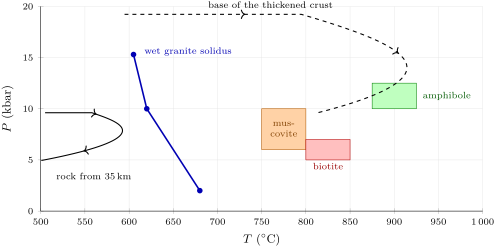
Where the crust melts. Blue: the solidus of a biotite granite with excess water (measured points, joined by straight segments). Boxes: the conditions at which dehydration melting of muscovite, biotite and amphibole was observed in experiments and in migmatites. Black: paths computed with the thickening model of ; the rock that ends up at 35\, km after stacking (solid) never reaches the wet solidus, while the base of the thickened crust (dashed) passes 900\, C. Both paths are drawn for the first 100 million years, until erosion stops.
Where the crust melts. Blue: the solidus of a biotite granite with excess water (measured points, joined by straight segments). Boxes: the conditions at which dehydration melting of muscovite, biotite and amphibole was observed in experiments and in migmatites. Black: paths computed with the thickening model of Chapter 11; the rock that ends up at 35 km35\,\mathrm{km} after stacking (solid) never reaches the wet solidus, while the base of the thickened crust (dashed) passes 900 ∘C900\,{}^{\circ}\mathrm{C}. Both paths are drawn for the first 100 million years, until erosion stops.
在原文中阅读 →