书籍暂未推出简体中文版——当前显示英文版。
University Earth and Space Sciences — Year 2 · 本科二年级
12Crustal Melting: Migmatites and Granites
Granite is what makes the continents light, and the mantle cannot make it directly: the melts of peridotite are basalts. Most granite is the continental crust melting itself. When a thickened mountain root heats up, when basalt ponds beneath the crust, or when a hot rock rises and its pressure falls, the micas and amphiboles of the deep crust give up their water, a granitic liquid appears between the grains, and the rock becomes a migmatite, half metamorphic, half igneous. This chapter follows that liquid from its first films to the pluton it may build, and reads in a granite’s chemistry the rock it came from.
You already know
From the high-school volume: granite, granitoid and granodiorite; felsic and mafic rocks; the roots of mountain belts. From the Year 1 volume: radiogenic heat production in the crust; the hydrolysis of silicates and clay minerals. From the chemistry books: the solidus and the liquidus of a binary system, molar mass and amount of substance. From Chapter 5: dykes, plutons and diapirs. From Chapter 7: partial melting, incongruent melting and decompression melting. From Chapter 10: metapelites, the Clapeyron slope of a reaction and the facies. From Chapter 11: P–T–t paths and the thickening model of the crust.
12.1 Why the crust melts
The word for it is old and plain.
Definition 12.1 (Anatexis)
Anatexis is the melting of a rock, whatever the degree of melting; in practice the word is used for the partial melting of the continental crust.
The wet solidus
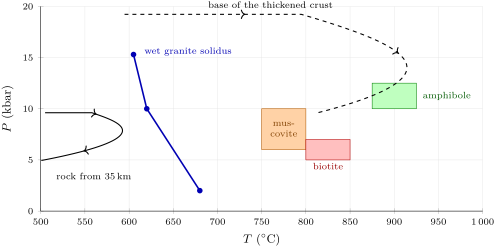
Granite melts at a low temperature only when it is wet. Stern and Wyllie melted a biotite granite of the Sierra Nevada batholith with excess water: the first liquid appeared at at and at at , and the whole rock was molten only above the solidus at , but above it at . The same granite studied earlier by Boettcher and Wyllie began to melt at at ; near its plagioclase broke down to jadeite and quartz, and from there the solidus turned back up, reaching at .
The wet solidus falls as pressure rises, the opposite of a dry solidus. The reason is where the water goes. Free water is a low-density fluid; dissolved in the melt it takes up very little room: Holtz and colleagues found its partial molar volume in a granitic melt close to , against for liquid water at room conditions and more for a hot fluid. The melting reaction
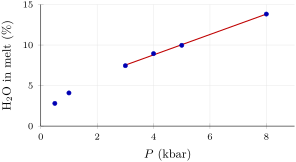
therefore has a negative volume change, while its entropy change, as for any melting, is positive: by the Clapeyron relation of Chapter 10, its slope is negative. Pressure also lets more water into the melt: for a haplogranite melt at the saturation content rises from by mass at to at and at , about more per kilobar between 3 and .
But the deep crust holds little free water: a metamorphic rock that has been heated has already driven most of its pore water out, through the dehydration reactions of Chapter 10. Its water is now locked in micas and amphiboles. Melting then has to wait for these minerals themselves to break down.
Definition 12.2 (Fluid-present and dehydration melting)
Fluid-present melting (or water-fluxed melting) is melting in the presence of a free aqueous fluid, at or near the wet solidus; the melt produced is limited by the supply of fluid. Dehydration melting (fluid-absent melting) is the incongruent melting of a hydrous mineral, mica or amphibole, with quartz and feldspar, without any free fluid: the water of the mineral enters the melt, and new anhydrous minerals (peritectic K-feldspar, aluminosilicate, garnet, cordierite, orthopyroxene) grow beside it.
Experiments fix where each hydrous mineral gives way. In muscovite schists from the Himalaya, Patiño Douce and Harris found dehydration melting beginning at 750 to between 6 and ; water added to the same rocks lowered the solidus but gave trondhjemitic melts unlike the leucogranites. A semipelitic gneiss began to melt near through its phengitic muscovite, but produced less than of melt; above , the breakdown of biotite and cordierite gave 10 to by volume. Biotite dehydration melting took place at 800 to and 0.5 to in the migmatites of the Bayerische Wald, and amphibole adds about of melt by volume between 875 and at 10 to . The order is that of the water’s hold: muscovite first, biotite next, amphibole last.
Proposition 12.3 (A water-limited melt fraction)
In dehydration melting without any free fluid, if a rock holds a mass fraction of a hydrous mineral that contains a mass fraction of water, and if all this water enters a melt that holds a mass fraction of water, the mass fraction of melt is
Because cannot exceed the saturation content at the pressure and temperature of melting, : the less water the melt holds, the more melt the same mica makes.
Proof. Per kilogram of rock the mineral releases kilograms of water. With no fluid phase and no water left in the solids, all of it is in the melt, whose mass holds kilograms of water: . Since , . ∎
A muscovite, of molar mass , holds two hydroxyl groups, the equivalent of one molecule of water, or of its mass. A schist with muscovite therefore has of water per kilogram to give away; dissolved at , it makes of melt. The micas set the budget, which is why fertile crust, the crust that melts readily, is rich in mica: metapelites first among them.
Where the heat comes from
The figure above sets the problem: the crust melts only where it is hotter than about , while the steady geotherm of the model in Chapter 11 reaches only at the base of a crust. Three ways lead past the dehydration-melting reactions.
Thickening and radiogenic heat. In the model of Chapter 11, a crust doubled by stacking heats up from inside; the rock that ends at mid-crustal depth peaks at and never melts, but the base of the thickened crust passes after about 31 million years and after about 56, beyond the biotite reaction. Melting of the lower crust is a slow consequence of thickening.
Decompression. A hot rock brought up faster than it cools crosses the dehydration-melting curves from the high-pressure side. Patiño Douce and Harris found that the solidus of muscovite schist has a smaller than that of biotite schist, so that muscovite schist melts more readily on decompression, and concluded that the Himalayan leucogranites formed by dehydration melting of metapelites during adiabatic decompression at 6 to and 750 to .
Heat from below. Basalt from the mantle that stops at the base of the crust brings its heat and its latent heat of crystallisation with it.
Definition 12.4 (Mafic underplating)
Mafic underplating is the ponding of mantle-derived basaltic magma at or near the base of the continental crust, where it crystallises and releases its heat into the crust above.
Underplating was invoked, for instance, for the rhyolites of the Antarctic Peninsula, where an andesitic to dacitic magma came from the melting of hydrous mafic lower crust in response to underplating; mantle melts can also make granitoids themselves, by crystallising or by remelting recently underplated bodies.
Proposition 12.5 (Heat budget of underplating)
A volume of basalt intruded at that crystallises completely, releasing a latent heat per unit volume, and cools to , can bring a volume of crust from to and melt a fraction of it, with
where is the heat capacity per unit volume (taken equal for both rocks) and the latent heat of the crustal melt per unit volume, if no heat is lost.
Proof. The heat released by the basalt, , equals the heat taken up by the crust, ; divide by and by the bracket of the crust. ∎
With and latent heats of , values typical of magmas, a basalt cooling from to can heat about two and a half times its volume of crust from and melt a fifth of it (Exercise 12.7). Underplating is efficient, but local: the heat goes where the basalt is.
12.2 Anatexis and migmatites
A partially molten rock that freezes before its melt leaves keeps both parts side by side.
Definition 12.6 (Migmatite and its parts)
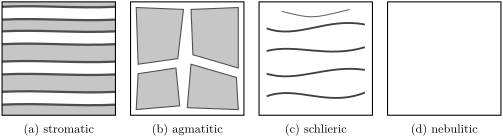
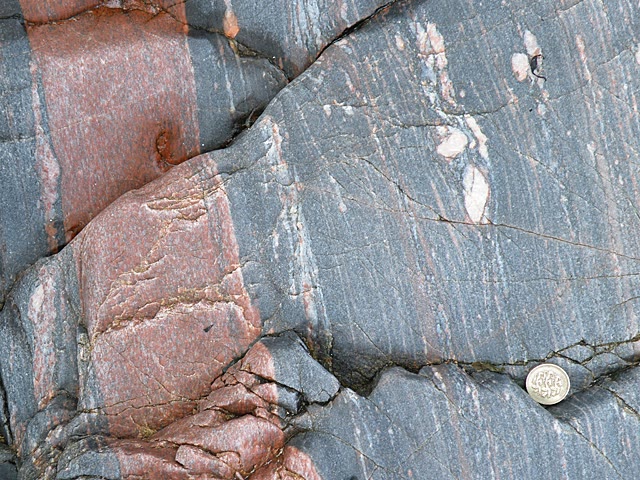
A migmatite is a composite silicate rock, heterogeneous at the outcrop scale, made of darker parts with the look of a metamorphic rock and lighter parts of plutonic look. Its leucosome is its light, quartz- and feldspar-rich part; its melanosome its dark part, rich in dark minerals, complementary to the leucosome; its mesosome the part of intermediate colour, a more or less modified relict of the parent rock (the paleosome). The leucosome and the melanosome together form the neosome, the newly formed part. A metatexite is a migmatite with discrete, well-defined leucosomes, mesosomes and melanosomes; a diatexite is one in which light and dark parts merge in streaks (schlieren) and ghost-like (nebulitic) structures.
The definition is descriptive on purpose: whether a leucosome is a frozen melt, a melt that came from elsewhere, or a metamorphic segregation is an interpretation. When it is a melt, the leucosome is the liquid and the melanosome the solid residue it left, enriched in biotite, garnet or cordierite: a metatexite records the first stage of anatexis, where only part of the rock melted, and a diatexite an advanced stage, where the dark minerals melted too and the melt stayed in place.
How much melt is in a migmatite? In the cordierite migmatites of the Bayerische Wald, formed by biotite dehydration melting, the leucosomes that are pure former melt make 20 to of the rock by volume, close to the 20 to produced in dehydration-melting experiments on similar rocks at the same conditions; where melt was removed, as in the most deformed types, the residue is left behind.
In the field — Reading a migmatite outcrop
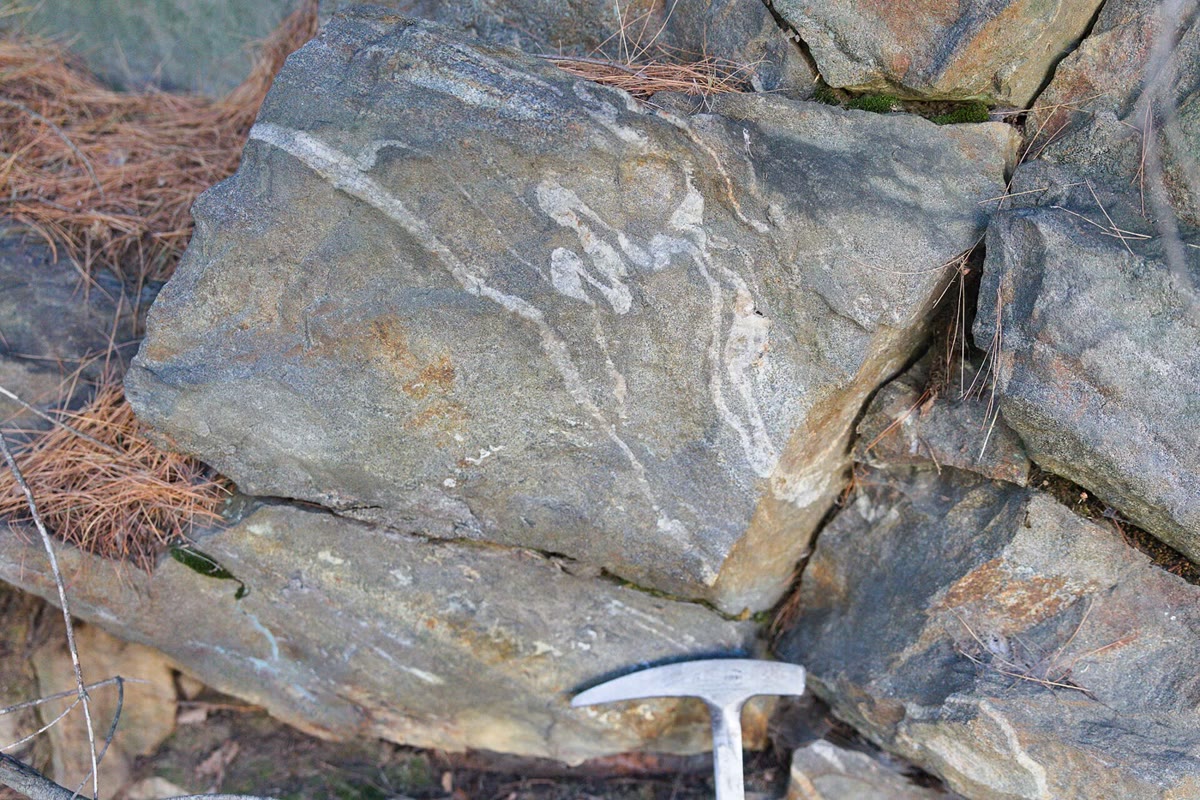
On a migmatite outcrop a geologist first maps the parts and their geometry: whether the leucosomes lie in the foliation or cut it, whether they carry a dark melanocratic border, and how much melanosome there is for each leucosome. Each feature has a meaning. Residual, melanocratic rock marks where melt came from; thin, short, branching leucosomes with little melanosome mark melting that had just begun; leucosomes parallel to the foliation mark where melt drained from the matrix and collected; leucosomes at a high angle to the layering, usually without dark borders, formed last and mark the channels through which melt left. A high ratio of melanosome to leucosome means that most of the melt has gone. Samples of leucosome, melanosome and mesosome are then taken for analysis, to test by mass balance whether the outcrop lost melt (Exercise 12.12).
12.3 From migmatite to pluton
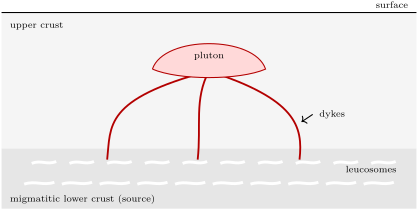
At the grain scale, the first melt lies along the grain boundaries and in small pools, mostly parallel to the foliation. Small as it is, it changes the rock: in experiments on partially melted granite, the strength of the aggregate falls steeply between the solidus and a melt fraction of , as the melt-bearing grain boundaries connect, and falls again, by about four orders of magnitude but from an already low value, when the crystal framework breaks down at higher melt fractions. Partially molten crust is therefore weak, and deformation gathers there as soon as melting starts. Deformation in turn drives the melt: it drains from the matrix along linked grain boundaries into leucosomes parallel to the foliation, then out of the melting layer through leucosomes that cut across it, and these join into the dykes of Chapter 5. The figure below sums up the path from the source to the pluton.
How long does the crust stay molten? In the Himalaya, widespread anatexis began some 30 million years after the collision of India with Asia, and the zircon and monazite of the anatectic rocks give ages from about 25 to 15 million years ago; a single sample may cover most of this span. The melting of the Himalayan crust was not an event but a state that lasted about ten million years.
12.4 Granite types
A granite remembers its source in its chemistry, first of all in how much aluminium it has compared with what its feldspars can take.
Definition 12.7 (Aluminium saturation index)
The aluminium saturation index of a rock is the molar ratio
and its companion is . A rock is peraluminous if , metaluminous if , and peralkaline if .
Proposition 12.8 (What the index measures)
A rock whose calcium, sodium and potassium are all in feldspars, and whose aluminium is all in feldspars, has . Hence a peraluminous rock has aluminium left over after its feldspars, held in aluminous minerals (muscovite, garnet, cordierite, aluminosilicate); a metaluminous rock has calcium left over, held in calcium silicates (hornblende, clinopyroxene, titanite); and a peralkaline rock has sodium and potassium left over, held in minerals without enough aluminium for feldspar (sodic pyroxene and sodic amphibole).
Proof. In oxide form, K-feldspar is , albite and anorthite : each formula has exactly one for one , or . Any mixture of the three therefore has , that is . If , the aluminium exceeds what the alkalis and calcium can bind into feldspar, and the excess must sit in other minerals. If but , there is enough aluminium for all the sodium and potassium as feldspar but not for all the calcium, which goes into minerals that need less aluminium per calcium than anorthite. If , even the alkalis cannot all be in feldspar. ∎
Moyen and colleagues found aluminosity the most useful indicator for telling granites with different sources apart; Frost and colleagues use the same index, with a small correction for phosphorus, as one of the three axes of their classification of granitic rocks.
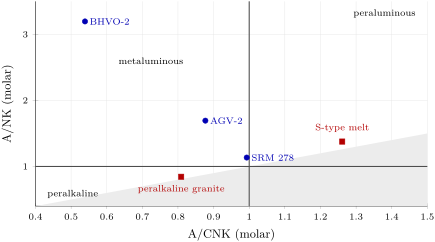
The chemistry follows the source. In 1974, Chappell and White noticed that, apart from the most felsic rocks, the granites of the Lachlan Fold Belt fall into two distinct groups, and interpreted them as melts of two kinds of source rock: older igneous rocks and sedimentary rocks. The hydrolysis of feldspars, seen in the Year 1 volume, carries sodium and calcium away in solution and keeps aluminium in clays: muds made of these clays are rich in aluminium, and so are their melts.
Definition 12.9 (Granite typology)
An I-type granite is a granite whose source was dominantly an older igneous rock, an S-type granite one whose source was dominantly a sedimentary (metasedimentary) rock, and an M-type granite one derived from the mantle. An A-type granite is defined by its chemistry and setting rather than its source: ferroan and potassic, strongly enriched in incompatible elements, and emplaced in stable intra-plate, back-arc or post-collisional settings.
S-type granites are peraluminous, with two micas or with cordierite; A-type granitoids are mostly metaluminous, some peraluminous. A single analysis can mislead, though: every granitoid suite ends near the composition of the granitic minimum, leucocratic and mildly peraluminous, so a peraluminous sample is no proof that crust was melted. What tells suites apart is the shape of their trend in Shand’s diagram: an arc suite reaches the minimum along a steep array from high A/NK and low A/CNK, a low-calcium S-type suite along an array with A/NK close to A/CNK. No consensus has been reached on the source of A-type magmas: one model makes them from underplated basalt, evolved by crystallisation, partial melting and assimilation of crust.
Definition 12.10 (Leucogranite)
A leucogranite is a light-coloured granite, almost free of dark minerals; the peraluminous leucogranites of collision belts carry muscovite, alone or with biotite.
The muscovite-bearing peraluminous leucogranites of collision belts have compositions close to the liquids of water-present or muscovite dehydration melting, at temperatures near where zircon and monazite of the source can survive and be carried into the melt as xenocrysts; cordierite-bearing peraluminous granites come from the hotter breakdown of biotite, at 800 to . The Himalayan leucogranites, with their strong crustal isotopic signature, belong to this family (Chapter 14).
12.5 Granites and the growth of continents
Two kinds of places make most granite. Above subduction zones, arc crust forms by the differentiation of mafic melts from the mantle, and the heat available is only what these melts bring. After a collision, the thickened crust is a very hot system: it melts on a large scale, at low temperature where water or muscovite allows it and at higher temperature by biotite breakdown, and these crust-derived granites recycle crust that already existed. Mantle melts reach the crust there too, in amounts large enough, Moyen and colleagues argue, to make late-orogenic belts important contributors to the growth of the crust. Whether a granite adds to the continents or only reworks them is thus a question of its source, which its isotopes answer (Chapter 4); the granites of the early Earth, very different from these, are the subject of Chapter 18.
12.6 Exercises
Molar masses (): 101.96, 56.08, 61.98, 94.20, 18.02; atomic masses: H 1.008, O 16.00, Na 22.99, Mg 24.31, Al 26.98, Si 28.09, K 39.10, Ca 40.08. Take .
Exercise 12.1 ★
The andesite reference material AGV-2 contains, in per , 17.03, 5.15, 4.204 and 2.898. (a) Compute its A/CNK and A/NK. (b) Classify it, and name a mineral that should hold its excess calcium.
Solution
Solution of Exercise 12.1.
(a) Per : , , , . A/CNK ; A/NK . (b) A/CNK A/NK: metaluminous. The calcium the feldspars cannot take goes into calcium silicates: hornblende (or clinopyroxene, titanite).
Exercise 12.2 ★
Three granites contain, besides quartz and feldspars: (a) muscovite, biotite and garnet; (b) hornblende, biotite and titanite; (c) aegirine, a sodium–iron pyroxene , and a sodic amphibole. Classify each by its aluminium saturation, and say which could be an S-type granite.
Solution
Solution of Exercise 12.2.
(a) Muscovite and garnet hold aluminium beyond the feldspars: peraluminous; this granite can be an S-type. (b) Hornblende and titanite hold calcium beyond the feldspars: metaluminous. (c) Aegirine and a sodic amphibole hold sodium without the aluminium of feldspar: peralkaline.
Exercise 12.3 ★
A crust of density has a linear geotherm . Between 2 and , approximate the wet granite solidus by the straight line through (, ) and (, ). At what depth, temperature and pressure does the geotherm meet it?
Solution
Solution of Exercise 12.3.
One kilometre of rock weighs , so (, in ). The solidus line is . Setting gives , , .
Exercise 12.4 ★
A grey biotite gneiss carries centimetre-thick white layers of quartz and feldspar, parallel to its foliation, each bordered by a thin black seam of biotite; between the layers the gneiss looks ordinary. (a) Name the white layers, the black seams and the ordinary gneiss. (b) Is the rock a metatexite or a diatexite, and what is its structure? (c) A few hundred metres away, the layering has gone: a streaky, granite-like rock holds faint ghosts of gneiss. What has changed?
Solution
Solution of Exercise 12.4.
(a) The white layers are leucosomes, the black seams melanosomes, the ordinary gneiss the mesosome. (b) Discrete, well-defined leucosomes, melanosomes and mesosomes: a metatexite, with a stromatic structure. (c) The rock has become a diatexite (schlieric and nebulitic): melting went further, the dark minerals melted too, and the melt stayed in place, erasing the layering.
Exercise 12.5 ★★
Take biotite as phlogopite, . (a) Compute its molar mass and the mass fraction of water it releases (its two hydroxyl groups give one ). (b) A gneiss with biotite by mass melts by biotite dehydration melting into a melt holding water. Using Proposition 12.3, find the melt fraction, and compare it with the fractions found in experiments on biotite dehydration melting.
Solution
Solution of Exercise 12.5.
(a) ; . (b) , or of melt by mass: within the 20 to by volume produced by biotite dehydration-melting experiments on similar rocks.
Exercise 12.6 ★★
A hundred grams of granite contain of K-feldspar , of albite , of anorthite , of quartz and of muscovite . (a) Compute the molar masses of the four aluminous minerals. (b) Compute the amounts of , , and in the rock, and its A/CNK. (c) Which mineral makes the rock peraluminous?
Solution
Solution of Exercise 12.6.
(a) K-feldspar , albite 262.24, anorthite 278.22, muscovite 398.33. (b) Amounts: K-feldspar , albite , anorthite , muscovite . K-feldspar is , albite , anorthite , muscovite per formula unit. ; , , , sum . A/CNK . (c) Without the muscovite the three feldspars give exactly 1 (Proposition 12.8); the muscovite, with one more than K-feldspar per formula unit, makes the rock peraluminous.
Exercise 12.7 ★★
A basaltic sill intruded at crystallises completely and cools to , releasing a latent heat of . The crust around it, at , is heated to and of it melts, with the same latent heat per unit volume of melt. Both rocks have a heat capacity of . Using Proposition 12.5, how many cubic metres of crust can one cubic metre of basalt treat this way? What does the result ignore?
Solution
Solution of Exercise 12.7.
Basalt: . Crust: . . The estimate ignores the heat that leaks away by conduction upwards and sideways and the time heat takes to spread; it also assumes that all the basalt’s heat reaches crust that is ready to melt: it is an upper bound.
Exercise 12.8 ★★
The obsidian reference material SRM 278 is certified at , 0.983, 4.84 and 4.16 ( by mass). (a) Compute its A/CNK and A/NK and classify it. (b) Recompute A/CNK with the two ends of the uncertainty. Is the classification robust?
Solution
Solution of Exercise 12.8.
(a) , , , ; A/CNK , A/NK : metaluminous, just. (b) With , ; with , . The index straddles 1 within the certified uncertainty: the obsidian lies on the metaluminous–peraluminous boundary, and its class is not robust.
Exercise 12.9 ★★
At , a haplogranite melt saturated in water holds water at , 8.94 at , 9.97 at and 13.82 at . (a) Fit a straight line to these four points by least squares and compare its slope with the per kilobar quoted by the experimenters. (b) Predict the saturation content at . (c) What is the least mass of melt that can carry of water at ? (d) Why should the line not be used at ?
Solution
Solution of Exercise 12.9.
(a) Means , ; , ; slope per kilobar, intercept . The slope agrees with the quoted 1.27 to within . (b) . (c) of melt. (d) The line rests on data between 3 and at only; nothing guarantees that solubility stays linear at higher pressure, where the melt and the fluid become more alike.
Exercise 12.10 ★★★
Approximate the dehydration-melting solidus of a muscovite schist by the straight line through (, ) and (, ), the ends of the experimental brackets. A schist at rises from without gaining or losing heat. (a) At what pressure does it reach the solidus? (b) Beyond, its temperature follows the solidus down, the heat for melting coming from its own cooling. With a heat capacity of and a latent heat of , what volume fraction of melt has formed when it reaches ? (c) Compare with the conditions proposed for the Himalayan leucogranites.
Solution
Solution of Exercise 12.10.
(a) The line rises by over : ; at , . (b) From 7.6 to the temperature falls along the line from 770 to ; the heat released, , melts , about of the rock by volume. (c) This is the window proposed for the Himalayan leucogranites, 6 to and 750 to : decompression alone makes melt, but only a few per cent per crossing of the curve.
Exercise 12.11 ★★★
Heat diffuses over a distance in a time of order . With , estimate the time for the heat of a -thick sill, and of a -thick underplated layer, to spread over its own thickness. Compare with the ten million years of Himalayan anatexis: can one underplating event explain it?
Solution
Solution of Exercise 12.11.
for the sill; for the underplate. Both are short beside ten million years: one event cannot keep the crust molten that long, which needs heat supplied again and again, by repeated intrusions or by the slow heating of a thickened crust.
Exercise 12.12 ★★★
A stromatic migmatite is analysed: leucosome , ; melanosome , ; mesosome, taken as the unmelted parent, , (all by mass). (a) If the neosome formed from the parent without gain or loss, what mass fraction of it is leucosome? (b) Check the answer with . (c) On the outcrop the leucosome makes only of the neosome by mass. How many grams of melt left per of parent rock?
Solution
Solution of Exercise 12.12.
(a) gives : a quarter of the neosome is leucosome. (b) , as in the mesosome: the closed-system interpretation holds. (c) For of parent, of melt and of residue formed; if grams of melt left, , so and : two thirds of the melt left the outcrop.
Problem 12.1
Weekend problem — a pluton from melted mica
A schist made of muscovite, biotite, quartz, plagioclase and other minerals (by mass; an invented rock) lies at the base of a crust doubled by stacking, the situation modelled in Chapter 11. It may melt and feed a granite pluton. Data: the atomic and molar masses at the head of the exercises; the wet granite solidus passes through (, ), (, ), (, ) and (, ); the water saturation content of a granitic melt at is at and at . The model base of the thickened crust follows:
| () | 0 | 10 | 20 | 30 | 40 | 50 | 60 | 70 | 80 | 90 | 100 |
|---|---|---|---|---|---|---|---|---|---|---|---|
| () | 595 | 656 | 734 | 795 | 845 | 885 | 909 | 914 | 900 | 867 | 814 |
| () | 19.2 | 19.2 | 19.2 | 19.2 | 17.9 | 16.5 | 15.1 | 13.7 | 12.4 | 11.0 | 9.6 |
Part I — Water from mica.
- Compute the molar mass of muscovite .
- Its two hydroxyl groups give one . What mass fraction of the mineral is released as water?
- How much water does the muscovite of one kilogram of schist release?
- Interpolating linearly, what is the saturation water content of the melt at ? What is then the least melt fraction the muscovite water can make?
- The melt of dehydration melting is far from saturated; take its water content as . What melt fraction does the muscovite make?
- In experiments on a two-mica metapelite at , the muscovite reaction gave only 1 to of melt. Name two reasons why a real rock may make less melt than your answer to question 5.
Part II — Heating the source.
- In Chapter 11, the rock left at mid-crust peaks at and . What is the wet solidus at ? Can that rock melt, even with free water?
- Interpolating between 15.3 and , find the wet solidus at the pressure of the base just after stacking. Is the base above it at ? At ?
- What limits the melting of the base at , and why does it stop soon?
- When does the base pass , the upper end of the muscovite bracket?
- The amphibole bracket spans 875 to at 10 to . When does the base enter this pressure range, and at what temperature?
- When does the base reach , the top of the pressure range of the muscovite experiments, and how hot is it then? Which hydrous minerals of the schist can still exist?
Part III — What melt? The melt, once crystallised, gives a leucogranite (invented analysis) with, in by mass, 15.0, 0.55, 3.4 and 4.9.
- Compute the amounts of the four oxides in of the rock.
- Compute its A/CNK.
- Compute its A/NK and classify the leucogranite.
- Is it an I-type or an S-type granite? Name two minerals that should hold its excess aluminium.
- How many moles of per are left over after the feldspars? If all of it went into muscovite, which holds one more per formula unit than K-feldspar, how many grams of muscovite would of granite contain?
- The obsidian SRM 278 has A/CNK . Could the leucogranite and the obsidian come from the same kind of source?
Part IV — How much crust? An invented pluton of this leucogranite has a volume of . Take for the granite and for the schist; suppose of the melt leaves its source and all the melt’s water escapes when it crystallises.
- What is the mass of the pluton?
- What mass of melt (with its water) did it take?
- Using the melt fraction of question 5, what mass of schist had to melt?
- What volume of schist is that?
- If the source was a layer thick, over what area did it melt?
- With the least melt fraction of question 4 instead, how much larger would the source be? Give the volume of source crust melted to make the pluton, in , from question 22.
Solution
Solution of Problem 12.1.
Part I.
1. .
2. .
3. of water per kilogram of schist.
4. . The least melt is per kilogram: (Proposition 12.3).
5. : .
6. For example: the rock may hold less muscovite; part of the muscovite may already have broken down below the solidus, with quartz, to K-feldspar and aluminosilicate, its water leaving as a fluid before melting began; the melt may hold more water than ; some water may stay in biotite.
Part II.
7. ; the rock peaks below it and cannot melt, even with free water.
8. . At the base, at , is below; at , at , it is above.
9. Melting at the wet solidus needs free water, and a heated metamorphic rock holds very little: the free water is used up by the first melt, which then stops growing until the micas break down.
10. Between 30 and : .
11. The base falls below between 70 and : , at , inside the amphibole bracket: an amphibolite at the base would be melting.
12. , at . That is above the muscovite bracket: the muscovite has broken down. It lies within the 800 to of biotite breakdown (measured at lower pressure): biotite, the schist’s other hydrous mineral, is at its limit.
Part III.
13. , , , .
14. A/CNK .
15. A/NK ; A/CNK : peraluminous.
16. Peraluminous, from a schist: an S-type granite. Its excess aluminium sits in muscovite and garnet (or cordierite).
17. of ; as muscovite, in of granite.
18. The obsidian is (just) metaluminous, without the excess aluminium of a metasedimentary melt: its source is probably different. But one sample proves little: every granitoid suite has mildly peraluminous members, and a suite is judged by its whole trend.
Part IV.
19. .
20. The granite is the melt minus its water: of melt.
21. Only of the schist’s mass leaves as melt: .
22. , that is , nearly ten times the pluton.
23. , a square about on a side.
24. With , the source is times larger, about . The volume of source crust melted to make the pluton, with the melt fraction of question 5, is .