书籍暂未推出简体中文版——当前显示英文版。
University Earth and Space Sciences — Year 2 · 本科二年级
11Thermobarometry and P–T–t Paths
A garnet a few millimetres across, grown in a schist, keeps in its core the composition it had when it started to grow and in its rim the composition it had when it stopped. Each zone was in equilibrium with the biotite and plagioclase around it at the time, and the way iron, magnesium and calcium were shared between these minerals depends on temperature and pressure. Read with the thermodynamics of the previous chapter, a garnet tells how deep its rock was buried and how hot it became; dated, it tells when, and how fast the rock came back up. This chapter turns metamorphic minerals into thermometers, barometers and clocks, and follows a rock along its path through the crust.
You already know
From the high-school volume: metamorphic grade, index minerals and isograds. From the Year 1 volume: the geotherm and radiogenic heat production; the continental crust about thick; radiometric dating, the closure temperature of a mineral and the cooling age it gives; the oceanic crust and its peridotite. From the physics books: the heat equation and the thermal diffusivity . From the chemistry books: the equilibrium constant, , and activities in ideal solutions. From Chapter 10: metamorphic reactions, the Clapeyron slope, the diagram and the facies.
11.1 Metamorphic zones
In the mudstones of the Scottish Highlands, George Barrow mapped in the 1890s a sequence of zones, each marked by the first appearance of a new index mineral. Going towards higher grade, chlorite is joined in turn by biotite, garnet, staurolite, kyanite and sillimanite; in the type sections the garnet to sillimanite zones formed at about 500 to and 5 to .
Definition 11.1 (Barrovian zones; metamorphic field gradient)
The Barrovian zones are the metamorphic zones of metapelites in the order chlorite, biotite, garnet, staurolite, kyanite, sillimanite, each beginning at the isograd of its index mineral. The metamorphic field gradient of a region is the curve, in the pressure–temperature plane, through the peak conditions recorded by its rocks at the places where they now crop out.
Each point of a field gradient comes from a different rock, and each rock reached its own peak at its own time: the field gradient is not the geotherm of any one moment, nor the path of any one rock. It is the trace the peaks leave on the present erosion surface.
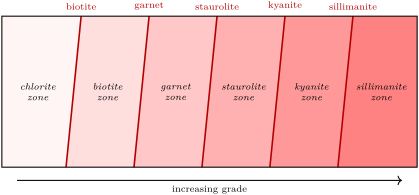
Isograds are mapped from mineral appearances, and only become conditions of pressure and temperature once the reactions behind them are known. To go further, one needs to measure temperature and pressure in a single rock.
11.2 Thermometers and barometers
Definition 11.2 (Geothermometer; geobarometer; exchange reaction; net-transfer reaction)
A geothermometer (geobarometer) is an equilibrium among minerals whose position depends mainly on temperature (pressure), so that the compositions of the minerals give the temperature (pressure) of their last equilibrium. An exchange reaction swaps two elements between two minerals, such as iron and magnesium between garnet and biotite, without creating or destroying either mineral. A net-transfer reaction makes some minerals at the expense of others.
The most widely used thermometer of metapelites is the exchange of iron and magnesium between garnet and biotite,
almandine plus phlogopite giving pyrope plus annite. Let and be the fractions of the sites filled by magnesium and iron in each mineral, and
Proposition 11.3 (An exchange equilibrium)
If garnet and biotite are ideal solutions and , and of the reaction above are constant, then at equilibrium
Proof. Each mineral has three sites for iron or magnesium. In an ideal solution the activity of an end member is the product of the fractions of its sites it fills: in garnet, and so on. The equilibrium constant is therefore
At equilibrium , with (the 1 of neglected), which gives the first equation; solving it for gives the second. ∎
The constants come from experiments in which synthetic garnet and biotite exchanged iron and magnesium at known temperature and . Twelve such brackets, from 550 to , plotted as against , fall close to a line (the figure below); fitted by least squares with , they give and , the values of published recalculations of the same data. At higher temperature the ratio rises towards 1: garnet takes a larger share of the magnesium.
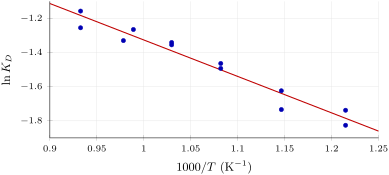
For at , , or . One more kilobar adds : the reaction swaps ions of the same charge between sites of nearly the same size, its volume change is small, and pressure barely matters. That is what makes a thermometer.
A barometer needs the opposite: a reaction with a large volume change. The net-transfer reaction
anorthite giving grossular, kyanite and quartz, packs the atoms of three feldspars into denser minerals: , twenty times that of the exchange. Its end-member equilibrium, reversed in experiments at 900 to and 19 to , runs along
In a rock, grossular is a small part of the garnet and anorthite a part of the plagioclase. With ideal activities, and , the condition written at and at gives
This geobarometer, named GASP after the four minerals (garnet, aluminosilicate, silica, plagioclase), serves wherever a metapelite holds all four.
Method 11.4 (Temperature and pressure of one rock)
(1) Measure, in minerals that grew together, the compositions the thermometer and the barometer need. (2) Guess a pressure and compute the temperature with the thermometer. (3) At that temperature, compute the pressure with the barometer. (4) Repeat (2) and (3) until neither changes; two or three rounds suffice, since each equation depends weakly on the variable the other one fixes. Graphically, the answer is where the line of the thermometer crosses the line of the barometer. (5) Propagate the uncertainties: for independent errors, , and similarly for .
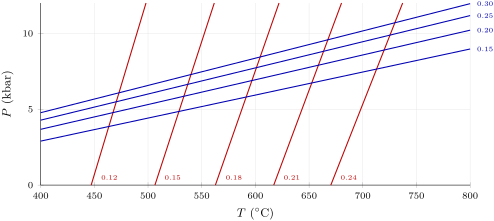
The thermometer lines are nearly vertical, the barometer lines inclined: they cross at a wide angle, which keeps the intersection precise. Ideal mixing is the main simplification of this chapter. Real garnets hold calcium and manganese, real biotites aluminium, titanium and ferric iron, and calibrations that correct for them shift temperatures by tens of degrees (in one well-studied region, instead of ); the best ones claim an uncertainty of about .
11.3 Pressure–temperature paths
A rock does not reach its highest pressure and highest temperature at the same moment. It is buried and heated, then brought back up and cooled, and its minerals react all along.
Definition 11.5 (P–T path; prograde and retrograde paths; peak metamorphic conditions)
The P–T path of a rock is the sequence of pressures and temperatures it passed through during a metamorphic event. Its prograde path is the part along which temperature rises, its retrograde path the part along which it falls. The peak metamorphic conditions are the pressure and temperature at the highest temperature of the path, the thermal peak; the pressure peak, or baric peak, need not coincide with it.
A path is clockwise when, drawn with temperature to the right and pressure upwards, the thermal peak comes after the baric peak, during decompression; it is anticlockwise when the thermal peak is reached while pressure still rises. Which sense a rock follows depends on how heat reached it, and the simplest case can be computed.
Imagine a crust thick, at steady state, with a heat production of , a heat flow of from below, a conductivity of and a diffusivity of , the last three within the ranges measured on rocks. Its surface heat flow is and its Moho lies at . A collision stacks a second copy of this crust on top of it, quickly compared with the time heat needs to move: the rocks of the lower sheet keep their temperatures but sit deeper, so that the geotherm becomes a sawtooth, with rocks at at beneath hot rocks of the upper sheet. The crust is now thick and holds twice the heat-producing rock. Thirty million years after the stacking, erosion begins and removes in 70 million years ().
Proposition 11.6 (Time scale of thermal relaxation)
In a layer of thickness whose two faces are held at fixed temperature, a temperature disturbance of the form decays as , with
Proof. Write , which vanishes at and . The heat equation gives , so with , and . ∎
The sawtooth has a wavelength of the order of the thickness of one sheet: with , , and the cold wedge at is erased within ten million years. The whole thickened crust, , relaxes on , so that heating continues for tens of millions of years, towards the much hotter geotherm that a crust twice as thick and with twice the heat-producing rock supports. The figure below shows the computed geotherms.
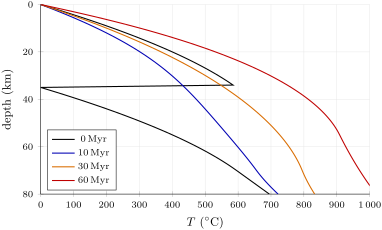
Follow the rock that was at the surface before the stacking and lies at just after it, under . In five million years it warms from 0 to without moving; by the start of erosion it has reached . Erosion then brings it up, but heat keeps arriving faster than it escapes: the rock is still warming when it has risen , and reaches its thermal peak, at , 43 million years after the stacking. Only then does it cool, through at depth and , on its way to the surface. The path (the figure below) is clockwise. It also stays within of its peak temperature for thirty million years, about a third of its whole journey, as England and Thompson found in 1984 for most geologically plausible cases: a rock spends a long time close to its peak, and the minerals it keeps mostly record that stage.
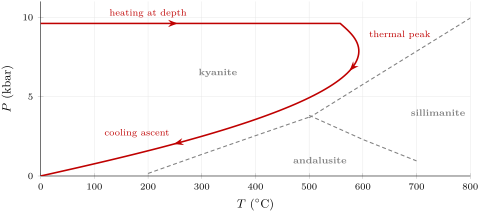
The model also shows why some paths turn the other way. Thickening alone heats a rock only after it has been buried, so its thermal peak comes during exhumation. A rock whose temperature rises while it is still being buried needs heat from elsewhere, such as magma rising into the crust above or beside it, and follows an anticlockwise path. And in the thickened crust the base heats far above its initial temperature: England and Thompson concluded that considerable melting of the crust is a likely consequence of thickening, the subject of Chapter 12.
11.4 Adding time
Definition 11.7 (P–T–t path)
The P–T–t path of a rock is its P–T path with the time at which each point was reached.
Time comes from radiometric dating. A mineral that grew during the event and has kept its daughter isotopes since, such as a zone of garnet dated by the samarium–neodymium method, dates its own growth, and its composition gives the pressure and temperature of that moment. A mineral that grew earlier, at higher temperature, gives instead a cooling age: the time at which the rock cooled through the closure temperature of that mineral and isotope system (Year 1 volume). For argon in a muscovite grain of radius, cooling at per million years, the closure temperature is at and at .
Definition 11.8 (Exhumation; exhumation rate)
Exhumation is the movement of a rock towards the Earth’s surface, by removal of the rocks above it. The exhumation rate is the rate of decrease of its depth.
Proposition 11.9 (Rates from two dated points)
If a rock was at temperature and depth at time and at , at a later time (ages counted back from today, ), its mean cooling and exhumation rates over the interval are
and their uncertainties, for independent errors on the two ages, follow from .
Proof. A mean rate is a difference divided by the elapsed time ; the variance of a difference of independent quantities is the sum of their variances. ∎
The depth at which a cooling age was set is rarely measured: it is estimated from the geotherm of the time, which is why exhumation rates are less certain than cooling rates. A pressure, where a mineral assemblage gives one, fixes the depth directly, as with the mean density of the rocks above.
11.5 Metamorphic series and paired belts
Definition 11.10 (Metamorphic series; paired metamorphic belts)
A metamorphic series (or facies series) is a sequence of metamorphic facies developed under the same range of ratios of pressure to temperature, and therefore occupying a radial sector of the pressure–temperature plane. Paired metamorphic belts are two parallel belts of the same age, one of high-pressure series and one of low-pressure series.
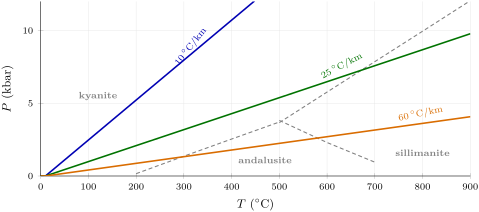
Three series are commonly distinguished. A high ratio of pressure to temperature, along a cold gradient, leads from the zeolite facies to the blueschists and eclogites: the series of subduction zones. An intermediate ratio leads through the greenschist, amphibolite and granulite facies, with kyanite then sillimanite in metapelites: the Barrovian series. A low ratio, along hot gradients such as those near intrusions, produces andalusite then sillimanite: the low-pressure or Buchan series. The figure below draws three gradients across the aluminosilicate diagram.
The idea of the series came from Japan, where Akiho Miyashiro defined them in 1961. In the southwest of the country the Sanbagawa belt, of high-pressure, low-temperature metamorphism, runs for more than beside the Ryoke belt, of high-temperature, low-pressure metamorphism, the two separated by a major fault: the classic pair. The Sanbagawa belt is an ancient subduction zone, the Ryoke belt the volcanic arc above it. A subduction zone thus makes both series at once, cold rocks dragged down by the sinking plate, hot ones heated in the arc; paired belts of the same kind are known around the Pacific.
11.6 Ultrahigh pressure and exhumation
In 1984 a quartzite was described from the Dora Maira massif of the Western Alps whose garnets, up to across and almost pure pyrope, enclose grains of coesite, the dense polymorph of silica, partly turned back to quartz; the expansion during that inversion cracked the host garnet radially around each grain. The coesite and its companions imply at least at about : rocks of the upper continental crust, once sediments, had gone down to or more and come back.
Definition 11.11 (Ultrahigh-pressure metamorphism)
Ultrahigh-pressure metamorphism is metamorphism of crustal rocks at pressures high enough for coesite, or diamond, to grow.
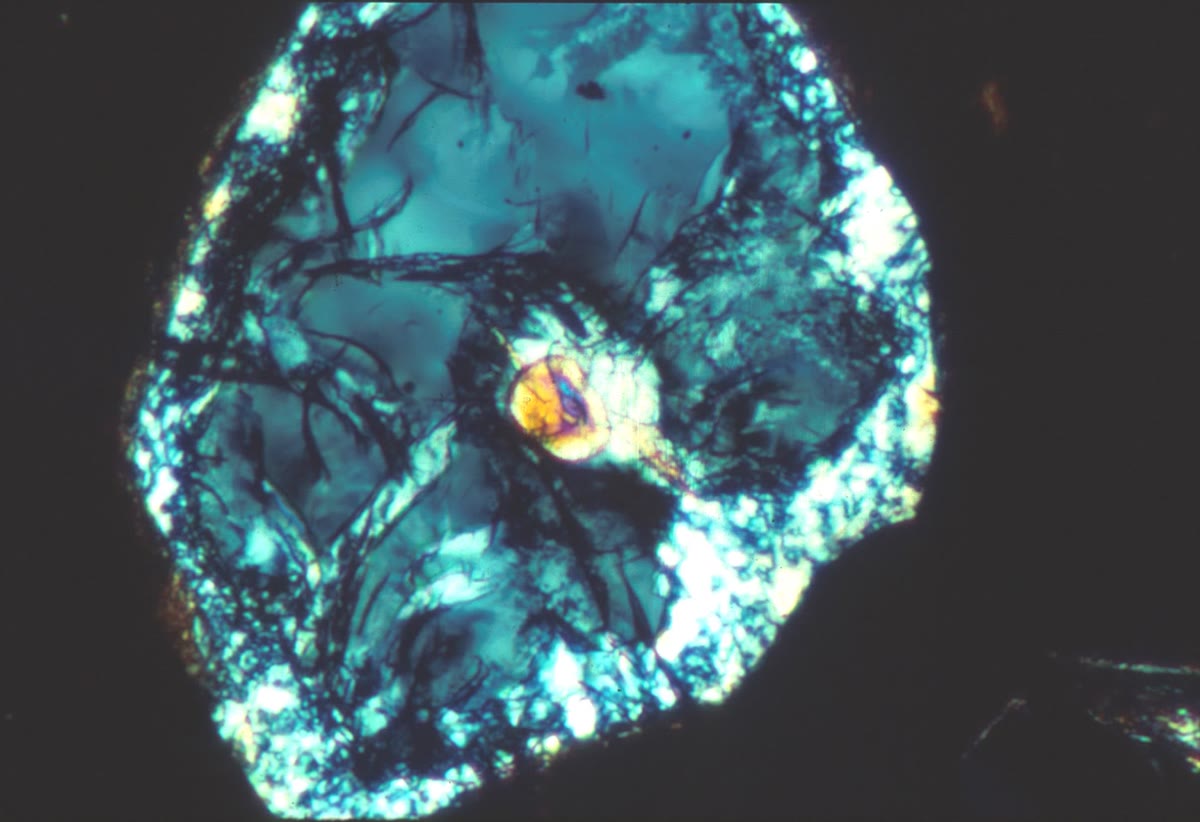
Six years later, diamonds averaging were found in gneisses, schists and garnet–pyroxene rocks of the Kokchetav massif of northern Kazakhstan, enclosed in garnet and zircon, which shielded them from turning into graphite: they grew at or more and above 900 to . Continental crust, light as it is, can be dragged more than a hundred kilometres down.
How it comes back is told by its clocks. In the deepest subducted rocks of the Alps, titanite dated at successive stages shows that a calc-silicate rock reached about at , was at at , and near 0.4 to at . The mean exhumation rates, 3.4 then , match the speeds of plates: the rocks came back about as fast as they went down, much faster than erosion could have unroofed them. The authors invoke buoyancy, the light crust rising through the denser mantle, and normal faulting, which thins the rocks above.
11.7 Ocean-floor metamorphism
Definition 11.12 (Ocean-floor metamorphism; serpentinisation)
Ocean-floor metamorphism is the regional metamorphism of the oceanic lithosphere near spreading centres, by hot aqueous fluids circulating under steep geothermal gradients; recrystallisation is generally incomplete and temperature typically increases with depth. Serpentinisation is the hydration of olivine-rich rocks into serpentine.
Seawater drawn into the young crust near a ridge axis heats up, reacts with the rocks and rises again. The basalts it passes through recrystallise, incompletely, into hydrous minerals, over a wide range of temperatures. Where the water reaches peridotite, as on the slow ridges where mantle rock comes up to the sea floor and feeds springs such as those of the Lost City field (Year 1 volume), olivine takes up water:
forsterite giving serpentine and brucite. The molar volumes, 43.65 for forsterite, 107.50 for serpentine and for brucite, show what this does to the rock: of olivine become of solids, more, and the density falls from 3.22 to . The rock swells and lightens, and the water it has bound goes down with it when the plate is subducted.
In the lab — Reading a garnet
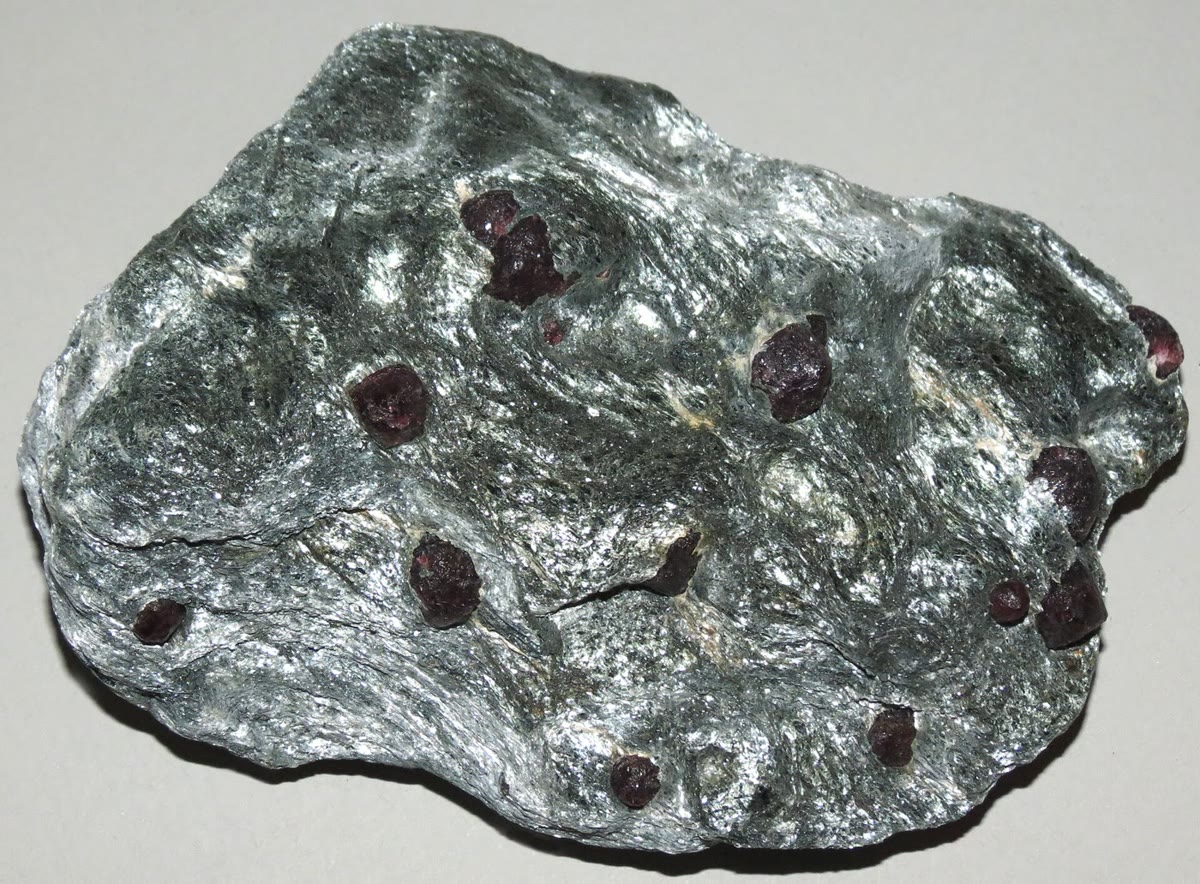
To read a P–T path, a petrologist first cuts a thin section through the centre of a garnet, since a section off-centre misses the core. Under the microscope the inclusions are mapped: small grains of quartz, biotite, plagioclase or kyanite trapped as the garnet grew, sometimes aligned in trails that preserve an older foliation of the rock. An electron microprobe then measures the composition along a line from core to rim, and a map of magnesium, iron, calcium and manganese shows the growth zones. Each zone is paired with the minerals that grew with it: inclusions for the core, the matrix in contact for the rim. Thermometer and barometer are applied to each pair, and the zones are dated where a mineral allows it. Chapter 31 describes the instruments.
11.8 Exercises
Exercise 11.1 ★
Six samples of one mudstone formation, collected along a road, hold: (A) chlorite, muscovite, quartz; (B) biotite, chlorite, muscovite, quartz; (C) garnet, biotite, muscovite, quartz; (D) staurolite, garnet, biotite, muscovite, quartz; (E) kyanite, staurolite, biotite, muscovite, quartz; (F) sillimanite, biotite, muscovite, quartz. (a) In which Barrovian zone does each lie? (b) How many isograds does the road cross, and which? (c) Why is it not enough to know the isograds to draw the metamorphic field gradient?
Solution
Solution of Exercise 11.1.
(a) A chlorite zone, B biotite zone, C garnet zone, D staurolite zone, E kyanite zone, F sillimanite zone. (b) Five: the biotite, garnet, staurolite, kyanite and sillimanite isograds, each between two successive samples, grade rising from A to F. (c) An isograd only says that a reaction ran; a field gradient needs pressures and temperatures, which come from calibrated reactions or from thermobarometry of the peak assemblage of each rock.
Exercise 11.2 ★
A garnet has and , the biotite beside it and . (a) Compute and . (b) With the calibration of this chapter, compute the temperature at and at . (c) Is the result a temperature or a pressure gauge?
Solution
Solution of Exercise 11.2.
(a) , ; , . (b) ; denominator ; at , ; at , . (c) Two kilobars change it by only : a thermometer.
Exercise 11.3 ★
A metapelite gives and . (a) Under rocks of mean density (), how deep was it? (b) What temperature gradient does that imply from at the surface? (c) The experimental kyanite sillimanite line passes through at and at : which aluminosilicate should the rock hold?
Solution
Solution of Exercise 11.3.
(a) . (b) . (c) At the line lies at ; at the rock is on the high-pressure side: kyanite.
Exercise 11.4 ★
For the serpentinisation of forsterite written in this chapter: (a) check that the equation is balanced in mass, with molar masses 140.693 (forsterite), 18.015 (water), 277.112 (serpentine) and (brucite); (b) compute the change in volume of the solids; (c) compute the densities of the olivine and of the products. (d) What does the change do to a serpentinised peridotite beneath the sea floor?
Solution
Solution of Exercise 11.4.
(a) Reactants ; products : balanced to the rounding. (b) become : . (c) Olivine ; products . (d) The rock swells by half its volume and becomes lighter; it also stores water in its minerals.
Exercise 11.5 ★★
Calibrate the thermometer from four of the experiments at : and at , and at . (a) Average each pair and find the line through the two means. (b) Deduce and , with . (c) Compare the temperatures that your calibration and that of the chapter give at for , and . What do you conclude about extrapolating a calibration?
Solution
Solution of Exercise 11.5.
(a) Means at and at . With and , K and . (b) , so ; . (c) At : for , 588.1 against ; for , 419 against ; for , 819 against . Within the range of the experiments the two calibrations agree, though their constants differ by and ; the errors of and compensate each other there and grow outside it. A calibration should not be used far outside the conditions of its experiments.
Exercise 11.6 ★★
(a) From the molar volumes at (almandine 115.32, pyrope 113.12, annite 154.30, phlogopite 149.65, grossular 125.28, anorthite 100.79, kyanite 44.15, quartz ), compute of the exchange and of the GASP reaction, and compare with the values the calibrations use, and . (b) For , by how many kelvin does an error of shift the temperature? (c) Along the GASP line of a rock with , by how many bar does an error of shift the pressure?
Solution
Solution of Exercise 11.6.
(a) Exchange: , against 0.311. GASP: , against , the value of the calibration at and , where thermal expansion and compression change the volumes. In both cases the GASP change is twenty to thirty times the exchange one. (b) : per kilobar. (c) The slope of the line is ; shift the pressure by .
Exercise 11.7 ★★
At , a garnet has and the plagioclase beside it . (a) Compute the GASP pressure. (b) Redo it with . (c) How deep was the rock, for a mean density of ?
Solution
Solution of Exercise 11.7.
(a) ; ; ; . (b) , : less, so the plagioclase must be analysed with care. (c) .
Exercise 11.8 ★★
Use the titanite ages of the deepest subducted rocks of the Alps: about at , at , at . (a) With a mean density of , convert the pressures to depths. (b) Compute the two mean exhumation rates and compare with the published 3.4 and . (c) What is the uncertainty of the first time interval, and what range of rates does it allow? (d) Compare with the erosion rate of the thickening model, .
Solution
Solution of Exercise 11.8.
(a) : , and . (b) and , a little above the published 3.4 and 1.6: their conversion of pressure to depth gives slightly smaller depth differences. (c) , so million years and a rate between and , 2.4 to : fast in any case. (d) Even the lowest rate is about fifty times the of the model: erosion alone cannot do it.
Exercise 11.9 ★★
For at , (a) compute and from the proposition; (b) with (a error on ) and , compute . (c) Which error dominates? Compare with the uncertainty of claimed for the best calibrations.
Solution
Solution of Exercise 11.9.
(a) ; per kilobar. (b) . (c) The analytical error on dominates; it alone is two thirds of the of the best calibrations, which also include the errors of the calibration itself.
Exercise 11.10 ★★★
A garnet rim has , , ; the matrix biotite , ; the plagioclase . (a) Apply the method of this chapter, starting from , until the temperature changes by less than . (b) Which aluminosilicate should the rock hold (use the experimental line of Exercise 11.3)? (c) Why must the barometer use the aluminosilicate actually present?
Solution
Solution of Exercise 11.10.
(a) Garnet , biotite , , , denominator ; . At : , then . At : , . At : , ; once more, . The rock equilibrated at about and . (b) At the kyanite sillimanite line lies at : kyanite. (c) The barometer was calibrated for kyanite; with sillimanite the reaction, and its line, differ, since the two polymorphs do not have the same Gibbs energy.
Exercise 11.11 ★★★
With : (a) compute the relaxation time of the proposition for and for . (b) The model erodes in 70 million years; compare that time with the two of (a). (c) Explain, from these times, why the rock of the model reaches its thermal peak after its pressure peak. (d) If erosion were ten times faster, what would change in the path?
Solution
Solution of Exercise 11.11.
(a) : for , ; for , four times more, . (b) Seventy million years is four to eighteen times these times: heat moves through the thickened crust much faster than erosion removes it. (c) The rock reaches its greatest depth at once, in the stacking; heat arrives over the following tens of millions of years, while erosion is slowly bringing it up: the temperature keeps rising for a while during the decompression. (d) Erosion in seven million years would bring the rock up before conduction had heated it: a lower thermal peak, reached early, at higher pressure, and a cold path back to the surface.
Exercise 11.12 ★★★
Take a crust thick of density above a mantle of . (a) At what depth does the pressure reach , the minimum for the Dora Maira coesite? (b) And , for the Kokchetav diamonds? (c) What mean gradient does at the depth of (a) imply, and in which series does it fall? (d) At , how long does the climb from the depth of (a) to take?
Solution
Solution of Exercise 11.12.
(a) The crust weighs ; the remaining need of mantle: depth , as the or more of the original study. (b) , depth . (c) : a very high ratio of pressure to temperature, the series of subduction zones. (d) .
11.9 Problem: A garnet’s journey
Problem 11.1
Weekend problem — thermobarometry, path and exhumation rate of one schist
A kyanite–garnet–biotite schist holds garnets with a core and a rim. The core encloses biotite, plagioclase and kyanite; the rim touches the biotite and plagioclase of the matrix. Around the garnets, some kyanite is replaced by sillimanite, and at the edges of the garnets some chlorite has grown. The analyses are:
| or | |||
|---|---|---|---|
| garnet core | 0.080 | 0.760 | 0.050 |
| biotite included in the core | 0.40 | 0.58 | — |
| plagioclase included in the core | — | — | 0.25 |
| garnet rim | 0.120 | 0.720 | 0.060 |
| matrix biotite | 0.46 | 0.53 | — |
| matrix plagioclase | — | — | 0.28 |
Use the garnet–biotite thermometer and the GASP barometer of this chapter (ideal mixing), , , a mean density of above the rock, and round each ratio to four decimals.
Part I — Temperatures.
- Compute in the garnet core and in the included biotite, then and for the core.
- Do the same for the rim and the matrix biotite.
- Compute the temperature of the core at .
- Compute the temperature of the rim at .
- By how many kelvin would an error of change these temperatures?
- Why is the core paired with the included biotite, and the rim with the matrix biotite?
Part II — Pressures.
- Compute the end-member pressure of the GASP reaction at the two temperatures of questions 3 and 4.
- Compute the GASP pressure of the core at the temperature of question 3.
- Compute the GASP pressure of the rim at the temperature of question 4.
- Recompute the temperature of the rim at the pressure of question 9, then its pressure at that temperature, and once more the temperature. Give the rim’s temperature and pressure.
- Do the same once for the core. Why does it change so little?
- Convert the pressures of the core and the rim into depths.
- The experimental kyanite sillimanite line passes through 3.67, 5.77 and at 500, 600 and . Which aluminosilicate was stable when the core grew, and when the rim grew? Is the kyanite of the core consistent?
Part III — The path.
- Between the core and the rim, by how much did temperature and pressure change? Was the garnet growing on the prograde or the retrograde path?
- Sillimanite replaces kyanite around the garnets. At the temperature of the rim, below what pressure must the rock have passed for that to happen? What did the rock do after the rim grew?
- Chlorite grows at the edges of the garnets. Which part of the path does it record?
- Draw the path: core, rim, sillimanite, chlorite. Is it clockwise or anticlockwise? Which peak came first?
- The thickening model of this chapter brings its rock to a thermal peak of at . Is the schist’s path of the same kind?
Part IV — How fast.
- The garnet rim gives a samarium–neodymium age of , taken as the age of the peak; a matrix muscovite gives an argon age of , the time at which the rock cooled through . Compute the mean cooling rate between them.
- The closure temperature of assumes cooling at per million years. Does the rate of question 19 call for a higher or a lower value, and why?
- At , take a geotherm of from at the surface. At what depth did the muscovite close?
- How far did the rock rise between the peak and the closure of the muscovite?
- What is the uncertainty of the time interval?
- Compute the mean exhumation rate from the peak to the closure of the muscovite, in millimetres per year and rounded to a tenth: the key number of this problem.
Solution
Solution of Problem 11.1.
Part I.
1. Garnet core , biotite ; , .
2. Rim , matrix biotite ; , .
3. ; numerator ; denominator ; .
4. Denominator ; .
5. for the core and for the rim.
6. A thermometer applies to minerals that were in equilibrium together. The biotite included in the core was shut away from the rest of the rock when the core grew; the matrix biotite last exchanged with the rim. Pairing the core with the matrix would mix two moments.
Part II.
7. Core ; rim .
8. ; ; .
9. ; ; .
10. At : ; at that temperature ; then . The rim grew at about and .
11. At , and : the core grew at about and . The first guess, , was already close, and the thermometer moves only per kilobar.
12. Core ; rim .
13. At the line lies at , below : kyanite, consistent with the kyanite included in the core. At it lies at , below : kyanite again.
Part III.
14. and (about deeper): the rock was being buried and heated, on its prograde path.
15. At or more, below : after the rim grew the rock lost at least , about of overburden, while staying at least as hot. It was exhumed while still hot.
16. Chlorite is a low-grade, hydrous mineral: it records the late retrograde path, cooling at shallow depth, with water.
17. Burial and heating to the rim, decompression without cooling, then cooling: drawn with temperature to the right and pressure upwards, the path turns clockwise. The pressure peak came first, at the rim; the thermal peak at the same time or later, during decompression.
18. Yes: the model also reaches its pressure peak first and its thermal peak, at , during the ascent, close to the schist’s rim conditions. Thickening followed by slow erosion explains the schist’s path.
Part IV.
19. per million years.
20. The rock cooled about one and a half times faster than assumed. A mineral that cools faster has less time to lose its argon, so it closes at a higher temperature: the true closure temperature lies somewhat above , and the closure somewhat deeper.
21. .
22. (with the unrounded depths, 27.52 and 13.17, ).
23. : , so a rate between and .
24. per million years, that is , about thirty times slower than the first stage of exhumation of the deepest Alpine rocks, and about twice the erosion rate of the thickening model.
本章定义的术语
- Barrovian zones; metamorphic field gradient
- Exhumation; exhumation rate
- Geothermometer; geobarometer; exchange reaction; net-transfer reaction
- Metamorphic series; paired metamorphic belts
- Ocean-floor metamorphism; serpentinisation
- P–T path; prograde and retrograde paths; peak metamorphic conditions
- P–T–t path
- Ultrahigh-pressure metamorphism