
全部书籍

专业

应用 关于 Coach 登录 开始阅读

书籍暂未推出简体中文版——当前显示英文版。

Earth and Space Sciences · 术语表

什么是 Foreland basin; flysch; molasse?

又称: foreland basin · flysch · molasse

Definition 13.9 University Earth and Space Sciences — Year 2 · 第 13 章 — Anatomy of a Mountain Belt: The Alps

A foreland basin is an elongate sedimentary basin that forms between an orogen and the stable continent in front of it, where the plate is bent down by the load of the thrust wedge; it is deepest next to the thrust front and is itself progressively overthrust. Flysch is the deep-water fill of such a basin, chiefly turbidites of sandstone and shale deposited while the basin is underfilled. Molasse is its later shallow-marine and continental fill, chiefly conglomerates and sandstones from the eroding belt, deposited once the supply fills the basin.
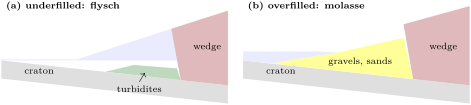
A foreland basin in two stages (schematic). (a) Early on, the bent plate subsides faster than sediment arrives: deep water against the thrust wedge, where turbidites (flysch) accumulate. (b) Later the eroding belt supplies more than the basin can hold: rivers fill it with gravels and sands (molasse), and the wedge thrusts over its own debris.
在原文中阅读 →