
全部书籍

专业

应用 关于 Coach 登录 开始阅读

书籍暂未推出简体中文版——当前显示英文版。

Earth and Space Sciences · 术语表

什么是 Front?

又称: cold front · warm front

Definition 25.2 Primary & Middle School Earth and Space Sciences · 第 25 章 — Air Masses, Fronts and Weather Maps

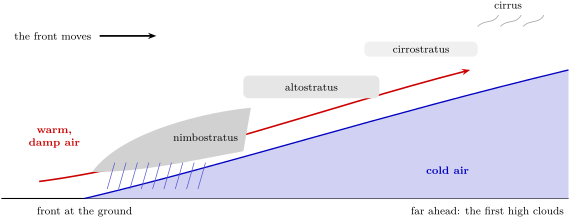
A front is the boundary at the ground between two air masses of different temperature and humidity. At a cold front, cold air pushes into warmer air and takes its place; at a warm front, warm air pushes into colder air and takes its place.
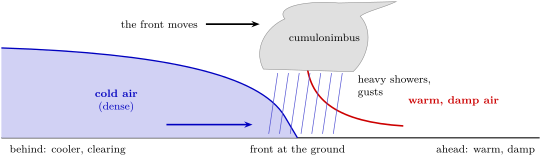
A cold front seen from the side (heights much exaggerated). The cold air pushes under the warm air like a wedge; the warm air is lifted steeply and builds towering clouds.
A warm front seen from the side (heights much exaggerated). The warm air climbs slowly over the cold air; its clouds come lower and thicker as the front approaches, and the rain is long and steady.

示例

Example 25.7 (Reading a barometer’s record)

For the first 8 hours the pressure rises to about 1031 hPa1031\,\mathrm{hPa}: the anticyclone passes over S, with settled weather. Then it falls for 30 hours, by about 45 hPa45\,\mathrm{hPa}: the depression is coming. It falls fastest a few hours before the warm front passes, more slowly in the warm air behind it, and reaches its lowest, about 986 hPa986\,\mathrm{hPa}, just as the cold front passes. Then it rises: the depression is moving away, and the cooler, clearer air behind the cold front arrives.

在原文中阅读 →