
সব বই

পেশাদার

1 Markets I: The Ecosystem and Exchange-Traded Marketsবাজার অনলাইন 2 Markets II: Rates, FX and Creditবাজার অনলাইন 3 Markets III: Commodities, Energy and Cryptoবাজার অনলাইন 4 Quantitative Methodsপদ্ধতি অনলাইন 5 Derivatives and Volatilityডেরিভেটিভস অনলাইন 6 Rates, Credit, XVA and Riskসুদহার, ঋণ ও ঝুঁকি অনলাইন 7 Research Craft: Predictors, Backtests, Measurement, Portfoliosগবেষণা অনলাইন 8 Strategies I: Equities and Futuresকৌশল অনলাইন 9 Strategies II: Volatility, Relative Value, Macro and the Bank Desksকৌশল অনলাইন 10 Microstructure and Executionএক্সিকিউশন অনলাইন 11 Market Making and High-Frequency Tradingমার্কেট মেকিং অনলাইন 12 Machine Learning for Marketsমেশিন লার্নিং অনলাইন 13 Low-Latency Softwareপ্রযুক্তি অনলাইন 14 Networks, Hardware and Trading Infrastructureপ্রযুক্তি অনলাইন 15 Research, Data and Risk Platformsপ্রযুক্তি অনলাইন 16 The Desk and the Firmপ্রতিষ্ঠান অনলাইন 17 The Industry: Firms, Roles and Careersক্যারিয়ার অনলাইন 18 Interviews I: Maths, Probability and Speedক্যারিয়ার অনলাইন 19 Interviews II: Markets, Trading Games and the Final Roundক্যারিয়ার অনলাইন 20 Interviews III: Codeক্যারিয়ার অনলাইন
অ্যাপ পরিচিতি Coach সাইন ইন পড়া শুরু করো

বইগুলো এখনো বাংলা ভাষায় পাওয়া যায় না — ইংরেজি সংস্করণ দেখানো হচ্ছে।

Earth and Space Sciences · পরিভাষা

Habitable zone কী?

Definition 2.9 High School Earth and Space Sciences · অধ্যায় 2 — A Habitable Planet

The habitable zone of a star is the range of distances from the star at which a rocky planet with enough water and an atmosphere like the Earth’s could keep liquid water on its surface. Its inner edge is where the planet would lose its water to the heat; its outer edge, where even a strong greenhouse effect could no longer keep it from freezing.
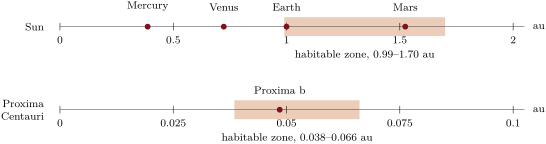
Top: the habitable zone of the Sun and the four rocky planets. Bottom: the habitable zone of the faint red star Proxima Centauri, computed by scaling the Sun’s with the square root of the star’s luminosity, and its planet Proxima b. Note the change of scale: the whole bottom strip is 0.1\, au long.
Top: the habitable zone of the Sun and the four rocky planets. Bottom: the habitable zone of the faint red star Proxima Centauri, computed by scaling the Sun’s with the square root of the star’s luminosity, and its planet Proxima b. Note the change of scale: the whole bottom strip is 0.1 au0.1\,\mathrm{au} long.

উদাহরণ

Example 2.13 (Proxima b)

The nearest star to the Sun, Proxima Centauri, 1.30 pc1.30\,\mathrm{pc} away, is a small red star whose luminosity is only about 0.00150.0015 that of the Sun. In 2016 a planet was found orbiting it every 11.2 days, at 0.0485 au0.0485\,\mathrm{au}, with at least 1.06 times the mass of the Earth. At that distance it receives about 0.64 of the irradiance the Earth receives, and it lies inside its star’s habitable zone. Whether it has an atmosphere, or water, is not known.

প্রসঙ্গসহ পড়ো →