书籍暂未推出简体中文版——当前显示英文版。
High School Earth and Space Sciences · 10–12 年级
2A Habitable Planet
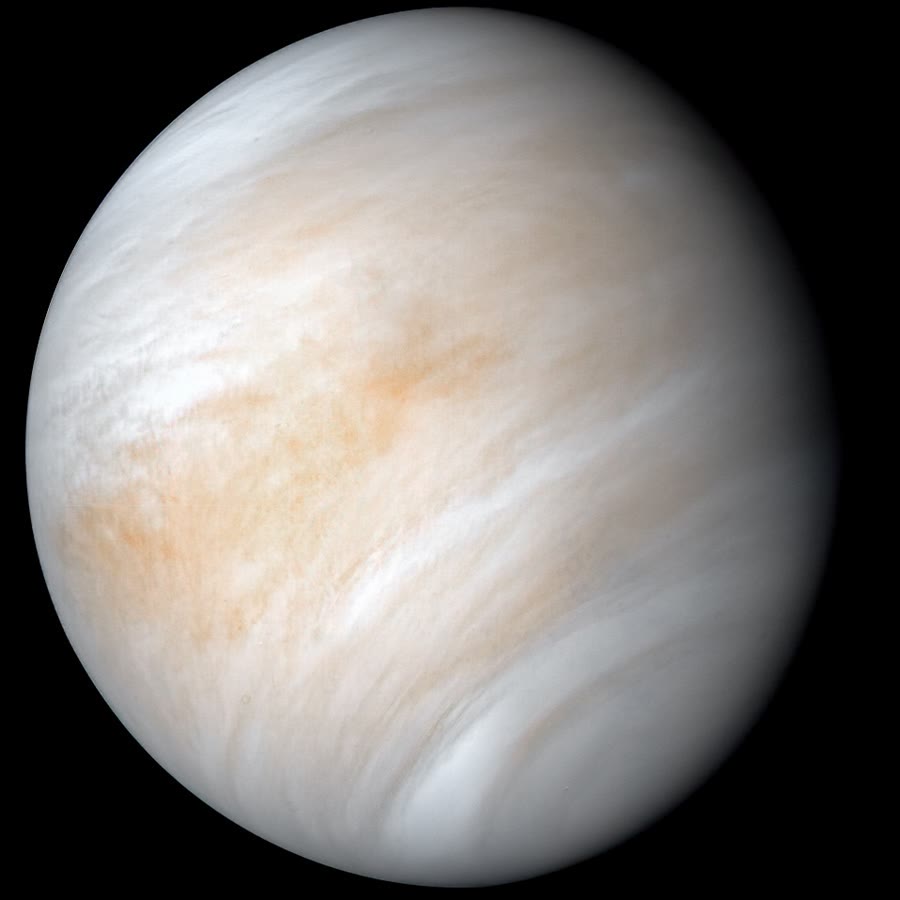
Three rocky planets circle the Sun side by side. On the surface of Venus the air is so dense that it presses ninety-two times harder than on the Earth, and so hot — more than — that lead would melt. On Mars the thin air presses less than a hundredth as hard as ours, and the average temperature is far below freezing. Between them, the Earth has oceans, rain and life. The three planets formed from the same disc of gas and dust around the young Sun, out of much the same rock. Why such different fates? This chapter looks at what sets the temperature of a planet, what lets it keep an atmosphere, under what conditions water can be liquid, and where, around the Sun and around other stars, such conditions can be found.
You already know
The Sun is a star; around it the four rocky planets Mercury, Venus, the Earth and Mars, then the four giant planets, travel on nearly circular orbits (the physics books and Book 1). Every body radiates energy as light, more and more of it as its temperature rises, mostly as infrared light at the temperatures of planets (the physics books). Greenhouse gases — water vapour, carbon dioxide, methane — absorb part of the infrared emitted by a surface and keep it warmer (the chemistry books). Water exists as ice, liquid water and water vapour; pressure is a force per unit area, measured in pascals (the physics books).
2.1 The temperature set by the star
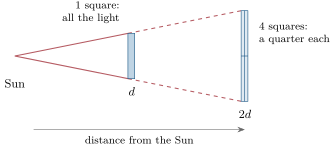
The Sun sends its light equally in all directions. At a distance , its power (its luminosity) is spread over a sphere of area .
Proposition 2.1 (The inverse-square law of sunlight)
The power received per square metre facing the Sun, the solar irradiance, at a distance from the Sun is
At the Earth’s distance, , ; at a distance measured in astronomical units, .
Proof. No light is lost in empty space, so the whole power crosses every sphere centred on the Sun; on a sphere of radius it is shared among square metres. Doubling multiplies the area by four and divides by four. ∎
A planet absorbs the part of this light that it does not reflect, and it radiates energy to space as infrared light. If it absorbs more than it radiates, it warms up; warmer, it radiates more; it settles at the temperature where the two balance.
Definition 2.2 (Equilibrium temperature)
The equilibrium temperature of a planet is the temperature at which a body radiating like a perfect emitter would send to space exactly the power the planet absorbs from its star. The fraction of the incoming light that the planet reflects as a whole is its Bond albedo .
Proposition 2.3 (Computing the equilibrium temperature)
For a planet that spreads the heat it absorbs over its whole surface,
At the Earth’s distance and with no reflection at all, this gives ; at a distance in astronomical units and with albedo , .
Partial proof. The planet intercepts sunlight on a disc of area and absorbs the power . It radiates from its whole surface, . A perfect emitter at temperature radiates per square metre (a law proved in the physics books, admitted here). Equating gives the formula; the radius cancels. With , the fourth root of is . ∎
Example 2.4 (The Earth)
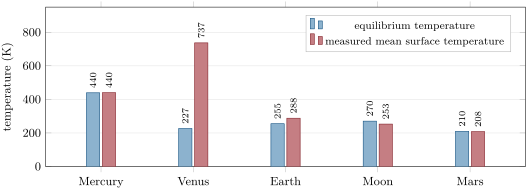
With and , , that is . (NASA’s fact sheet lists .) The average temperature of the Earth’s surface is , : the greenhouse effect of the atmosphere warms it by about . Without it the oceans would freeze.
Remark 2.5 (Reading the chart)
For Mercury and Mars, which have almost no atmosphere or a very thin one, the measured mean is close to the equilibrium temperature. The Moon’s mean lies below it: its days and nights each last about two weeks, and its surface swings from about to , which the simple formula, made for a planet that spreads its heat evenly, does not capture. Venus is the striking case: with a Bond albedo of 0.77 — its clouds reflect most of the sunlight — its equilibrium temperature is lower than the Earth’s, yet its surface is more than hotter than that: the greenhouse effect of its thick carbon-dioxide atmosphere.
2.2 Holding an atmosphere
A gas is made of molecules in constant motion, faster the hotter the gas. A molecule at the top of an atmosphere that moves upwards faster than the planet’s escape speed — the speed needed to leave its gravity for good (the physics books) — is lost to space. Over billions of years, a small planet with a weak gravity loses its air; a large one keeps it.
| body | escape speed () | surface pressure (bar) | atmosphere |
|---|---|---|---|
| Moon | 2.4 | 0 | none |
| Mercury | 4.3 | 0 | none |
| Mars | 5.0 | 0.006 | thin, carbon dioxide |
| Venus | 10.4 | 92 | thick, carbon dioxide |
| Earth | 11.2 | 1 | nitrogen and oxygen |
Remark 2.6 (Size is not the whole story)
The Moon and Mercury, small and (for Mercury) close to the hot Sun, have lost almost all their gases. Mars, with half the Earth’s escape speed, kept a thin atmosphere. Venus and the Earth have nearly the same size and escape speed, yet very different atmospheres: their histories — the fate of their water and of their carbon dioxide — diverged, as Chapter 26 will show for the Earth.
2.3 Liquid water
Proposition 2.7 (When water can be liquid)
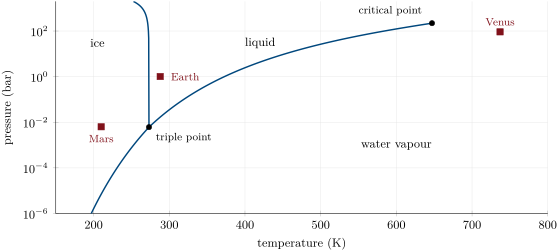
Liquid water exists only at pressures above that of the triple point, (), where ice, liquid and vapour coexist at , and at temperatures below the critical point, (), beyond which liquid and vapour can no longer be told apart. At a given pressure above the triple point, water is liquid between its melting point, close to , and its boiling point, which falls as the pressure falls.
Example 2.8 (Three planets on one diagram)
The Earth’s surface, at and , lies inside the liquid field: water there can be liquid, ice or vapour as the weather goes. Venus, at , lies far beyond the critical temperature: no liquid water is possible at all. Mars, at , lies just above the triple point: water there boils at about , so liquid water could survive only in a window of about half a degree, and the mean temperature, , is in the ice field.

2.4 The habitable zone
Definition 2.9 (Habitable zone)
The habitable zone of a star is the range of distances from the star at which a rocky planet with enough water and an atmosphere like the Earth’s could keep liquid water on its surface. Its inner edge is where the planet would lose its water to the heat; its outer edge, where even a strong greenhouse effect could no longer keep it from freezing.
Proposition 2.10 (The Sun’s habitable zone)
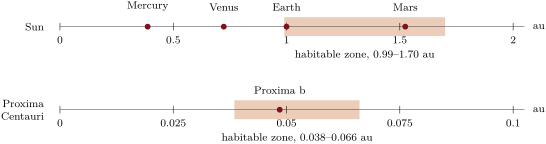
Detailed models of planetary atmospheres place the habitable zone of the Sun between and . The Earth () lies just inside its inner edge; Mars () lies inside it; Venus () lies well inside the inner edge.
Proposition 2.11 (Habitable zones of other stars)
Around a star of luminosity , a planet receives the same irradiance as at a distance from the Sun when it lies at
The edges of the habitable zone move in proportion, to a first approximation (the colour of the star’s light also matters a little).
Proof. Equal irradiance means , so . ∎
2.5 Planets of other stars
Definition 2.12 (Exoplanet)
An exoplanet is a planet that orbits a star other than the Sun.
Exoplanets are far too faint and too close to their stars to be seen directly, apart from a few giants. Most are found indirectly: either the planet passes in front of its star once per orbit and dims it very slightly, or its pull makes the star wobble towards and away from us, which shifts the colour of the star’s light back and forth. The second method gives only a minimum mass for the planet, because the tilt of the orbit is not known. These methods are studied in the Year 3 volume.
Figures as of 2026
On 15 October 2026 the NASA Exoplanet Archive listed 6 451 confirmed exoplanets.
Example 2.13 (Proxima b)
The nearest star to the Sun, Proxima Centauri, away, is a small red star whose luminosity is only about that of the Sun. In 2016 a planet was found orbiting it every 11.2 days, at , with at least 1.06 times the mass of the Earth. At that distance it receives about 0.64 of the irradiance the Earth receives, and it lies inside its star’s habitable zone. Whether it has an atmosphere, or water, is not known.
Remark 2.14 (Habitable is not inhabited)
The habitable zone is a statement about distance and light only. A planet inside it may have no water, no atmosphere, or the wrong one — Mars lies inside the Sun’s zone and has no liquid water at its surface today. The Earth is habitable because several conditions hold at once: the right distance, a mass large enough to keep an atmosphere, abundant water, and a greenhouse effect neither too weak nor too strong.
2.6 Exercises
Exercise 2.1 ★
Define the equilibrium temperature of a planet. Why is the Earth’s mean surface temperature higher than its equilibrium temperature?
Solution
Solution of Exercise 2.1.
The temperature at which a perfect emitter would radiate to space exactly the power the planet absorbs from its star. The Earth’s surface is warmer ( against about ) because greenhouse gases absorb part of the infrared it emits and send part of it back down.
Exercise 2.2 ★
Using the bar chart of equilibrium and measured temperatures, name the body whose surface is warmed most by its atmosphere, and estimate by how many kelvins.
Solution
Solution of Exercise 2.2.
Venus: measured against an equilibrium temperature of about , a warming of about .
Exercise 2.3 ★
Mars orbits at from the Sun. Using the inverse-square law with , compute the solar irradiance at Mars.
Solution
Solution of Exercise 2.3.
(the fact sheet gives , with the exact mean distance).
Exercise 2.4 ★
Using the phase diagram of water, give the state of water at and ; at and ; at and .
Solution
Solution of Exercise 2.4.
, : liquid (below the boiling point, about ). , : ice (the pressure lies above the ice–vapour curve, which is at about at ). , : vapour — the temperature is above the critical temperature, so no liquid can exist.
Exercise 2.5 ★
What is an exoplanet? Describe in one sentence each the two main ways in which exoplanets are detected.
Solution
Solution of Exercise 2.5.
A planet orbiting a star other than the Sun. Transits: the planet passes in front of its star and dims it slightly at every orbit. Wobble: the planet’s pull moves the star back and forth along our line of sight, which shifts the colour of its light periodically.
Exercise 2.6 ★★
Compute the Earth’s equilibrium temperature with and , then with . Convert both to degrees Celsius.
Solution
Solution of Exercise 2.6.
. With : .
Exercise 2.7 ★★
A star is four times as luminous as the Sun. Between which distances does its habitable zone lie? Would the Earth, placed at from it, be inside?
Solution
Solution of Exercise 2.7.
: from to . At the planet would receive four times the Earth’s irradiance: far inside the inner edge, too hot.
Exercise 2.8 ★★
Venus orbits at . Compute the irradiance it receives, then its equilibrium temperature with its Bond albedo of 0.77. Compare with its surface temperature of and explain the difference.
Solution
Solution of Exercise 2.8.
; . The surface is about hotter: its thick carbon-dioxide atmosphere () produces an enormous greenhouse effect.
Exercise 2.9 ★★
On Mars the mean surface pressure is , just above the triple point of water, and water boils there at about . Explain why liquid water cannot last on the surface of Mars today, even on a summer afternoon when the ground reaches .
Solution
Solution of Exercise 2.9.
At water is liquid only between about and . At the pressure is below the boiling curve: water boils away into vapour; at night it freezes.
Exercise 2.10 ★★
The escape speed is on the Moon and on the Earth. Compute their ratio. Explain why the Earth has kept an atmosphere and the Moon has not.
Solution
Solution of Exercise 2.10.
. A gas molecule must move almost five times faster to escape the Earth than the Moon; over billions of years the Moon’s weak gravity let its gases escape, while the Earth’s kept most of them.
Exercise 2.11 ★★
Suppose the Earth were covered with ice and its Bond albedo rose to 0.50. Compute its new equilibrium temperature. Explain why such a state, once reached, would tend to last.
Solution
Solution of Exercise 2.11.
, about . The ice would reflect so much sunlight that the planet would stay cold enough to keep it: a reinforcing loop.
Exercise 2.12 ★★★
Show that , with in astronomical units, follows from the formula of the chapter. By what factor does the equilibrium temperature change when the distance is multiplied by four?
Solution
Solution of Exercise 2.12.
; and . Four times farther: divided by .
Exercise 2.13 ★★★
At what distance from the Sun would a planet of albedo 0.294 have an equilibrium temperature of ? Compare with the inner edge of the habitable zone, and explain why the two are different.
Solution
Solution of Exercise 2.13.
, so , inside the inner edge (). The equilibrium temperature ignores the greenhouse effect: a real planet with an atmosphere is warmer than , so it overheats and loses its water already farther out, at about . The edges come from models of the whole atmosphere, not from alone.
Exercise 2.14 ★★★
On a planet whose surface pressure is , water boils at about . Between which temperatures can water be liquid there? What would happen to a lake on that planet on a day at ?
Solution
Solution of Exercise 2.14.
Between the melting point, about , and the boiling point, about . At the lake would boil.
Exercise 2.15 ★★★
A planet orbits at from a star half as luminous as the Sun. Compute the edges of the star’s habitable zone and say whether the planet is inside. How sure can one be of the answer?
Solution
Solution of Exercise 2.15.
: from to . The planet is right at the outer edge. The edges are model results and the scaling is approximate, so it is impossible to say whether it is inside or outside.
2.7 Problem: Could Proxima b Hold an Ocean?
Problem 2.1
Weekend problem — from the light of a faint red star to the temperature of its nearest planet
A student reads the data sheet of the planet Proxima b. Its star has a luminosity ; the planet orbits at in 11.18 days and has at least 1.055 times the mass of the Earth. Use , , the Sun’s habitable zone , and the Earth’s escape speed .
Part I — The light of the star.
- Compute the irradiance at the planet as a fraction of the Earth’s, (with in solar luminosities and in au).
- Express it in .
- Compare it with the irradiance at Venus () and at Mars ().
- How many of the planet’s years fit into one Earth year?
Part II — Temperatures without an atmosphere.
- Compute the equilibrium temperature of a perfectly dark planet () at that irradiance.
- Compute it for a planet as bright as Venus ().
- Which of these two temperatures is above the freezing point of water? What do the two results show about the role of clouds and ice?
Part III — The habitable zone.
- Compute .
- Compute the inner edge of the star’s habitable zone.
- Compute its outer edge.
- Is Proxima b inside the habitable zone?
- At what distance from the Sun would a planet receive the same irradiance as Proxima b? Where would that be in the Sun’s habitable zone?
Part IV — An atmosphere and water?
- If the planet had the Earth’s mean density, its radius would be times the Earth’s. Compute this factor.
- The escape speed is proportional to . Estimate the planet’s escape speed. Could it keep an atmosphere?
- Why is the mass known only as a minimum?
- On the phase diagram, what is the lowest surface pressure that would allow liquid water at all?
- Compute the equilibrium temperature of Proxima b with the Earth’s albedo, 0.294.
- By how many kelvins would its greenhouse effect then have to warm it to bring its surface to the Earth’s mean temperature, ?
Solution
Solution of Problem 2.1.
1. .
2. .
3. Between the two: about three times less than Venus, one and a half times more than Mars.
4. .
5. .
6. .
7. Neither: is still below . A bright cover of clouds or ice lowers the equilibrium temperature by more than : what covers a planet matters as much as its distance.
8. .
9. .
10. .
11. Yes: .
12. : in the inner half of the Sun’s habitable zone, between the Earth and Mars.
13. .
14. , about the Earth’s: its gravity could hold an atmosphere (whether it has one depends on its history).
15. The wobble of the star reveals only the part of its motion along our line of sight; since the tilt of the orbit is unknown, the mass found is the true mass only if the orbit is seen edge-on, and a minimum otherwise.
16. The pressure of the triple point, , about .
17. .
18. : Proxima b would need a greenhouse warming of about , almost twice the Earth’s .