
全部书籍

专业

应用 关于 Coach 登录 开始阅读

书籍暂未推出简体中文版——当前显示英文版。

Earth and Space Sciences · 术语表

什么是 Habitable zone?

Definition 2.9 High School Earth and Space Sciences · 第 2 章 — A Habitable Planet

The habitable zone of a star is the range of distances from the star at which a rocky planet with enough water and an atmosphere like the Earth’s could keep liquid water on its surface. Its inner edge is where the planet would lose its water to the heat; its outer edge, where even a strong greenhouse effect could no longer keep it from freezing.
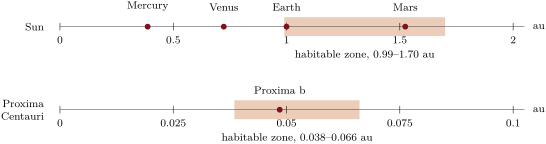
Top: the habitable zone of the Sun and the four rocky planets. Bottom: the habitable zone of the faint red star Proxima Centauri, computed by scaling the Sun’s with the square root of the star’s luminosity, and its planet Proxima b. Note the change of scale: the whole bottom strip is 0.1\, au long.
Top: the habitable zone of the Sun and the four rocky planets. Bottom: the habitable zone of the faint red star Proxima Centauri, computed by scaling the Sun’s with the square root of the star’s luminosity, and its planet Proxima b. Note the change of scale: the whole bottom strip is 0.1 au0.1\,\mathrm{au} long.

示例

Example 2.13 (Proxima b)

The nearest star to the Sun, Proxima Centauri, 1.30 pc1.30\,\mathrm{pc} away, is a small red star whose luminosity is only about 0.00150.0015 that of the Sun. In 2016 a planet was found orbiting it every 11.2 days, at 0.0485 au0.0485\,\mathrm{au}, with at least 1.06 times the mass of the Earth. At that distance it receives about 0.64 of the irradiance the Earth receives, and it lies inside its star’s habitable zone. Whether it has an atmosphere, or water, is not known.

在原文中阅读 →