
সব বই

পেশাদার

1 Markets I: The Ecosystem and Exchange-Traded Marketsবাজার অনলাইন 2 Markets II: Rates, FX and Creditবাজার অনলাইন 3 Markets III: Commodities, Energy and Cryptoবাজার অনলাইন 4 Quantitative Methodsপদ্ধতি অনলাইন 5 Derivatives and Volatilityডেরিভেটিভস অনলাইন 6 Rates, Credit, XVA and Riskসুদহার, ঋণ ও ঝুঁকি অনলাইন 7 Research Craft: Predictors, Backtests, Measurement, Portfoliosগবেষণা অনলাইন 8 Strategies I: Equities and Futuresকৌশল অনলাইন 9 Strategies II: Volatility, Relative Value, Macro and the Bank Desksকৌশল অনলাইন 10 Microstructure and Executionএক্সিকিউশন অনলাইন 11 Market Making and High-Frequency Tradingমার্কেট মেকিং অনলাইন 12 Machine Learning for Marketsমেশিন লার্নিং অনলাইন 13 Low-Latency Softwareপ্রযুক্তি অনলাইন 14 Networks, Hardware and Trading Infrastructureপ্রযুক্তি অনলাইন 15 Research, Data and Risk Platformsপ্রযুক্তি অনলাইন 16 The Desk and the Firmপ্রতিষ্ঠান অনলাইন 17 The Industry: Firms, Roles and Careersক্যারিয়ার অনলাইন 18 Interviews I: Maths, Probability and Speedক্যারিয়ার অনলাইন 19 Interviews II: Markets, Trading Games and the Final Roundক্যারিয়ার অনলাইন 20 Interviews III: Codeক্যারিয়ার অনলাইন
অ্যাপ পরিচিতি Coach সাইন ইন পড়া শুরু করো

বইগুলো এখনো বাংলা ভাষায় পাওয়া যায় না — ইংরেজি সংস্করণ দেখানো হচ্ছে।

Earth and Space Sciences · পরিভাষা

Hotspot track; age progression কী?

অন্য নাম: hotspot track · age progression

Definition 15.3 University Earth and Space Sciences — Year 1 · অধ্যায় 15 — Hotspots and Intraplate Volcanism

A hotspot track is the line of volcanoes, seamounts and volcanic ridges that a plate carries away from a hotspot as it moves over it. Its age progression is the regular increase of the ages of its volcanoes with the distance from the active one. The direction of a track at the hotspot is the azimuth, measured from north, towards which its young part runs away from the hotspot.
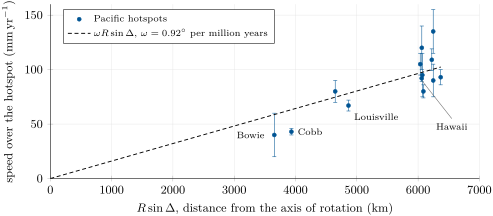
The speeds of the Pacific plate over thirteen of its hotspots, with their uncertainties, against the distance of each hotspot from the axis of rotation through the fitted pole. A rigid plate turning about that pole puts them on a line through the origin; the least-squares line gives = 0.92 / Myr. Most hotspots lie 6000 to 6400\, km from the axis, where the speed is nearly the same; the scatter there, larger than the error bars, shows the limits of a fixed frame. Data: W. J. and J. P. Morgan (2007), Table 1 of their electronic supplement.
The speeds of the Pacific plate over thirteen of its hotspots, with their uncertainties, against the distance of each hotspot from the axis of rotation through the fitted pole. A rigid plate turning about that pole puts them on a line through the origin; the least-squares line gives ω=0.92∘/Myr\omega = 0.92{}^{\circ}/\mathrm{Myr}. Most hotspots lie 6000 to 6400 km6400\,\mathrm{km} from the axis, where the speed is nearly the same; the scatter there, larger than the error bars, shows the limits of a fixed frame. Data: W. J. and J. P. Morgan (2007), Table 1 of their electronic supplement.
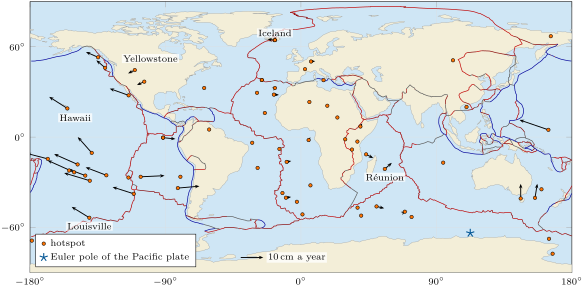
The 68 hotspots of W. J. and J. P. Morgan (2007). Arrows: the motion of the plate over each hotspot where it was measured, along the direction of the track and with a length proportional to the speed (scale at bottom, south of the Atlantic); where a hotspot lies under two plates, as Iceland does, both are drawn. The star is the Euler pole of the Pacific plate relative to the hotspots, fitted to the fifteen Pacific tracks by : the Pacific arrows turn about it. Plate boundaries: PB2002 (red: ridges; dark red: transforms; blue: subduction zones; grey: collision zones).
The 68 hotspots of W. J. and J. P. Morgan (2007). Arrows: the motion of the plate over each hotspot where it was measured, along the direction of the track and with a length proportional to the speed (scale at bottom, south of the Atlantic); where a hotspot lies under two plates, as Iceland does, both are drawn. The star is the Euler pole of the Pacific plate relative to the hotspots, fitted to the fifteen Pacific tracks by Method 15.5: the Pacific arrows turn about it. Plate boundaries: PB2002 (red: ridges; dark red: transforms; blue: subduction zones; grey: collision zones).
প্রসঙ্গসহ পড়ো →