সব বই

পেশাদার

1 Markets I: The Ecosystem and Exchange-Traded Marketsবাজার অনলাইন 2 Markets II: Rates, FX and Creditবাজার অনলাইন 3 Markets III: Commodities, Energy and Cryptoবাজার অনলাইন 4 Quantitative Methodsপদ্ধতি অনলাইন 5 Derivatives and Volatilityডেরিভেটিভস অনলাইন 6 Rates, Credit, XVA and Riskসুদহার, ঋণ ও ঝুঁকি অনলাইন 7 Research Craft: Predictors, Backtests, Measurement, Portfoliosগবেষণা অনলাইন 8 Strategies I: Equities and Futuresকৌশল অনলাইন 9 Strategies II: Volatility, Relative Value, Macro and the Bank Desksকৌশল অনলাইন 10 Microstructure and Executionএক্সিকিউশন অনলাইন 11 Market Making and High-Frequency Tradingমার্কেট মেকিং অনলাইন 12 Machine Learning for Marketsমেশিন লার্নিং অনলাইন 13 Low-Latency Softwareপ্রযুক্তি অনলাইন 14 Networks, Hardware and Trading Infrastructureপ্রযুক্তি অনলাইন 15 Research, Data and Risk Platformsপ্রযুক্তি অনলাইন 16 The Desk and the Firmপ্রতিষ্ঠান অনলাইন 17 The Industry: Firms, Roles and Careersক্যারিয়ার অনলাইন 18 Interviews I: Maths, Probability and Speedক্যারিয়ার অনলাইন 19 Interviews II: Markets, Trading Games and the Final Roundক্যারিয়ার অনলাইন 20 Interviews III: Codeক্যারিয়ার অনলাইন
অ্যাপ পরিচিতি Coach সাইন ইন পড়া শুরু করো

বইগুলো এখনো বাংলা ভাষায় পাওয়া যায় না — ইংরেজি সংস্করণ দেখানো হচ্ছে।

Earth and Space Sciences · পরিভাষা

Hydrous melting কী?

Definition 22.5 High School Earth and Space Sciences · অধ্যায় 22 — Magmatism at Subduction Zones

Hydrous melting (or flux melting) is the partial melting of a rock caused by the addition of water, which lowers the temperature at which the rock begins to melt.
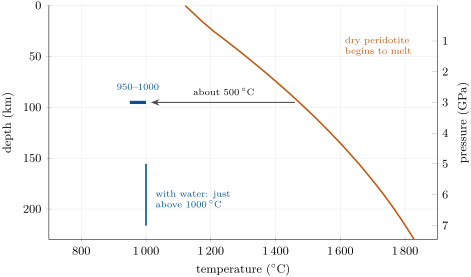
The temperature at which mantle peridotite begins to melt, against depth: dry (orange) and saturated with water (blue, the two ranges measured so far). At the depth of the slab beneath arcs, about 100\, km, water lowers it by about 500\, C. Sources: Hirschmann (2000), with the PREM densities; Wang and others (2020); Kawamoto and Holloway (1997).
The temperature at which mantle peridotite begins to melt, against depth: dry (orange) and saturated with water (blue, the two ranges measured so far). At the depth of the slab beneath arcs, about 100 km100\,\mathrm{km}, water lowers it by about 500 ∘C500\,{}^{\circ}\mathrm{C}. Sources: Hirschmann (2000), with the PREM densities; Wang and others (2020); Kawamoto and Holloway (1997).
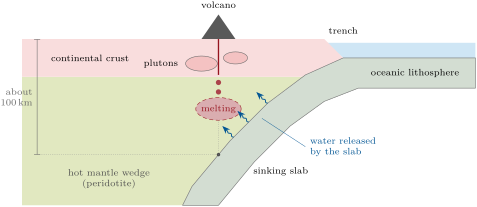
Magmatism at a subduction zone (schematic, not to scale). As the slab warms, its minerals give up their water, which rises into the hot mantle wedge and makes it melt in part. The magma rises: some of it erupts at the volcanoes, more of it cools in the crust as plutons.
প্রসঙ্গসহ পড়ো →
