全部书籍

专业

应用 关于 Coach 登录 开始阅读

书籍暂未推出简体中文版——当前显示英文版。

Earth and Space Sciences · 术语表

什么是 Intrusive bodies?

又称: pluton · dyke · sill · laccolith · batholith

Definition 5.10 University Earth and Space Sciences — Year 2 · 第 5 章 — Magmas and Their Emplacement

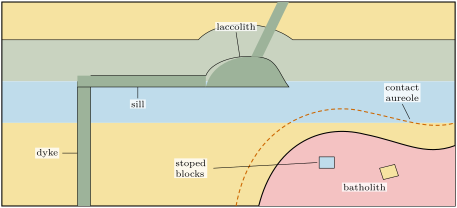
A pluton is any body of magma that solidified within the crust. A dyke is a sheet-like pluton that cuts across the layering of its host rock (or any sheet if the host has no layering); a sill is a sheet-like pluton parallel to the layering. A laccolith is a sill that has thickened by pushing up the overlying layers into a dome. A batholith is a large pluton, or an assembly of plutons, with an exposed area of more than 100 km2100\,\mathrm{km}^{2}.

Shapes of intrusive bodies in a layered host (schematic, not to scale): a feeder dyke cutting across the layers, a sill along a bedding plane, a laccolith doming the layers above it, a dyke cutting up to the surface, and a batholith with blocks stoped from its roof and a contact aureole.
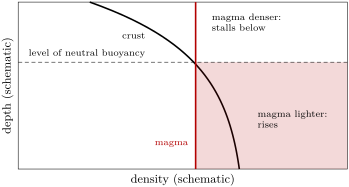
The level of neutral buoyancy (schematic). The density of the crust increases with depth, by compaction of sediments and by the change to denser rocks; a magma of fixed density rises while it is lighter than its surroundings (shaded) and spreads out where the two densities meet.
在原文中阅读 →