University Earth and Space Sciences — Year 2 · Bachelor Year 2
5Magmas and Their Emplacement
A basaltic melt at flows with a viscosity of about : thick, but it pours. A dry rhyolitic melt at has a viscosity near , and a block of it would take hours to sag visibly under its own weight. Between the two lie ten orders of magnitude, more than between water and the basalt, and most of the difference comes from two things: the silica that links the melt into a network, and the temperature, which is several hundred degrees lower in silicic magmas. A few per cent of dissolved water, which a rhyolitic magma can hold at depth, brings its viscosity down by a factor of , and loses it again as the magma rises and the water comes out as bubbles. These numbers decide whether a magma reaches the surface quietly, explodes, or freezes kilometres down as a dyke, a sill or a pluton. This chapter treats a magma as a material: its density, viscosity and volatiles, the physics of its ascent through cracks and as blobs, the shapes it takes when it stops, and the heat it gives to the rocks around it.
You already know
Viscous flow (physics books’ Year 2 volume): in a Newtonian fluid of viscosity the shear stress is times the velocity gradient; between two parallel walls a pressure gradient drives a parabolic (plane Poiseuille) profile; a sphere moving slowly through a viscous fluid feels the Stokes drag . Heat conduction (same volume): temperature obeys , with diffusivity , and a step of temperature spreads as an error function over a distance of order . Buoyancy (physics books’ Year 1 volume): a body immersed in a denser fluid feels a net upward force equal to the weight of fluid displaced minus its own. Chemical equilibrium (chemistry books): at equilibrium the activities of products and reactants satisfy the law of mass action with a constant that depends on temperature. From the Year 1 volume of this series: the lithostatic pressure and the geotherm; from the school volumes: mafic and felsic rocks, phenocrysts and porphyritic textures.
5.1 What a magma is
Definition 5.1 (Magma)
A magma is molten or partly molten rock beneath the surface: a silicate melt, the liquid made mostly of silicon, oxygen and metal cations, together with any crystals and gas bubbles it carries. A crystal mush is a magma so rich in crystals that they touch and form a framework: it cannot flow as a liquid, and its melt can only move through the pores between crystals.
The composition of the melt is given, as for rocks, in weight per cent of oxides. Three melts serve as references throughout the chapter, all of them studied in the laboratory: a tholeiitic basalt dredged from a mid-ocean ridge (about SiO, iron oxide, MgO), an andesite ( SiO) and a rhyolite ( SiO, NaO KO and almost no iron or magnesium). Their eruption temperatures differ as much as their compositions: basaltic magmas erupt at (lava streaming through a tube on Kilauea has been measured near ), andesitic magmas at , rhyolitic magmas at . A rhyolitic magma is cooler because it is the residue of a long crystallisation or the first melt of crustal rocks, both of which happen at low temperature (Chapter 8).
The crystal content decides whether a magma flows. Field and geochronological studies of large granite bodies conclude that bulk magmatic flow needs a melt fraction of at least by volume; below that the crystals are welded to their neighbours and the material deforms as a solid with melt-filled pores. Much of the magma stored in the crust is thought to sit in that state, as a mush that becomes mobile again when hot magma is added from below.
5.2 Density and viscosity
5.2.1 The density of a melt
A silicate melt has no crystal lattice, but its volume can still be built from its components. Experiments on many melts show that each oxide contributes a nearly fixed volume per mole, its partial molar volume, which changes slowly and linearly with temperature and pressure; the volume of the melt is the sum of these contributions. The table below gives the values used in this chapter.
| Oxide | () | ( ) | ( ) |
|---|---|---|---|
| SiO | 26.86 | 0 | |
| AlO | 37.42 | 2.62 | |
| FeO | 12.68 | 3.69 | |
| MgO | 12.02 | 3.27 | |
| CaO | 16.90 | 3.74 | |
| NaO | 29.65 | 7.68 | |
| KO | 47.28 | 12.08 | |
| HO | 22.9 | 9.5 |
Proposition 5.2 (Density of a silicate melt)
Let a melt contain oxide components with mole fractions , molar masses and partial molar volumes . If the components mix ideally in volume,
Proof. One mole of melt contains moles of component , of mass . Ideal mixing in volume means that each mole of component adds the volume whatever the others are, so the mole of melt occupies . The density is the ratio of the two. ∎
Water has a molar mass of only but a partial molar volume of , close to that of silica: it lowers the density of a melt strongly. Applied to the three reference melts, the proposition gives for the basalt at , for the andesite at and for the dry rhyolite at ; one per cent of dissolved water takes about off the basalt, as much as several hundred degrees of heating. A basaltic melt is therefore lighter than the mantle peridotite it comes from (about below the crust in the reference Earth model) and a little lighter than the lower crust of that model (), while a rhyolitic melt is lighter even than its upper crust (). This difference drives magmas upward.
5.2.2 Viscosity
The viscosity of a silicate melt is set by the network of SiO tetrahedra linked through shared oxygens: to flow, the melt must break and remake silicon–oxygen bonds. Silica and alumina build the network; the cations of magnesium, iron, calcium and the alkalis break it, and so does water, which turns bridging oxygens into hydroxyl groups. Laboratory measurements on natural melts cover more than fifteen orders of magnitude, from to , and they do not follow a simple Arrhenius law: the viscosity rises faster than exponentially in as the melt cools towards its glass transition.
Proposition 5.3 (Vogel–Fulcher–Tammann law)
The viscosity of a silicate melt of fixed composition follows, to within a few tenths of a logarithmic unit,
with in pascal seconds and in kelvins. For natural melts is close to whatever the composition; and (in kelvins) are linear combinations of the mole percentages of the oxides, with a few products of them, fitted to about measurements.
Proof. Admitted at this level. ∎
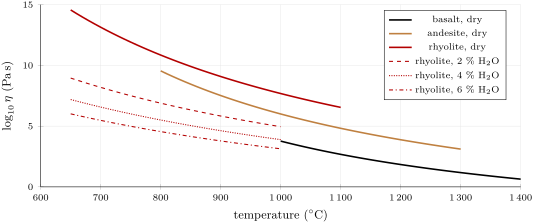
The figure below shows the law for the three reference melts and for the rhyolite with dissolved water. At the basalt has ; the andesite at is about ; the dry rhyolite at about . Four per cent of water brings the same rhyolite down to , six per cent to . An independent equation fitted only to hydrous granitic melts gives the same values to within half a logarithmic unit (Exercise 5.1). The effect of water is largest at low temperature, where a few tenths of a per cent change the viscosity by orders of magnitude.
Crystals make a magma stiffer still. A suspension of rigid particles resists shear more than its liquid alone, because the liquid must flow around the particles, and when the particles are crowded enough to touch they lock into a framework.
Proposition 5.4 (Einstein–Roscoe relation)
A suspension of a volume fraction of rigid spheres in a Newtonian liquid of viscosity has the viscosity
where is the maximum packing fraction, at which the suspension jams. For small this reduces to Einstein’s .
Proof. Admitted at this level. ∎
Twenty per cent of crystals double the viscosity, forty per cent multiply it by seven, sixty per cent by more than sixty (Exercise 5.5); in real magmas, where the crystals are elongated and of many sizes, the lock-up comes earlier, near the of crystals at which the field evidence places the end of bulk flow.
5.3 Volatiles
Definition 5.5 (Magmatic volatiles)
A magmatic volatile is a component of a magma that is dissolved in the melt at depth and forms a separate gas phase at low pressure: mainly water, then carbon dioxide, then sulfur species. Volatile exsolution is the separation of a volatile from the melt into bubbles of gas. The volatile saturation pressure of a melt is the pressure below which its dissolved volatiles exceed their solubility, so that a gas phase must form.
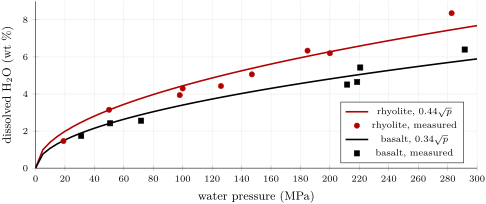
Mafic magmas typically carry of volatiles by mass, intermediate magmas , felsic magmas , and the exsolution of of water drives most explosive eruptions. How much water a melt can hold depends above all on pressure. The figure below shows measurements on basaltic and rhyolitic melts held at a known water pressure until saturated, then quenched to glass and analysed: the solubility rises steeply at low pressure and more slowly at high pressure.
Proposition 5.6 (Square-root law for water)
Suppose water dissolves in a silicate melt mostly as hydroxyl groups, through the reaction , with the oxygen of the melt in large excess. Then, at low water contents, the dissolved water is proportional to the square root of the water pressure: , with a constant of the melt and the temperature.
Proof. The law of mass action gives , where is the fugacity of water (close to its pressure at moderate pressures) and the are mole fractions. The oxygen of the melt is in large excess, so stays nearly constant, and . Each dissolved water molecule makes two hydroxyls, so the dissolved water is , proportional to . At higher contents part of the water dissolves as molecules, in proportion to itself, and the solubility rises faster than the square root (Exercise 5.10). ∎
Fitted by least squares to the measurements, gives weight per cent per for the basalts and for the rhyolites; every measurement lies within one per cent of water of its curve. The saturation pressure of a melt with per cent of water is then : for a rhyolite with of water, about down in the crust, but only for a basalt with , a hundred metres or less.
Carbon dioxide is far less soluble than water. It dissolves as molecules in rhyolites and as carbonate groups in basalts, more in alkaline melts than in tholeiites, and its solubility also rises with pressure. A magma carrying both gases therefore starts to exsolve deep, with a gas very rich in CO, and the gas becomes richer in water as the magma rises. Basalts erupted on the deep sea floor contain vesicles of more than CO, which required saturation with CO even under of water. Estimates of the initial CO content of the parental basalts of Kilauea range from , and melt inclusions trapped in their olivine crystals record saturation pressures up to .
Exsolved gas takes up a large volume. One per cent of water in a magma at occupies, as an ideal gas, about of the volume at , at and more than at atmospheric pressure (Exercise 5.7). The bubbles lower the density of the magma further and drive it upward faster; in a viscous magma they cannot escape, and Chapter 6 shows how they fragment it.
5.4 Ascent
A body of magma less dense than its surroundings feels a buoyancy force of per unit volume, where is the density difference. It can rise in two ways: through a crack it opens ahead of itself, or as a hot, soft blob that pushes the surrounding rock aside.
5.4.1 Dykes
At depth the rock is under a large lithostatic pressure, but a crack filled with magma at a slightly higher pressure than the least principal stress can open and lengthen at its tip. Magma fills the crack as it grows, and the result is a thin sheet of magma, metres wide and kilometres long, that cuts its way upward: a dyke in the making. The magma then flows between two nearly parallel walls.
Proposition 5.7 (Flow of magma in a dyke)
A Newtonian magma of viscosity driven upward by a pressure gradient (for buoyant flow, ) between two parallel walls a distance apart flows with the mean velocity
and the volume flux per unit length of dyke is .
Proof. In steady laminar flow the velocity profile across the dyke is the plane Poiseuille parabola , for , which vanishes on both walls. Its mean is . ∎
The cube of the width makes wide dykes far more efficient than narrow ones. A basalt of in a dyke wide, with , rises at about and crosses of crust in an hour; a rhyolite of in the same dyke would take more than a year, and would freeze on the way, so silicic magmas need much wider dykes (Exercise 5.6). The Reynolds number of these flows is small enough for them to stay laminar. Ascent rates estimated for magmas during eruptions separate effusive eruptions, below about , from explosive ones above it, with a transitional range from where both styles occur; kimberlites, which come from depths beyond , have been estimated at , and a diffusion study of one of them gives averaged over the last , a journey of days.
5.4.2 Diapirs
Definition 5.8 (Diapir, level of neutral buoyancy, stoping)
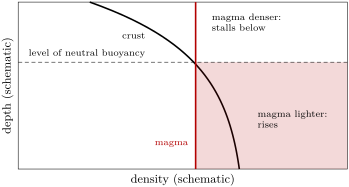
A diapir is a body of buoyant material, magma or partly molten rock, that rises through its surroundings by flowing them aside. The level of neutral buoyancy of a magma is the depth at which its density equals that of the surrounding rock: below it the magma is buoyant, above it it is denser than its surroundings. Magmatic stoping is the detachment of blocks of the wall or roof rock, which sink into the magma; blocks that stay enclosed in the solidified rock are xenoliths.
Proposition 5.9 (Stokes ascent)
A sphere of radius and density deficit rising slowly through a Newtonian medium of viscosity reaches the terminal velocity
if it is rigid, and times this if it is a fluid of negligible viscosity.
Proof. Admitted at this level. ∎
The rock around a diapir is not a fluid of but a hot solid, whose viscosity is many orders of magnitude higher than that of any melt: in the crust, a sphere of magma a kilometre across rises only millimetres a year, and loses its heat long before it has risen far (Exercise 5.9). Diapirs work where the surroundings are hot and soft, in the mantle and in the deep roots of mountain belts, and where the buoyant material is a partly molten mass kilometres across; the shallow crust is crossed by dykes.
5.5 Emplacement
Most magma never reaches the surface. It stops where it is no longer buoyant, or where it is blocked by a stronger layer, and spreads into a body whose shape records how it made room for itself.
Definition 5.10 (Intrusive bodies)
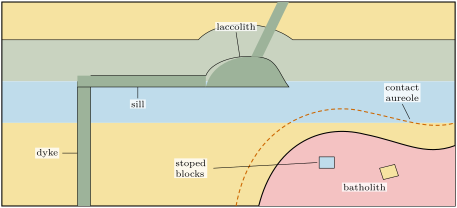
A pluton is any body of magma that solidified within the crust. A dyke is a sheet-like pluton that cuts across the layering of its host rock (or any sheet if the host has no layering); a sill is a sheet-like pluton parallel to the layering. A laccolith is a sill that has thickened by pushing up the overlying layers into a dome. A batholith is a large pluton, or an assembly of plutons, with an exposed area of more than .
Where a magma stops depends first on its density. In a crust whose density increases with depth, a magma rises to its level of neutral buoyancy and spreads sideways there, as a sill or a lens; light sediments near the surface are especially effective traps for dense basaltic magma. A strong, stiff layer can also stop a dyke and divert it along its base. The figure below shows the principle.
A pluton must make room for itself. It can lift its roof, as a laccolith does; it can push its walls aside where they are soft; it can fill space opened by faulting; and it can stope its roof, block by block. Large plutons were long pictured as huge tanks of magma emplaced at once. Dating has changed that picture. The zircons of the Tuolumne Intrusive Suite, a granite batholith in California, show that it was emplaced between and , oldest at the margins and youngest at the centre, and one of its units alone over more than , between and . A single body of magma thick and wide emplaced at depth would have cooled below , where it is about half crystallised, in about years. Such plutons must have been assembled incrementally, from many smaller intrusions such as sheets and dykes, over millions of years (Exercise 5.11).
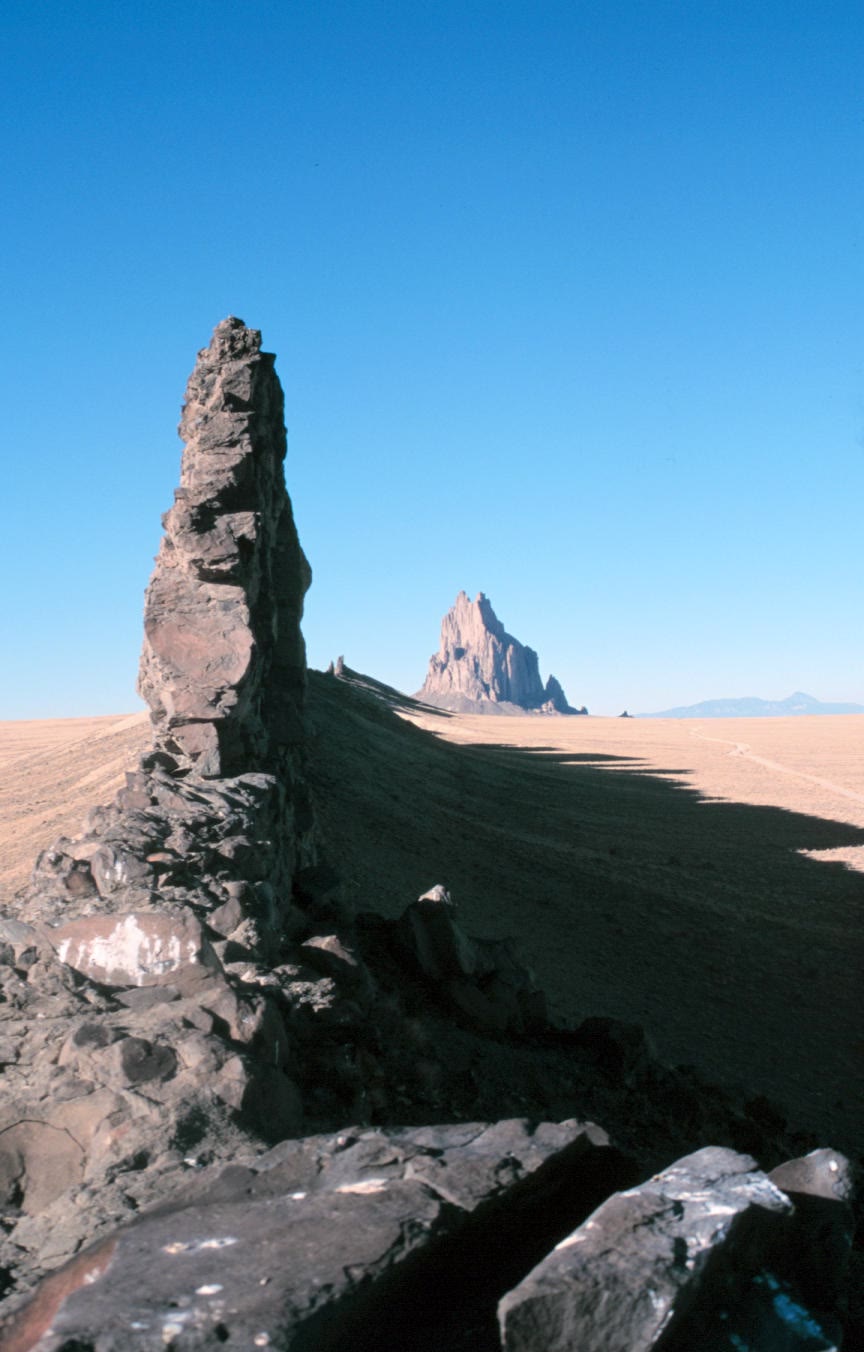
5.6 Cooling and contact metamorphism
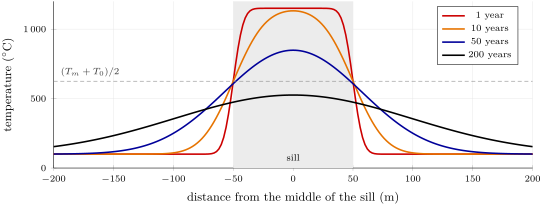
An intrusion loses its heat by conduction into its host rocks. The simplest model treats the intrusion and its host as one conducting medium of uniform diffusivity : at time zero a sheet of thickness is at the intrusion temperature and the host at . The solution of the heat equation, with measured from the middle of the sheet, is
The figure below shows it for a sill thick.
Proposition 5.11 (Contact temperature)
In this model, as long as is small compared with , the temperature at the contact of the intrusion stays at the mean of the intrusion and host temperatures.
Proof. At the contact the first error function is and the second is , which is close to while . Then . ∎
A basaltic dyke at in rocks at thus heats its contact to . The heat of crystallisation, typically , keeps the magma hot longer and raises this value: with released between and the same model gives , while temperature-dependent conductivities and wet host rocks lower both estimates by 50 to .
The time scale of cooling is the time heat needs to diffuse across the intrusion, of order : about days for a dyke wide, a century for a sill thick, a hundred thousand years for a pluton of a few kilometres. The latent heat lengthens it, and so does the need to solidify the magma rather than merely cool it.
Proposition 5.12 (Solidification of an intrusion)
Let magma at its solidification temperature , with latent heat per unit volume, fill the space beside a host rock at occupying , both of heat capacity per unit volume and diffusivity . The solidification front advances as , where is the root of
and the contact stays at . A sill of thickness , solidifying from both walls, is solid after .
Proof. The magma ahead of the front stays at , so heat flows only in the solid and the host, where we try with . Every function of of the form solves the heat equation; this one tends to far into the host () and equals on the front . At it gives the stated contact temperature. On the front, the latent heat released by the advancing solid, per unit area and time, must be conducted away, . Equating the two and using gives the equation for . Each wall of the sill grows its own front, independently while the core stays at ; the two fronts meet when . ∎
With the latent heat of a basalt and a host at about , is about : a sill thick solidifies in about seventy years, and its contact stays near rather than while it does. The weekend problem works through this case. Because the time grows as the square of the thickness, a sill ten times thicker takes a hundred times longer.
Definition 5.13 (Contact aureole and its rocks)
A chilled margin is the fine-grained or glassy rim of an intrusion, where the magma cooled quickly against colder host rock. A contact aureole is the zone of host rock around an intrusion that was metamorphosed by its heat. Hornfels is the hard, fine-grained, non-foliated rock that mudstones and volcanic rocks become in a contact aureole. Skarn is the rock formed where hot magmatic fluids react with carbonate host rock, depositing calcium–iron–magnesium silicates such as garnet and pyroxene, often with magnetite and metal sulfides.
Contact aureoles range from a few centimetres around small dykes and sills to several tens of metres around a large stock, and contact metamorphism spans about to more than . A mudstone becomes a hornfels, a limestone a marble, a sandstone a quartzite. A magma emplaced deep in rocks that are already hot makes almost no aureole: the width depends on the size and temperature of the intrusion and on the temperature of its host, as the cooling model predicts (Exercise 5.12). The minerals that grow in an aureole, and what they say about temperature, belong to Chapter 10; the metals that skarns concentrate to Chapter 29.
In the field — Reading the contacts of a dyke
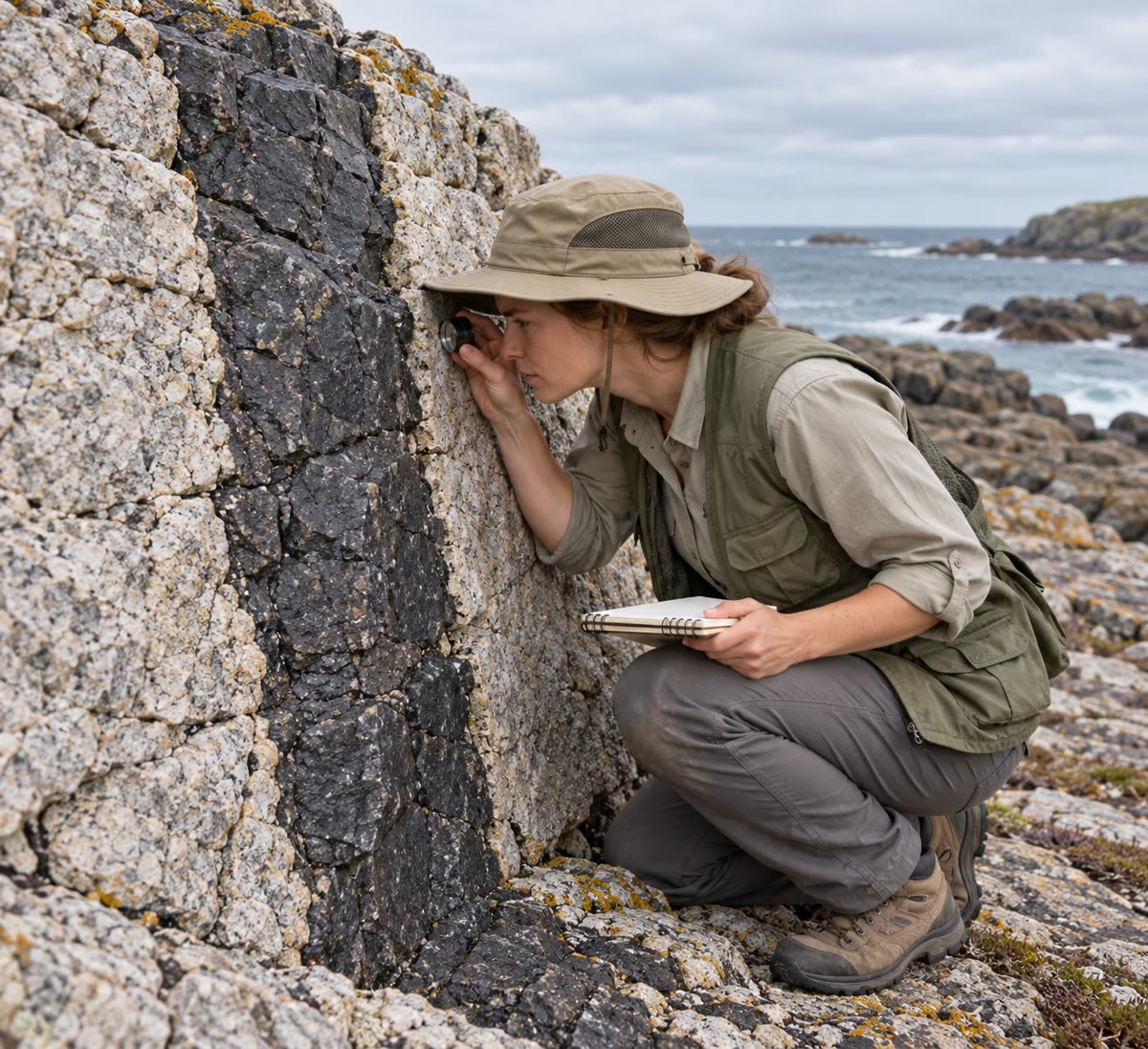
Where a dyke is exposed, a geologist first follows its contacts with the host rock. A margin finer-grained or glassier than the centre of the dyke shows that the magma was chilled against cold rock; a dyke wide studied on the coast of British Columbia has chilled margins thick. The host rock is examined next to the contact for baking: a change of colour, a hardening, new minerals that fade away from the dyke. The width of the baked zone and of the chilled margin, measured against the width of the dyke, indicates how hot the host was when the dyke arrived; a dyke with no chilled margin and no aureole was intruded into rocks that were already hot. Samples are taken across the dyke, from margin to centre, for the geochemistry of its melt and for the size of its crystals.
5.7 Exercises
Exercise 5.1 ★
For hydrous granitic melts, an equation fitted to measurements gives , with in , the water content in weight per cent and in kelvins. Compute at for and , and the factor by which the three extra per cent of water reduce the viscosity.
Solution
Solution of Exercise 5.1.
. For , : . For , : , , , and . The viscosity falls by .
Exercise 5.2 ★
With the square-root law, for a rhyolite and for a basalt (weight per cent per ), compute the saturation pressure of a rhyolite with of water and of a basalt with , and the corresponding depths in a crust of density ().
Solution
Solution of Exercise 5.2.
Rhyolite: , at a depth of . Basalt: , at . The rhyolite starts to form bubbles deep in the crust, the basalt only near the surface (if it carries no CO).
Exercise 5.3 ★
Compute the contact temperature of a basaltic dyke at intruded into rocks at , then into rocks at . Which of the two dykes will have the wider chilled margin?
Solution
Solution of Exercise 5.3.
and . The dyke in the cold rock is chilled more strongly at its contact, and has the wider chilled margin.
Exercise 5.4 ★
Name each body. (a) A sheet of dolerite thick lying between two beds of sandstone over . (b) A vertical sheet of basalt wide cutting horizontal limestones. (c) A granite exposed over , made of a dozen units of different ages. (d) A lens of porphyry across, flat at its base, above which the beds are arched up. (e) A horizontal sheet of basalt in a granite.
Solution
Solution of Exercise 5.4.
(a) A sill, parallel to the bedding. (b) A dyke, cutting across the bedding. (c) A batholith, more than and assembled from many intrusions. (d) A laccolith, which has domed its roof. (e) A dyke: granite has no layering, so any sheet in it is a dyke, whatever its orientation.
Exercise 5.5 ★★
A basaltic melt has . With the Einstein–Roscoe relation (), compute the viscosity of the magma with , , and of crystals, and compare the first with Einstein’s dilute formula. At what crystal fraction does the relation predict jamming?
Solution
Solution of Exercise 5.5.
: for , , so , against , , with Einstein’s formula (close, as it should be in the dilute limit). For : , ; for : , ; for : , about . Jamming at .
Exercise 5.6 ★★
Magma of density less than its walls rises through a dyke. (a) For a basalt (, ) in a dyke wide, compute the mean velocity, the flux per metre of dyke, the Reynolds number and the time to rise . (b) Same time for a rhyolite of in a dyke wide, then wide. (c) A dyke wide loses its heat in a time of order , with : which of the three ascents can succeed?
Solution
Solution of Exercise 5.6.
. (a) ; ; , laminar; , about . (b) , days; with , is a hundred times larger, , and days. (c) The dyke cools in about , 2.9 days; the dyke in , 289 days. The basalt () and the rhyolite in the wide dyke (4.7 days) arrive before their dykes freeze; the rhyolite in the dyke (472 days) cannot.
Exercise 5.7 ★★
A magma of density at releases of its mass as water vapour. Treating the vapour as an ideal gas (, ), compute the volume fraction of gas in the magma at , and . Which of the three values is the least reliable, and why?
Solution
Solution of Exercise 5.7.
Per kilogram of magma, of water and ; the remaining melt occupies . At : , fraction . At : , fraction . At : , fraction . The value at is the least reliable: water vapour at such pressure is dense and far from ideal (and much of the water would in fact still be dissolved).
Exercise 5.8 ★★
In a basin, the density of the rocks increases with depth as (, in ) down to . (a) Where is the level of neutral buoyancy of a basaltic melt of ? (b) The density model of this chapter shows that one per cent of dissolved water lowers the density of a basaltic melt by about . Where does a melt with one more per cent of water stop? (c) What is the buoyancy force per cubic metre of the dry melt below its level of neutral buoyancy?
Solution
Solution of Exercise 5.8.
(a) gives . (b) The melt has : , about higher. (c) At the rock has ; the force is per cubic metre, upward.
Exercise 5.9 ★★
Suppose a granitic diapir of radius and density deficit rises through lower crust of viscosity . Compute its Stokes velocity (rigid sphere) in millimetres per year and the time to rise . Compare with the time scale of its cooling, with . What do you conclude?
Solution
Solution of Exercise 5.9.
, or a year, . Rising takes . The cooling time scale is : the body solidifies after rising about . A magmatic diapir cannot cross such a crust; it needs hotter, softer surroundings.
Exercise 5.10 ★★★
Water dissolves in a melt both as molecules, , and as hydroxyl groups, (the oxygen of the melt in large excess), so that the total dissolved water is . (a) Express as a function of and show that it behaves as at low and as at high . (b) At what fugacity are the two forms of water equally abundant? (c) With and , compute that fugacity, and the share of water dissolved as hydroxyl at .
Solution
Solution of Exercise 5.10.
(a) , so . The ratio of the first term to the second is : it tends to zero when (the square root dominates) and grows without bound with (the linear term dominates). (b) gives , so . (c) . At : , , so and the hydroxyl share is .
Exercise 5.11 ★★★
A granite pluton of is assembled over . (a) Compute its mean magma supply in per year and in per second. (b) A single dyke long and wide, with a mean velocity of , feeds it: how long would the dyke take to deliver the whole pluton? What fraction of the is that? (c) If the pluton is built of sheets thick and by wide, how many sheets are needed, and how much time separates two of them on average? (d) With and , how long does a sheet take to solidify? Is the pluton ever a single large body of magma?
Solution
Solution of Exercise 5.11.
(a) a year, that is a year, or , about eight litres a second. (b) The dyke carries , and delivers in , about 20 years: of the . (c) Each sheet holds , so 500 sheets, one every years on average. (d) , 2.7 years. Each sheet solidifies thousands of years before the next arrives: unless the supply comes in rapid bursts, the pluton is never one large body of magma, as the dating of large plutons suggests.
Exercise 5.12 ★★★
Far from a thin dyke of width (at distances ), its heat acts as an instantaneous plane source: . (a) Show that at distance the temperature is highest at , and that this highest rise is . (b) For a dyke wide with , at what distance does the rock warm by at most , and when ()? (c) Why are the aureoles of thin dykes so narrow?
Solution
Solution of Exercise 5.12.
(a) At fixed , , whose derivative vanishes at . Then and , so . (b) : , reached after , about 230 days (at only 2.7 dyke widths the plane-source approximation is rough). (c) The heating falls off as : a thin dyke carries little heat, and the rock is warmed appreciably only within a few dyke widths.
5.8 Problem: The sill under the plateau
Problem 5.1
Weekend problem — following a basaltic magma from its feeder dyke to a sill, its water, and the time the sill takes to solidify
Beneath an imaginary plateau, sediments (shale and sandstone) of mean density rest at depth on a crystalline basement of density . A basaltic magma rose from through a dyke wide and spread along the base of the sediments as a dolerite sill thick. Data: intrusion temperature ; melt viscosity law ( in kelvins); melt density with its water ; of crystals by volume (Einstein–Roscoe, ); dissolved water , solubility per cent per ; temperature of the host at the sill ; , , latent heat , the magma being treated as solidifying at its intrusion temperature; ; one year is .
Part I — The magma.
- Compute and of the melt at ().
- Same at . By what factor does the viscosity change over these ?
- Compute the viscosity of the magma with its crystals at .
- At what crystal fraction would the Einstein–Roscoe relation make the magma jam? Compare with the field estimate of the end of bulk flow.
- Compute the density difference between the magma and the basement, and between the magma and the sediments.
- Compute the lithostatic pressure at the level of the sill.
Part II — Up the dyke.
- Compute the buoyant pressure gradient that drives the magma through the basement.
- Compute the mean velocity of the magma in the dyke.
- Compute the flux per metre of dyke, and the total flux if the dyke is long.
- Compute the Reynolds number of the flow. Is it laminar?
- How long does the magma take to rise from to ?
- Compare with the time scale over which the dyke loses its heat. Can it stay open?
- Explain why the magma stopped at and spread sideways, using the chapter’s vocabulary.
Part III — The water.
- Compute the saturation pressure of the melt’s water, and the depth in the sediments where it is reached.
- How much water could the melt hold at the level of the sill? Does the sill magma exsolve water?
- Vesicles in the chilled margin of the sill contain mostly CO. Explain.
- If all of water came out at the surface, at and , what volume fraction of the magma would the vapour occupy (ideal gas)?
Part IV — Cooling and solidification.
- Ignoring latent heat, compute the contact temperature of the sill.
- Ignoring latent heat, compute the temperature above the top contact years after the intrusion.
- Same model: compute the temperature at the middle of the sill after years and years.
- Same model: above the top contact, compute the temperature after , and years. Does the rock there ever reach ?
- Compute for the sill.
- Evaluate for , and (, , ), and give to two decimals.
- With latent heat, compute the contact temperature while the sill solidifies. Why is it higher than in question 18?
- Compute the time scale in years.
- Compute the time the sill takes to solidify, in years, the key number of this problem, and explain why it is shorter than the time scale of the last question even though latent heat must be removed.
Solution
Solution of Problem 5.1.
1. ; .
2. , : a factor of for .
3. .
4. . The field evidence places the end of bulk flow at a melt fraction of , that is of crystals: earlier, because real crystals are not spheres of one size.
5. Basement: , the magma is lighter. Sediments: , the magma is denser.
6. .
7. .
8. .
9. ; over , about .
10. : laminar.
11. , about .
12. , 16.5 days, far longer than : the dyke stays open while the magma flows.
13. At the magma meets sediments lighter than itself: the base of the sediments is its level of neutral buoyancy. Above it the magma would be denser than its surroundings, so it spreads sideways along the contact as a sill.
14. , reached at below the surface.
15. , far more than the present: the sill magma exsolves no water.
16. CO is much less soluble than water: it saturates and forms bubbles deep in the ascent, so the first gas of a basalt is mostly CO.
17. Per kilogram, , ; the melt occupies ; the fraction is , .
18. .
19. After 10 years, . The point is at from the middle: .
20. At the middle, : after 10 years , ; after 50 years, , , .
21. At : after 300 years, after 363 years (the maximum), after 420 years. Without latent heat, the rock above the sill never quite reaches .
22. .
23. : ; : ; : . The value lies between and , close to : .
24. . The latent heat released at the solidification front keeps the magma side at longer, so the contact receives more heat.
25. , 113 years.
26. , so : the sill is solid after years. It is shorter than by the factor : that time scale only sets the order of magnitude, and both walls of the sill draw heat into a cold host at once, fast enough to remove the latent heat as well.