全部书籍

专业

应用 关于 Coach 登录 开始阅读

书籍暂未推出简体中文版——当前显示英文版。

Earth and Space Sciences · 术语表

什么是 Model resolution matrix?

Definition 1.13 University Earth and Space Sciences — Year 3 · 第 1 章 — Seismology and Earth Imaging

For a linear estimate mε=Hεd\mathbf m_\varepsilon = \mathsf H_\varepsilon \mathbf d of the model m\mathbf m from data d=Gm+e\mathbf d = \mathsf G\mathbf m + \mathbf e, the model resolution matrix is R=HεG\mathsf R = \mathsf H_\varepsilon\mathsf G, so that

mε=R m+Hεe.\mathbf m_\varepsilon = \mathsf R\,\mathbf m + \mathsf H_\varepsilon\mathbf e .

For damped least squares, R=(N+ε2I)−1N\mathsf R = (\mathsf N + \varepsilon^2\mathsf I)^{-1} \mathsf N. Row jj of R\mathsf R shows how the estimate of parameter jj averages the true parameters; R=I\mathsf R = \mathsf I means perfect resolution.

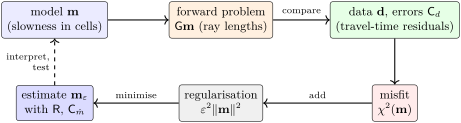
The linear inverse problem as a loop (schematic). The forward problem predicts data from a model; the misfit, weighted by the data errors, measures the disagreement; the regularisation term keeps the model small; minimising their sum gives the estimate, which is only interpretable together with its resolution matrix and covariance.
在原文中阅读 →