全部书籍

专业

应用 关于 Coach 登录 开始阅读

书籍暂未推出简体中文版——当前显示英文版。

Earth and Space Sciences · 术语表

什么是 Nappe?

Definition 20.6 High School Earth and Space Sciences · 第 20 章 — Building Mountains

A nappe is a large sheet of rock that has been carried a long distance, often tens of kilometres, over the rocks beneath it along a thrust that is nearly flat.
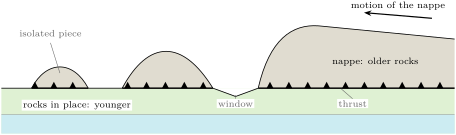
A nappe (not to scale): a sheet of older rocks carried along a nearly flat thrust over younger rocks that have stayed in place. Erosion has cut a window through it and left an isolated piece of it on the left. The teeth on the thrust point toward the block that moved over.
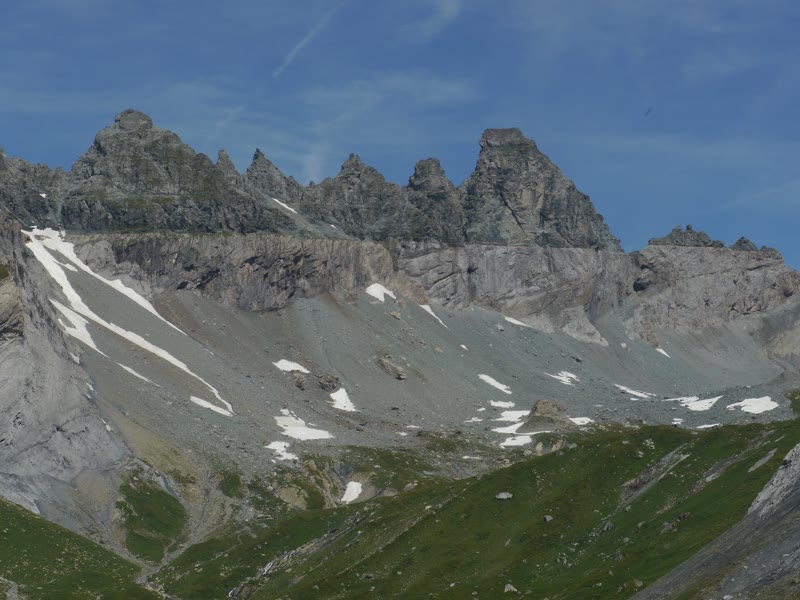
The Glarus Thrust in the Alps of eastern Switzerland. The dark rocks of the peaks, laid down in the Permian, between about 299 and 252 million years ago, rest on lighter and much younger rocks; the thrust is the sharp boundary between them. The upper rocks have moved some 40 to 50\, km. Photograph Christian Heine (CC BY-SA 3.0).
The Glarus Thrust in the Alps of eastern Switzerland. The dark rocks of the peaks, laid down in the Permian, between about 299 and 252 million years ago, rest on lighter and much younger rocks; the thrust is the sharp boundary between them. The upper rocks have moved some 40 to 50 km50\,\mathrm{km}. Photograph Christian Heine (CC BY-SA 3.0).
在原文中阅读 →
