সব বই

পেশাদার

1 Markets I: The Ecosystem and Exchange-Traded Marketsবাজার অনলাইন 2 Markets II: Rates, FX and Creditবাজার অনলাইন 3 Markets III: Commodities, Energy and Cryptoবাজার অনলাইন 4 Quantitative Methodsপদ্ধতি অনলাইন 5 Derivatives and Volatilityডেরিভেটিভস অনলাইন 6 Rates, Credit, XVA and Riskসুদহার, ঋণ ও ঝুঁকি অনলাইন 7 Research Craft: Predictors, Backtests, Measurement, Portfoliosগবেষণা অনলাইন 8 Strategies I: Equities and Futuresকৌশল অনলাইন 9 Strategies II: Volatility, Relative Value, Macro and the Bank Desksকৌশল অনলাইন 10 Microstructure and Executionএক্সিকিউশন অনলাইন 11 Market Making and High-Frequency Tradingমার্কেট মেকিং অনলাইন 12 Machine Learning for Marketsমেশিন লার্নিং অনলাইন 13 Low-Latency Softwareপ্রযুক্তি অনলাইন 14 Networks, Hardware and Trading Infrastructureপ্রযুক্তি অনলাইন 15 Research, Data and Risk Platformsপ্রযুক্তি অনলাইন 16 The Desk and the Firmপ্রতিষ্ঠান অনলাইন 17 The Industry: Firms, Roles and Careersক্যারিয়ার অনলাইন 18 Interviews I: Maths, Probability and Speedক্যারিয়ার অনলাইন 19 Interviews II: Markets, Trading Games and the Final Roundক্যারিয়ার অনলাইন 20 Interviews III: Codeক্যারিয়ার অনলাইন
অ্যাপ পরিচিতি Coach সাইন ইন পড়া শুরু করো

বইগুলো এখনো বাংলা ভাষায় পাওয়া যায় না — ইংরেজি সংস্করণ দেখানো হচ্ছে।

Earth and Space Sciences · পরিভাষা

Net radiation; radiative surplus and deficit কী?

অন্য নাম: net radiation · radiative surplus · radiative deficit

Definition 27.6 University Earth and Space Sciences — Year 1 · অধ্যায় 27 — Radiation and Heat Transport

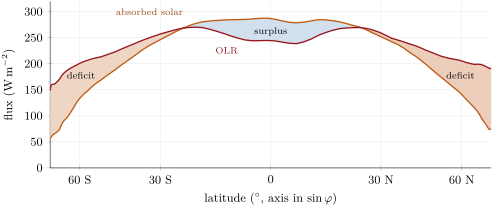
The net radiation at the top of the atmosphere is

R=(1−α) Qˉ⏟absorbed solar−OLR,R = \underbrace{(1 - \alpha)\,\bar Q}_{\text{absorbed solar}} - \text{OLR},

where α\alpha is the local albedo, the fraction of the incoming sunlight reflected to space; all three quantities are annual means at one latitude. A latitude where R>0R > 0 has a radiative surplus; one where R<0R < 0 has a radiative deficit.

Zonal and annual mean absorbed solar radiation (orange) and outgoing longwave radiation (red) at the top of the atmosphere, from the NCEP-NCAR Reanalysis 1, means 1991–2020 (data provided by the NOAA PSL, Boulder, Colorado, USA, from their website at https://psl.noaa.gov). Shaded: the radiative surplus of the low latitudes and the deficits of the high latitudes.

উদাহরণ

Example 27.7 (The reanalysis’s global budget)

Averaged over the globe, the reanalysis receives 341.9 W m−2341.9\,\mathrm{W}\,\mathrm{m}^{-2}, reflects 117.0 W m−2117.0\,\mathrm{W}\,\mathrm{m}^{-2} (an albedo of 0.3420.342), absorbs 224.8 W m−2224.8\,\mathrm{W}\,\mathrm{m}^{-2} and emits 237.7 W m−2237.7\,\mathrm{W}\,\mathrm{m}^{-2}: a net radiation of −12.9 W m−2-12.9\,\mathrm{W}\,\mathrm{m}^{-2}. The OLR is within 1.3 W m−21.3\,\mathrm{W}\,\mathrm{m}^{-2} of the assessed 239 W m−2239\,\mathrm{W}\,\mathrm{m}^{-2}, but the reflection is 17 W m−217\,\mathrm{W}\,\mathrm{m}^{-2} larger than the assessed 100 W m−2100\,\mathrm{W}\,\mathrm{m}^{-2}. A real imbalance of this size would cool the Earth by 6.6 PW6.6\,\mathrm{PW}; it is an error of the model, not a property of the Earth, and the transport below is computed after removing the global mean.

প্রসঙ্গসহ পড়ো →