
All books

Professional

Apps About Coach Log in Start reading

Earth and Space Sciences · Glossary

What is Open and closed carbonate systems?

Also known as: open carbonate system · closed carbonate system

Definition 15.3 University Earth and Space Sciences — Year 3 · Chapter 15 — Water–Rock Interaction

A water dissolves calcite in an open carbonate system when it stays in contact with a gas of fixed PCOX2P_{\ce{CO2}}, which replaces the carbon dioxide used. It does so in a closed carbonate system when it was charged with carbon dioxide first and then isolated from the gas, so that the carbon dioxide it holds is all it can use.
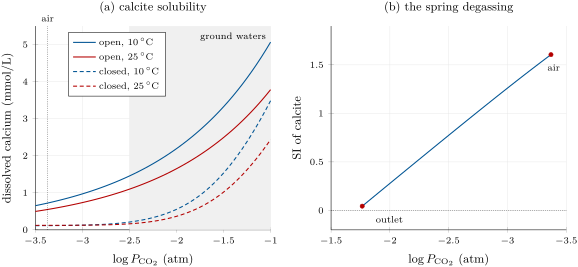
(a) Calcium dissolved by water in equilibrium with calcite, against the partial pressure of carbon dioxide (for the closed system, the pressure the water was charged at): open system solid, closed system dashed; cold water dissolves more; the grey band is the range of ground waters. (b) The spring below the Varden limestone, at 10\, C, losing carbon dioxide on its way down the hill (read from left to right, on a reversed axis) before any calcite forms: its calcium and alkalinity are fixed, its pH rises from 7.2 to 8.8, and its saturation index from 0.04 to 1.6. Equilibrium constants from a public database, extended Debye–Hückel activity coefficients.
(a) Calcium dissolved by water in equilibrium with calcite, against the partial pressure of carbon dioxide (for the closed system, the pressure the water was charged at): open system solid, closed system dashed; cold water dissolves more; the grey band is the range of ground waters. (b) The spring below the Varden limestone, at 10 ∘C10\,{}^{\circ}\mathrm{C}, losing carbon dioxide on its way down the hill (read from left to right, on a reversed axis) before any calcite forms: its calcium and alkalinity are fixed, its pH rises from 7.2 to 8.8, and its saturation index from 0.04 to 1.6. Equilibrium constants from a public database, extended Debye–Hückel activity coefficients.
Read in context →