
সব বই

পেশাদার

1 Markets I: The Ecosystem and Exchange-Traded Marketsবাজার অনলাইন 2 Markets II: Rates, FX and Creditবাজার অনলাইন 3 Markets III: Commodities, Energy and Cryptoবাজার অনলাইন 4 Quantitative Methodsপদ্ধতি অনলাইন 5 Derivatives and Volatilityডেরিভেটিভস অনলাইন 6 Rates, Credit, XVA and Riskসুদহার, ঋণ ও ঝুঁকি অনলাইন 7 Research Craft: Predictors, Backtests, Measurement, Portfoliosগবেষণা অনলাইন 8 Strategies I: Equities and Futuresকৌশল অনলাইন 9 Strategies II: Volatility, Relative Value, Macro and the Bank Desksকৌশল অনলাইন 10 Microstructure and Executionএক্সিকিউশন অনলাইন 11 Market Making and High-Frequency Tradingমার্কেট মেকিং অনলাইন 12 Machine Learning for Marketsমেশিন লার্নিং অনলাইন 13 Low-Latency Softwareপ্রযুক্তি অনলাইন 14 Networks, Hardware and Trading Infrastructureপ্রযুক্তি অনলাইন 15 Research, Data and Risk Platformsপ্রযুক্তি অনলাইন 16 The Desk and the Firmপ্রতিষ্ঠান অনলাইন 17 The Industry: Firms, Roles and Careersক্যারিয়ার অনলাইন 18 Interviews I: Maths, Probability and Speedক্যারিয়ার অনলাইন 19 Interviews II: Markets, Trading Games and the Final Roundক্যারিয়ার অনলাইন 20 Interviews III: Codeক্যারিয়ার অনলাইন
অ্যাপ পরিচিতি Coach সাইন ইন পড়া শুরু করো

বইগুলো এখনো বাংলা ভাষায় পাওয়া যায় না — ইংরেজি সংস্করণ দেখানো হচ্ছে।

Earth and Space Sciences · পরিভাষা

Open and closed carbonate systems কী?

অন্য নাম: open carbonate system · closed carbonate system

Definition 15.3 University Earth and Space Sciences — Year 3 · অধ্যায় 15 — Water–Rock Interaction

A water dissolves calcite in an open carbonate system when it stays in contact with a gas of fixed PCOX2P_{\ce{CO2}}, which replaces the carbon dioxide used. It does so in a closed carbonate system when it was charged with carbon dioxide first and then isolated from the gas, so that the carbon dioxide it holds is all it can use.
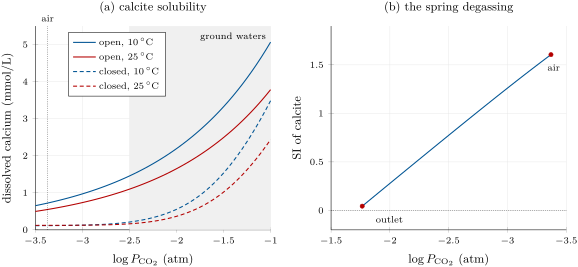
(a) Calcium dissolved by water in equilibrium with calcite, against the partial pressure of carbon dioxide (for the closed system, the pressure the water was charged at): open system solid, closed system dashed; cold water dissolves more; the grey band is the range of ground waters. (b) The spring below the Varden limestone, at 10\, C, losing carbon dioxide on its way down the hill (read from left to right, on a reversed axis) before any calcite forms: its calcium and alkalinity are fixed, its pH rises from 7.2 to 8.8, and its saturation index from 0.04 to 1.6. Equilibrium constants from a public database, extended Debye–Hückel activity coefficients.
(a) Calcium dissolved by water in equilibrium with calcite, against the partial pressure of carbon dioxide (for the closed system, the pressure the water was charged at): open system solid, closed system dashed; cold water dissolves more; the grey band is the range of ground waters. (b) The spring below the Varden limestone, at 10 ∘C10\,{}^{\circ}\mathrm{C}, losing carbon dioxide on its way down the hill (read from left to right, on a reversed axis) before any calcite forms: its calcium and alkalinity are fixed, its pH rises from 7.2 to 8.8, and its saturation index from 0.04 to 1.6. Equilibrium constants from a public database, extended Debye–Hückel activity coefficients.
প্রসঙ্গসহ পড়ো →