
全部书籍

专业

应用 关于 Coach 登录 开始阅读

书籍暂未推出简体中文版——当前显示英文版。

Earth and Space Sciences · 术语表

什么是 Radiative–convective equilibrium?

又称: radiative--convective equilibrium

Definition 27.1 University Earth and Space Sciences — Year 3 · 第 27 章 — Planetary Atmospheres and Habitability

A column of atmosphere is in radiative–convective equilibrium when, at every level, the net flux of radiation is balanced, except in a lower layer where convection carries heat upwards and holds the temperature gradient at the adiabatic one. The lower, convective layer is the troposphere; the upper layer, in radiative equilibrium, the stratosphere; the tropopause is the level where they meet.
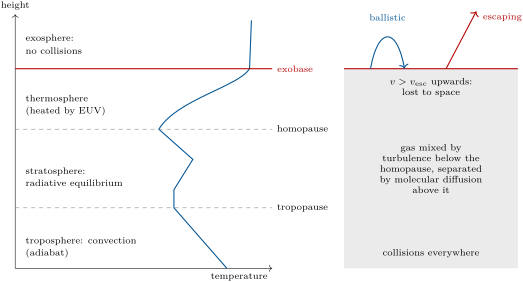
The layers of a planetary atmosphere (schematic, not to scale). Left: a temperature profile like the Earth’s, with the troposphere held at the adiabat by convection, a stratosphere in radiative equilibrium, and a thermosphere heated from above by extreme-ultraviolet sunlight. Right: above the exobase a particle meets nothing; one moving upwards faster than the escape velocity leaves the planet, a slower one falls back on a ballistic arc.
在原文中阅读 →