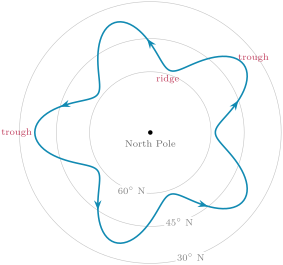
A Rossby wave is a wave of the westerly flow of the upper troposphere, a series of troughs and ridges thousands of kilometres long with a large north–south amplitude. An upper-level trough is an elongated region of relatively low pressure in such a wave, where the flow bends towards the equator; an upper-level ridge is an elongated region of relatively high pressure, where it bends towards the pole.
示例
Example 22.6 (Three waves at 45° N)
With Ω=7.292×10⁻⁵s−1 (a sidereal day of 23.9345h) and a=6371km, β=1.62×10⁻¹¹m−1s−1 at 45∘ N. In a westerly of 15m/s, a wave of 4000km has β/k2=6.6m/s and moves east at 8.4m/s; one of 6000km has β/k2=14.8m/s and barely moves, at 0.2m/s; one of 8000km moves west at 11.2m/s.
 Coach