
All books

Professional

Apps About Coach Log in Start reading

Earth and Space Sciences · Glossary

What is Seismic refraction and reflection surveys?

Also known as: seismic refraction survey · seismic reflection survey

Definition 2.1 University Earth and Space Sciences — Year 3 · Chapter 2 — Exploration Seismology

A seismic refraction survey records, along a line of receivers, the first arrivals from a controlled source, and uses the head waves that travel along the top of faster layers to find their speeds and depths. A seismic reflection survey records the whole wave train, at offsets mostly smaller than the depths of interest, and uses the waves reflected at near-normal incidence by the interfaces to image the layering.
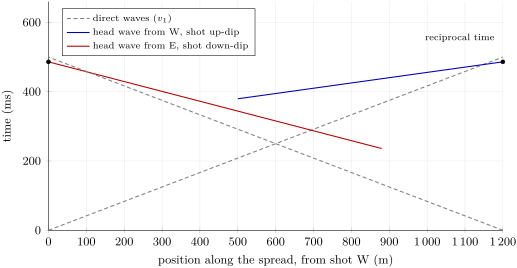
A reversed refraction profile on the west limb of the Varden anticline (computed; problem, Part I). The refractor, the top of the limestone, rises from W to E at 10.8 under a 1200\, m spread; the chalk and shale above are lumped into one layer of 2.40\, km\, s-1. The head wave shot up-dip from W appears fast (6.57\, km\, s-1), the one shot down-dip from E slow (3.52\, km\, s-1); both take 486.1\, ms to cross the whole spread. The head waves overtake the direct waves only near the far end: the refractor is deep for so short a spread.
A reversed refraction profile on the west limb of the Varden anticline (computed; problem, Part I). The refractor, the top of the limestone, rises from W to E at 10.8∘10.8{}^{\circ} under a 1200 m1200\,\mathrm{m} spread; the chalk and shale above are lumped into one layer of 2.40 km s−12.40\,\mathrm{km}\,\mathrm{s}^{-1}. The head wave shot up-dip from W appears fast (6.57 km s−16.57\,\mathrm{km}\,\mathrm{s}^{-1}), the one shot down-dip from E slow (3.52 km s−13.52\,\mathrm{km}\,\mathrm{s}^{-1}); both take 486.1 ms486.1\,\mathrm{ms} to cross the whole spread. The head waves overtake the direct waves only near the far end: the refractor is deep for so short a spread.
Read in context →