
সব বই

পেশাদার

1 Markets I: The Ecosystem and Exchange-Traded Marketsবাজার অনলাইন 2 Markets II: Rates, FX and Creditবাজার অনলাইন 3 Markets III: Commodities, Energy and Cryptoবাজার অনলাইন 4 Quantitative Methodsপদ্ধতি অনলাইন 5 Derivatives and Volatilityডেরিভেটিভস অনলাইন 6 Rates, Credit, XVA and Riskসুদহার, ঋণ ও ঝুঁকি অনলাইন 7 Research Craft: Predictors, Backtests, Measurement, Portfoliosগবেষণা অনলাইন 8 Strategies I: Equities and Futuresকৌশল অনলাইন 9 Strategies II: Volatility, Relative Value, Macro and the Bank Desksকৌশল অনলাইন 10 Microstructure and Executionএক্সিকিউশন অনলাইন 11 Market Making and High-Frequency Tradingমার্কেট মেকিং অনলাইন 12 Machine Learning for Marketsমেশিন লার্নিং অনলাইন 13 Low-Latency Softwareপ্রযুক্তি অনলাইন 14 Networks, Hardware and Trading Infrastructureপ্রযুক্তি অনলাইন 15 Research, Data and Risk Platformsপ্রযুক্তি অনলাইন 16 The Desk and the Firmপ্রতিষ্ঠান অনলাইন 17 The Industry: Firms, Roles and Careersক্যারিয়ার অনলাইন 18 Interviews I: Maths, Probability and Speedক্যারিয়ার অনলাইন 19 Interviews II: Markets, Trading Games and the Final Roundক্যারিয়ার অনলাইন 20 Interviews III: Codeক্যারিয়ার অনলাইন
অ্যাপ পরিচিতি Coach সাইন ইন পড়া শুরু করো

বইগুলো এখনো বাংলা ভাষায় পাওয়া যায় না — ইংরেজি সংস্করণ দেখানো হচ্ছে।

Earth and Space Sciences · পরিভাষা

Seismic refraction and reflection surveys কী?

অন্য নাম: seismic refraction survey · seismic reflection survey

Definition 2.1 University Earth and Space Sciences — Year 3 · অধ্যায় 2 — Exploration Seismology

A seismic refraction survey records, along a line of receivers, the first arrivals from a controlled source, and uses the head waves that travel along the top of faster layers to find their speeds and depths. A seismic reflection survey records the whole wave train, at offsets mostly smaller than the depths of interest, and uses the waves reflected at near-normal incidence by the interfaces to image the layering.
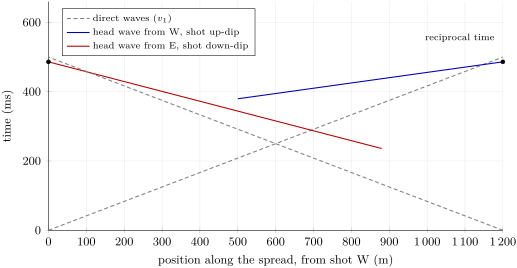
A reversed refraction profile on the west limb of the Varden anticline (computed; problem, Part I). The refractor, the top of the limestone, rises from W to E at 10.8 under a 1200\, m spread; the chalk and shale above are lumped into one layer of 2.40\, km\, s-1. The head wave shot up-dip from W appears fast (6.57\, km\, s-1), the one shot down-dip from E slow (3.52\, km\, s-1); both take 486.1\, ms to cross the whole spread. The head waves overtake the direct waves only near the far end: the refractor is deep for so short a spread.
A reversed refraction profile on the west limb of the Varden anticline (computed; problem, Part I). The refractor, the top of the limestone, rises from W to E at 10.8∘10.8{}^{\circ} under a 1200 m1200\,\mathrm{m} spread; the chalk and shale above are lumped into one layer of 2.40 km s−12.40\,\mathrm{km}\,\mathrm{s}^{-1}. The head wave shot up-dip from W appears fast (6.57 km s−16.57\,\mathrm{km}\,\mathrm{s}^{-1}), the one shot down-dip from E slow (3.52 km s−13.52\,\mathrm{km}\,\mathrm{s}^{-1}); both take 486.1 ms486.1\,\mathrm{ms} to cross the whole spread. The head waves overtake the direct waves only near the far end: the refractor is deep for so short a spread.
প্রসঙ্গসহ পড়ো →