全部书籍

专业

应用 关于 Coach 登录 开始阅读

书籍暂未推出简体中文版——当前显示英文版。

Earth and Space Sciences · 术语表

什么是 Solar abundance; dex?

又称: solar abundance · dex

Definition 30.1 University Earth and Space Sciences — Year 3 · 第 30 章 — Where the Elements Come From

The solar abundance of an element XX is the number of its atoms relative to those of hydrogen in the Sun, written on a logarithmic scale on which hydrogen is set at 1212:

log⁡ε(X)=12+log⁡10NXNH.\log\varepsilon(X) = 12 + \log_{10}\frac{N_X}{N_\mathrm{H}} .

A difference of one unit in such a logarithm is called a dex: two abundances that differ by 0.30.3 dex differ by a factor 100.3≈210^{0.3} \approx 2. For a star, the abundance relative to the Sun is written with brackets, [X/H]=log⁡10(NX/NH)⋆−log⁡10(NX/NH)⊙[X/\mathrm{H}] = \log_{10}(N_X/N_\mathrm{H})_\star - \log_{10}(N_X/N_\mathrm{H})_\odot, and likewise [X/Y][X/Y] for any two elements.

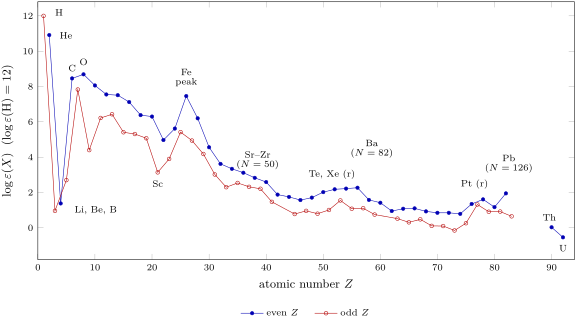
The abundances of the elements in the Sun, on a logarithmic scale with hydrogen at 12: photospheric values, or those of the CI chondrites for the elements that have no measurable photospheric line (Asplund, Amarsi and Grevesse, 2021). Even and odd atomic numbers are drawn as two lines. Technetium (Z = 43) and promethium (Z = 61) have no long-lived isotope, nor have the elements between bismuth and thorium.
The abundances of the elements in the Sun, on a logarithmic scale with hydrogen at 12: photospheric values, or those of the CI chondrites for the elements that have no measurable photospheric line (Asplund, Amarsi and Grevesse, 2021). Even and odd atomic numbers are drawn as two lines. Technetium (Z=43Z = 43) and promethium (Z=61Z = 61) have no long-lived isotope, nor have the elements between bismuth and thorium.
在原文中阅读 →