
All books

Professional

Apps About Coach Log in Start reading

Earth and Space Sciences · Glossary

What is Stacking (seismic)?

Definition 2.15 University Earth and Space Sciences — Year 3 · Chapter 2 — Exploration Seismology

Stacking (seismic) is the summation, after the normal-moveout correction, of the traces of a CMP gather into a single trace placed at the midpoint. The stacked traces, side by side along the line, form the stacked section, an image of the reflectors in two-way time.
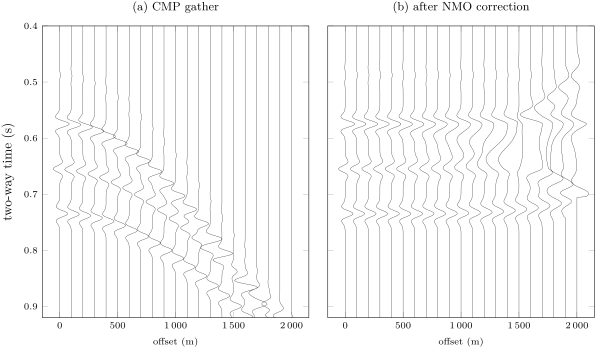
A synthetic CMP gather beneath the syncline axis of the Varden line (computed by exact ray tracing through the flat-layered column; 30 Hz Ricker wavelet; no noise). (a) The four reflections (top of the shale, top and base of the limestone, top of the basement) curve down with offset along near-hyperbolae. (b) After the NMO correction with the stacking velocities fitted on the offsets up to 600\, m, the reflections are flat out to about 1\, km; beyond, the true times depart from the hyperbola and the correction leaves them bent, and the wavelets are stretched; in processing, the stretched far traces of the shallow reflections are muted before the stack.
A synthetic CMP gather beneath the syncline axis of the Varden line (computed by exact ray tracing through the flat-layered column; 30 Hz Ricker wavelet; no noise). (a) The four reflections (top of the shale, top and base of the limestone, top of the basement) curve down with offset along near-hyperbolae. (b) After the NMO correction with the stacking velocities fitted on the offsets up to 600 m600\,\mathrm{m}, the reflections are flat out to about 1 km1\,\mathrm{km}; beyond, the true times depart from the hyperbola and the correction leaves them bent, and the wavelets are stretched; in processing, the stretched far traces of the shallow reflections are muted before the stack.
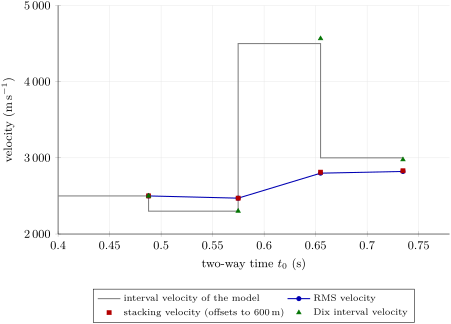
Velocities beneath the syncline axis (computed). The RMS velocity, a weighted mean, changes slowly; the stacking velocities of the gather lie close to it. Applied to them, the Dix equation recovers the interval velocity of each layer (the step line, drawn at the base of each layer) to within a few per cent, the error growing in the thin, fast limestone.
Read in context →