
全部书籍

专业

应用 关于 Coach 登录 开始阅读

书籍暂未推出简体中文版——当前显示英文版。

Earth and Space Sciences · 术语表

什么是 Synthetic-aperture radar; radar backscatter?

又称: synthetic-aperture radar · radar backscatter

Definition 25.9 University Earth and Space Sciences — Year 3 · 第 25 章 — Remote Sensing and GIS

A synthetic-aperture radar (SAR) is a radar carried along a track that looks sideways, and that combines the echoes it records from the same point of the ground along a length of its track, keeping their phases, as if they had been received by one antenna as long as that length. The radar backscatter of a surface is the fraction of the power it receives that it sends back towards the antenna.
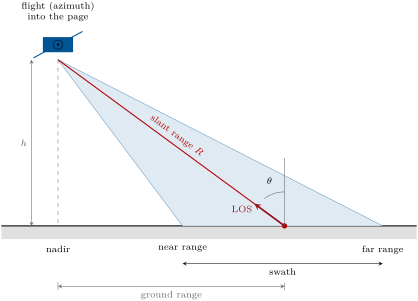
The geometry of a side-looking radar, in the plane perpendicular to its track. The beam lights a swath to one side of the nadir; a point of the ground is seen at the slant range R under the incidence angle , along the line of sight (LOS). Echoes are sorted by their delay across the track, in range, and by the phase history of the synthetic aperture along it, in azimuth.
The geometry of a side-looking radar, in the plane perpendicular to its track. The beam lights a swath to one side of the nadir; a point of the ground is seen at the slant range RR under the incidence angle θ\theta, along the line of sight (LOS). Echoes are sorted by their delay across the track, in range, and by the phase history of the synthetic aperture along it, in azimuth.
在原文中阅读 →