
সব বই

পেশাদার

1 Markets I: The Ecosystem and Exchange-Traded Marketsবাজার অনলাইন 2 Markets II: Rates, FX and Creditবাজার অনলাইন 3 Markets III: Commodities, Energy and Cryptoবাজার অনলাইন 4 Quantitative Methodsপদ্ধতি অনলাইন 5 Derivatives and Volatilityডেরিভেটিভস অনলাইন 6 Rates, Credit, XVA and Riskসুদহার, ঋণ ও ঝুঁকি অনলাইন 7 Research Craft: Predictors, Backtests, Measurement, Portfoliosগবেষণা অনলাইন 8 Strategies I: Equities and Futuresকৌশল অনলাইন 9 Strategies II: Volatility, Relative Value, Macro and the Bank Desksকৌশল অনলাইন 10 Microstructure and Executionএক্সিকিউশন অনলাইন 11 Market Making and High-Frequency Tradingমার্কেট মেকিং অনলাইন 12 Machine Learning for Marketsমেশিন লার্নিং অনলাইন 13 Low-Latency Softwareপ্রযুক্তি অনলাইন 14 Networks, Hardware and Trading Infrastructureপ্রযুক্তি অনলাইন 15 Research, Data and Risk Platformsপ্রযুক্তি অনলাইন 16 The Desk and the Firmপ্রতিষ্ঠান অনলাইন 17 The Industry: Firms, Roles and Careersক্যারিয়ার অনলাইন 18 Interviews I: Maths, Probability and Speedক্যারিয়ার অনলাইন 19 Interviews II: Markets, Trading Games and the Final Roundক্যারিয়ার অনলাইন 20 Interviews III: Codeক্যারিয়ার অনলাইন
অ্যাপ পরিচিতি Coach সাইন ইন পড়া শুরু করো

বইগুলো এখনো বাংলা ভাষায় পাওয়া যায় না — ইংরেজি সংস্করণ দেখানো হচ্ছে।

Earth and Space Sciences · পরিভাষা

Total-field anomaly; diurnal correction; reduction to the pole কী?

অন্য নাম: total-field anomaly · diurnal correction · reduction to the pole

Definition 31.7 University Earth and Space Sciences — Year 3 · অধ্যায় 31 — Field and Lab Methods III

Let F\mathbf{F} be the main field at the survey and ΔB\Delta\mathbf{B} the field of the magnetised rocks.

  • The total-field anomaly is the measured intensity minus that of the main field, ΔT=∣F+ΔB∣−∣F∣\Delta T = |\mathbf{F} + \Delta\mathbf{B}| - |\mathbf{F}|; when ∣ΔB∣≪∣F∣|\Delta\mathbf{B}| \ll |\mathbf{F}| it is the projection ΔB⋅F/∣F∣\Delta\mathbf{B}\cdot\mathbf{F}/|\mathbf{F}|.
  • The diurnal correction removes the variations of the field with time: a magnetometer at a fixed base station records the field throughout the survey, and each reading T(t)T(t) of the moving instrument is replaced by T(t)−Tbase(t)T(t) - T_\mathrm{base}(t).
  • The reduction to the pole computes, from the measured anomaly, the anomaly the same rocks would give if the main field were vertical, as at a magnetic pole; the anomaly then sits above its source.
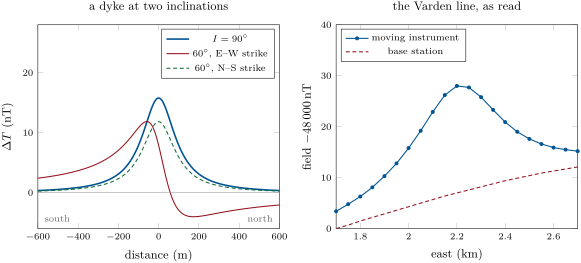
Left: the total-field anomaly of a vertical dyke 20\, m thick, its top 100\, m deep, susceptibility 0.01, in a field of 50\,000\, nT; on profiles across an east–west strike at inclinations of 90 and 60, and across a north–south strike at 60. Right: the readings along the Varden magnetic line, one station every 50\, m and every two minutes from west to east, and the base station at the same times (plotted at the position the moving instrument then had): the daytime rise of the field is half the size of the anomaly.
Left: the total-field anomaly of a vertical dyke 20 m20\,\mathrm{m} thick, its top 100 m100\,\mathrm{m} deep, susceptibility 0.010.01, in a field of 50 000 nT50\,000\,\mathrm{nT}; on profiles across an east–west strike at inclinations of 90∘90{}^{\circ} and 60∘60{}^{\circ}, and across a north–south strike at 60∘60{}^{\circ}. Right: the readings along the Varden magnetic line, one station every 50 m50\,\mathrm{m} and every two minutes from west to east, and the base station at the same times (plotted at the position the moving instrument then had): the daytime rise of the field is half the size of the anomaly.
প্রসঙ্গসহ পড়ো →