
全部书籍

专业

应用 关于 Coach 登录 开始阅读

书籍暂未推出简体中文版——当前显示英文版。

Earth and Space Sciences · 术语表

什么是 Tsunami?

Definition 20.10 Primary & Middle School Earth and Space Sciences · 第 20 章 — Earthquakes

A tsunami is a series of sea waves set off by a sudden movement of the sea floor — usually an earthquake under the sea, sometimes an eruption — which can cross whole oceans and flood the coasts.
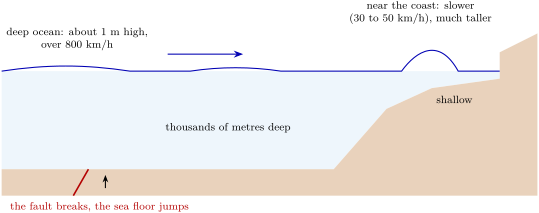
A tsunami crossing the ocean (a drawing, not to scale: the height of the wave is greatly exaggerated). It is low and very fast over the deep ocean; it slows down and grows in shallow water near the coast.

示例

Example 20.11 (From Sumatra to Sri Lanka)

Colombo, the largest city of Sri Lanka, is about 1830 km1830\,\mathrm{km} from the epicentre of the 2004 earthquake. At 800 km/h800\,\mathrm{km}/\mathrm{h}, a tsunami covers this distance in 1830÷800≈2.31830 \div 800 \approx 2.3 hours, that is about 2 hours and 17 minutes. Nobody in Sri Lanka felt the earthquake: the wave came without any warning but the sea itself.

在原文中阅读 →