সব বই

পেশাদার

1 Markets I: The Ecosystem and Exchange-Traded Marketsবাজার অনলাইন 2 Markets II: Rates, FX and Creditবাজার অনলাইন 3 Markets III: Commodities, Energy and Cryptoবাজার অনলাইন 4 Quantitative Methodsপদ্ধতি অনলাইন 5 Derivatives and Volatilityডেরিভেটিভস অনলাইন 6 Rates, Credit, XVA and Riskসুদহার, ঋণ ও ঝুঁকি অনলাইন 7 Research Craft: Predictors, Backtests, Measurement, Portfoliosগবেষণা অনলাইন 8 Strategies I: Equities and Futuresকৌশল অনলাইন 9 Strategies II: Volatility, Relative Value, Macro and the Bank Desksকৌশল অনলাইন 10 Microstructure and Executionএক্সিকিউশন অনলাইন 11 Market Making and High-Frequency Tradingমার্কেট মেকিং অনলাইন 12 Machine Learning for Marketsমেশিন লার্নিং অনলাইন 13 Low-Latency Softwareপ্রযুক্তি অনলাইন 14 Networks, Hardware and Trading Infrastructureপ্রযুক্তি অনলাইন 15 Research, Data and Risk Platformsপ্রযুক্তি অনলাইন 16 The Desk and the Firmপ্রতিষ্ঠান অনলাইন 17 The Industry: Firms, Roles and Careersক্যারিয়ার অনলাইন 18 Interviews I: Maths, Probability and Speedক্যারিয়ার অনলাইন 19 Interviews II: Markets, Trading Games and the Final Roundক্যারিয়ার অনলাইন 20 Interviews III: Codeক্যারিয়ার অনলাইন
অ্যাপ পরিচিতি Coach সাইন ইন পড়া শুরু করো

বইগুলো এখনো বাংলা ভাষায় পাওয়া যায় না — ইংরেজি সংস্করণ দেখানো হচ্ছে।

Earth and Space Sciences · পরিভাষা

Tully–Fisher relation কী?

অন্য নাম: Tully--Fisher relation

Definition 29.18 University Earth and Space Sciences — Year 3 · অধ্যায় 29 — The Milky Way and Galaxies

The Tully–Fisher relation is the correlation between the luminosity, or better the mass of stars and gas, of a spiral galaxy and the speed of its flat rotation curve; in its baryonic form, Mb=A V4M_\mathrm{b} = A\,V^4, it holds from about 30 to 300 km s−1300\,\mathrm{km}\,\mathrm{s}^{-1}.

The rungs of the distance ladder, with the distances over which each is used here: parallaxes of the best catalogue, to 10\,\% out to 4\, kpc; Cepheids and the TRGB from the Large Magellanic Cloud to the hosts of the nearest Type Ia supernovae, 45\, Mpc; the supernovae of the smooth expansion, at redshifts 0.023 to 0.15 (96 to 616\, Mpc for H_0 = 73). Dotted: two anchors of the Cepheid scale with geometric distances (eclipsing binaries in the LMC, water masers orbiting the black hole of NGC 4258), and M31, the nearest large spiral. Arrows: each rung is calibrated on objects that the one below also measures, the Cepheids of the Galaxy by their parallaxes, the supernovae of nearby galaxies by the Cepheids and the TRGB of their hosts.
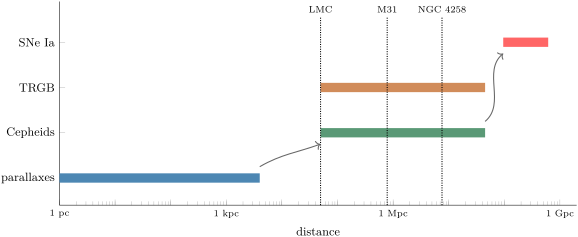
The rungs of the distance ladder, with the distances over which each is used here: parallaxes of the best catalogue, to 10 %10\,\% out to 4 kpc4\,\mathrm{kpc}; Cepheids and the TRGB from the Large Magellanic Cloud to the hosts of the nearest Type Ia supernovae, 45 Mpc45\,\mathrm{Mpc}; the supernovae of the smooth expansion, at redshifts 0.023 to 0.15 (96 to 616 Mpc96\text{ to }616\,\mathrm{Mpc} for H0=73H_0 = 73). Dotted: two anchors of the Cepheid scale with geometric distances (eclipsing binaries in the LMC, water masers orbiting the black hole of NGC 4258), and M31, the nearest large spiral. Arrows: each rung is calibrated on objects that the one below also measures, the Cepheids of the Galaxy by their parallaxes, the supernovae of nearby galaxies by the Cepheids and the TRGB of their hosts.
প্রসঙ্গসহ পড়ো →