 Coach
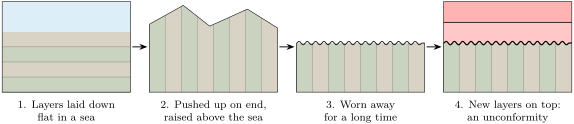
An unconformity is a surface of erosion between two sets of rocks formed at very different times: the older rocks were worn away before the younger ones were laid down on top of them. It marks a long time of which no layer has been kept.
উদাহরণ
Example 22.8 (The history of the Varden Hills)
Apply the method to section E–F.
- The schist is cut by the granite and lies under all the layers: it is the oldest rock.
- The granite cuts the schist (cross-cutting), so it is younger. It cuts none of the layers above: it is older than the sandstone.
- The granite cooled deep underground, yet the base of the sandstone, which lies on the schist, reaches the top of the granite: the rocks that covered them were worn away before the sand came. The base of the sandstone is an unconformity.
- Sandstone, limestone, shale and chalk were laid down in that order (superposition).
- The layers were laid down flat, but now they are folded, arched up over the granite and bent down further east: the folding came after the chalk.
- The fault breaks all the folded layers: it is younger than the folding.
- Today’s ground cuts across everything, and the river sand lies on top of it: erosion and the rivers are the most recent events.
The history, oldest first: the schist; the granite; erosion; the four layers; the folding; the fault; today’s erosion and river sand.