书籍暂未推出简体中文版——当前显示英文版。
Primary & Middle School Earth and Space Sciences · 1–9 年级
22The Ages of the Earth
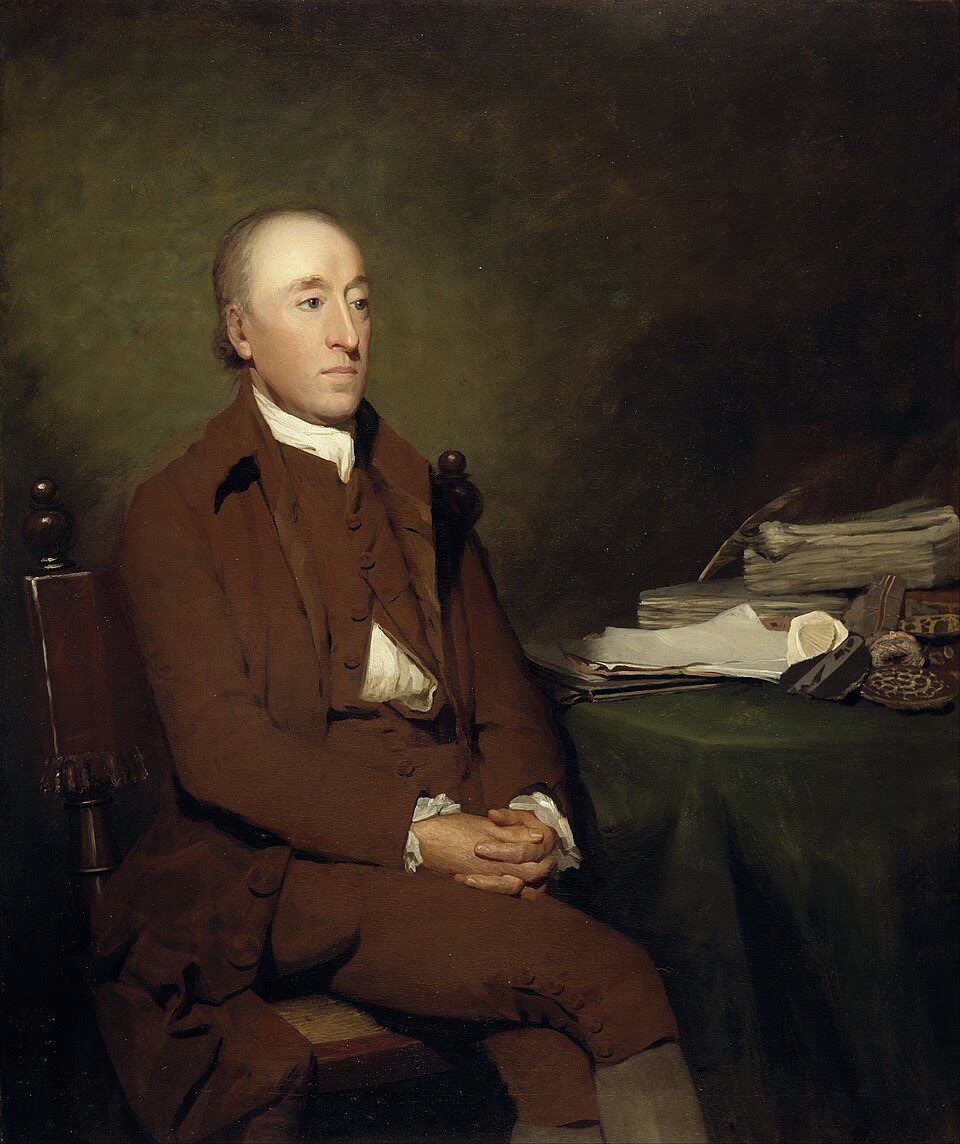
In June 1788, the Scottish geologist James Hutton and two friends, the mathematician John Playfair and the chemist James Hall, visited Siccar Point, a rocky point “washed bare by the sea” on the coast of Scotland. At the bottom of the rock they saw grey layers standing on end, almost vertical. Above them lay layers of red sandstone, gently sloping. Hutton explained what had happened: the grey layers had been laid down flat on the floor of a sea, then pushed up on end, then worn away, before the red sand was laid on top of them. Each of these steps needed an immense time. Playfair wrote later: “The mind seemed to grow giddy by looking so far into the abyss of time.”
How can we tell which rock is older than another, without any date written on it? How old is the Earth? And how can such a long history be pictured at all?
You already know
Sediments settle in layers, one on top of the other, and harden into sedimentary rock; fossils are the remains or traces of living things kept in rock (Chapter 21). A fault is a break in the rocks along which the two sides have moved (Chapter 20). Granite is an igneous rock: it forms when molten rock cools slowly, deep underground; schist is a metamorphic rock, changed by heat and pressure; a conglomerate is a sedimentary rock made of pebbles cemented together (Chapter 15).
22.1 Which came first?
Historians can put events in order even without their dates. The First World War came before the Second: their names say so. Television was not yet in homes when the Wright brothers first flew in 1903, but many people watched the first steps on the Moon on television in 1969: so the flight came first, then television in homes, then the Moon. Gathering clues and comparing them is enough to find the order. For almost all of the Earth’s history there is no written record at all, and geologists work the same way: they use clues kept in the rocks.
Definition 22.1 (Relative dating and absolute age)
Relative dating puts rocks and events in order, from the oldest to the youngest, without saying how many years ago they happened: this rock is older than that one. An absolute age is an age given as a number of years, for example “ million years”.
22.2 Four principles for putting rocks in order
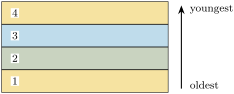
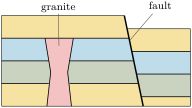
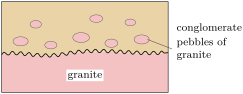
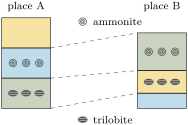
Four simple principles do most of the work of relative dating. They are pictured below, in four imagined cliffs. The first was stated by Nicolas Steno in 1669; Hutton built on it at the end of the eighteenth century.
Definition 22.2 (Principle of superposition)
The principle of superposition: in a pile of sedimentary layers that has not been turned over, each layer is younger than the layer below it and older than the layer above it. The oldest layer is at the bottom, the youngest at the top.
Definition 22.3 (Principle of cross-cutting relationships)
The principle of cross-cutting relationships: a rock or a structure that cuts across other rocks is younger than the rocks it cuts. A mass of granite that cuts through layers, a fault that breaks them and an erosion surface that wears them away are all younger than those layers.
Definition 22.4 (Principle of inclusion)
The principle of inclusion: pieces of one rock found inside another rock are older than the rock that holds them. The pebbles of a conglomerate existed before the conglomerate formed around them.
Definition 22.5 (Principle of fossil succession)
The principle of fossil succession: the kinds of animals and plants found as fossils change from older layers to younger ones, always in the same order. Rocks that hold the same kinds of fossils are of the same age, even when they lie far apart.
The principle of superposition holds only for layers that have not been turned over: in a few places, mountain building has folded a pile of layers so strongly that it lies upside down. Geologists then look for clues that show which way up the layers formed — footprints and ripple marks, for example, are on the top surface of a layer. The principle of fossil succession works because life on Earth has changed through time: most fossils belong to species that no longer live anywhere. Why life changed is told in the biology books.
History — William Smith, the canal builder
Between 1785 and 1800, while Hutton worked in Scotland, William Smith, an English engineer who built canals, collected the fossil shells of the limestones and shales he dug through. He found that each layer held its own fossils, unlike those of the layers above and below. Using these fossils as markers, he could recognise the same layer wherever it appeared, and he drew some of the first geological maps of large areas.
22.3 Gaps in the record
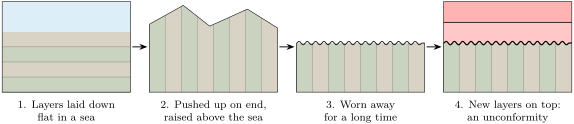
At Siccar Point, the grey layers and the red sandstone did not form one after the other. Between them, the grey layers were tilted and raised, then worn away for a very long time, and no layer from that time was kept. The surface between the two sets of rocks is a gap in the record.
Definition 22.6 (Unconformity)
An unconformity is a surface of erosion between two sets of rocks formed at very different times: the older rocks were worn away before the younger ones were laid down on top of them. It marks a long time of which no layer has been kept.
22.4 Reading the history of a region
A cross-section shows the rocks as they would appear in a cut straight down into the ground. The four principles turn it into a story.
Method 22.7 (Putting the events of a cross-section in order)
- Find the oldest rocks: those that are cut by everything else, or lie at the bottom of the pile.
- Find each rock or structure that cuts others (a granite, a fault, an erosion surface): it is younger than everything it cuts.
- Read the layers from the bottom up (superposition), and look for unconformities, where time is missing.
- Layers are laid down flat: if they are tilted or folded, the folding came after them.
- Write the events in order, from the oldest to the youngest, with the clue for each one.
 schist &
 granite &
 sandstone &
 limestone
 shale &
 chalk &
 river sand &
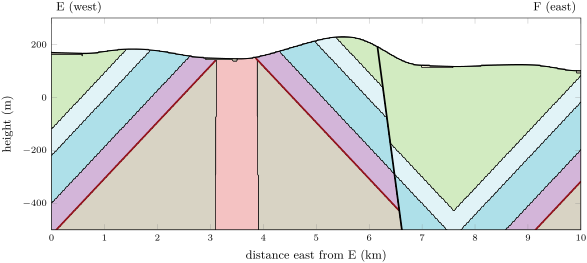
 base of the sandstone Section E–F, from west (E) to east (F) across the middle of the Varden Hills, the invented region of this series, through its granite. The thick black line is the fault. The heights are stretched 5 times compared with the distances, to make the layers easier to see.
Example 22.8 (The history of the Varden Hills)
Apply the method to section E–F.
- The schist is cut by the granite and lies under all the layers: it is the oldest rock.
- The granite cuts the schist (cross-cutting), so it is younger. It cuts none of the layers above: it is older than the sandstone.
- The granite cooled deep underground, yet the base of the sandstone, which lies on the schist, reaches the top of the granite: the rocks that covered them were worn away before the sand came. The base of the sandstone is an unconformity.
- Sandstone, limestone, shale and chalk were laid down in that order (superposition).
- The layers were laid down flat, but now they are folded, arched up over the granite and bent down further east: the folding came after the chalk.
- The fault breaks all the folded layers: it is younger than the folding.
- Today’s ground cuts across everything, and the river sand lies on top of it: erosion and the rivers are the most recent events.
The history, oldest first: the schist; the granite; erosion; the four layers; the folding; the fault; today’s erosion and river sand.
Relative dating gives the order of the events, but not their dates nor how long each one lasted: the method says that the fault is younger than the chalk, not by how many years.
22.5 Eras and periods
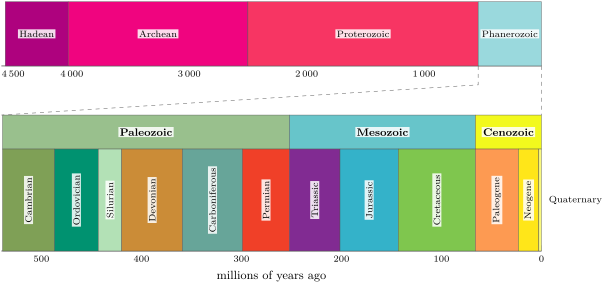
Fossil succession lets geologists match layers all over the world. Joining their observations, they divided the Earth’s history into spans of time, the same way historians speak of centuries and the reigns of kings.
Definition 22.9 (Era and geological period)
An era is a long span of the Earth’s history, set by the general kind of life that existed at that time: the Paleozoic, the Mesozoic and the Cenozoic. Each era is divided into shorter spans, the geological periods, such as the Jurassic or the Cretaceous.
Definition 22.10 (Geological time scale)
The geological time scale is the list of the divisions of the Earth’s history in order — the long spans of its early history, the eras and the geological periods — with the age, in years, of the start of each one. An international chart gives each division its name, its age and its colour.
The three eras are recent compared with the whole history. The Paleozoic began million years ago, when fossils of animals with shells became common; the Mesozoic lasted from to million years ago; the Cenozoic, the era we live in, started million years ago. Before the Paleozoic stretch three long spans, the Hadean, the Archean and the Proterozoic: they cover about 88 % of the Earth’s history, yet their fossils are rare. The dinosaurs lived in the Mesozoic: they dominated for more than million years, and by the end of the Cretaceous all of them were gone.
The Varden Hills fit on this scale. Their sandstone is Triassic, their limestone and shale are Jurassic, their chalk is Cretaceous: all three belong to the Mesozoic. On section E–F, they are drawn in pale versions of the chart’s colours.
22.6 The Earth’s history in one year
Numbers in billions of years are hard to picture. Imagine instead the whole history of the Earth squeezed into one year. The Earth forms on 1 January at midnight; today is the stroke of midnight at the end of 31 December. The Earth is about million years old, so one day of this year stands for , about million years.
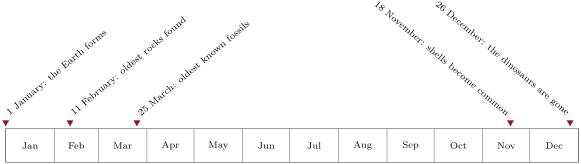
The oldest rocks found so far come in on 11 February; the oldest known fossils on 25 March. For most of the year, there are no animals with shells, and fossils are rare. Animals with shells become common only on 18 November. The dinosaurs, after more than million years of rule, are gone on 26 December, five days before the end of the year. Our own species arrives in the last hour of 31 December: the problem of this chapter finds when.
In the lab — A ribbon of time
Indoors, unroll of paper ribbon or till roll on the floor of a corridor: at for a million years, it holds the whole history of the Earth. Mark the start of the Paleozoic from the end, and the end of the dinosaurs from the end. Then try to mark the whole of human history: our species, about years old, fills the last , thinner than the pencil line.
22.7 Ages in years
Relative dating cannot say how many years ago a rock formed. Absolute ages became possible with the discovery of radioactivity. Some minerals contain radioactive atoms, which change slowly into other atoms at a steady rate, the same at every time and place; measuring how many have changed gives the age of the mineral in years. How radioactivity works is told in the physics books, and how geologists use it is the subject of a later volume.
These measurements gave the Earth its age: about billion years, known to within 1 %. The oldest rocks found so far, in north-western Canada, are billion years old; tiny crystals found in Australia are even older, up to about billion years. The time scale itself joins the two kinds of dating: a rock that can be measured in years, found with layers dated by their fossils, gives an age to the start or end of a geological period.
22.8 Exercises
Exercise 22.1 ★
Match each name with its meaning: superposition; cross-cutting relationships; inclusion; fossil succession; unconformity. (a) A surface of erosion between rocks of very different ages. (b) The pebbles in a rock are older than the rock. (c) The bottom layer of an untouched pile is the oldest. (d) Rocks with the same kinds of fossils are of the same age. (e) A fault is younger than the layers it breaks.
Solution
Solution of Exercise 22.1.
(a) unconformity; (b) inclusion; (c) superposition; (d) fossil succession; (e) cross-cutting relationships.
Exercise 22.2 ★
A cliff shows four flat layers, from the bottom up: a red sandstone, a grey shale, a white limestone and a yellow sandstone. (a) Which layer is the oldest? Which is the youngest? (b) Which principle did you use? (c) What has to be true of the layers for the answer to hold?
Solution
Solution of Exercise 22.2.
(a) The red sandstone, at the bottom, is the oldest; the yellow sandstone, at the top, is the youngest. (b) The principle of superposition. (c) The layers have not been turned over since they formed.
Exercise 22.3 ★
(a) Put the three eras in order, from the oldest: Mesozoic, Cenozoic, Paleozoic. (b) In which era do we live? (c) In which era did the dinosaurs live? (d) Using the time scale, give the geological period that comes right after the Triassic, and the one right before the Paleogene.
Solution
Solution of Exercise 22.3.
(a) Paleozoic, Mesozoic, Cenozoic. (b) The Cenozoic. (c) The Mesozoic. (d) The Jurassic comes right after the Triassic; the Cretaceous comes right before the Paleogene.
Exercise 22.4 ★
True or false? Correct the false sentences. (a) Relative dating gives the age of a rock in years. (b) A fault is younger than the layers it cuts. (c) The pebbles in a conglomerate are younger than the conglomerate. (d) Two layers far apart that hold the same kinds of fossils are of the same age.
Solution
Solution of Exercise 22.4.
(a) False: relative dating only puts rocks in order; an age in years is an absolute age. (b) True. (c) False: the pebbles are older than the conglomerate that holds them (principle of inclusion). (d) True (principle of fossil succession).
Exercise 22.5 ★★
In a cliff, three flat layers (1 at the bottom, then 2 and 3) are cut by a wall of granite. A fourth layer lies on top of layer 3 and over the top of the granite, without being cut. (a) Is the granite older or younger than layer 3? Explain. (b) Is it older or younger than layer 4? (c) Write the five events in order, from the oldest. (d) The granite cooled deep underground. What happened to the top of the granite before layer 4 was laid down?
Solution
Solution of Exercise 22.5.
(a) Younger: it cuts layer 3, and a rock that cuts another is younger (cross-cutting). (b) Older: layer 4 lies over it without being cut. (c) Layer 1, layer 2, layer 3, the granite, layer 4. (d) The rocks above it were worn away by erosion until the granite reached the surface; layer 4 was then laid down on this erosion surface, an unconformity.
Exercise 22.6 ★★
Use the starts of the eras: Paleozoic , Mesozoic , Cenozoic million years ago. (a) How long did the Paleozoic last? (b) How long did the Mesozoic last? (c) How long has the Cenozoic lasted so far? (d) Which era is the longest? Which is the shortest?
Solution
Solution of Exercise 22.6.
(a) million years. (b) million years. (c) 66 million years. (d) The Paleozoic is the longest, the Cenozoic the shortest (so far).
Exercise 22.7 ★★
The Earth is about million years old, and the Paleozoic began million years ago. (a) How many million years passed before the Paleozoic began? (b) What percentage of the Earth’s history is that? Round to the nearest whole number. (c) Explain why most of the fossils found by geologists come from the last three eras.
Solution
Solution of Exercise 22.7.
(a) million years. (b) : about 88 %. (c) Before the Paleozoic, animals with shells were not yet common, and soft living things almost never become fossils; shells and bones, which fossilise well, are common only from the Paleozoic on.
Exercise 22.8 ★★
The whole history of the Earth, million years, is drawn along a running track long: the start line is the formation of the Earth, the finish line is today. (a) How many million years does each metre stand for? (b) The Paleozoic began million years ago. How many metres before the finish line is it? (c) The dinosaurs were gone million years ago. How far before the finish line? (d) Our species appeared about years ago. Give the distance in centimetres. Could a runner see it?
Solution
Solution of Exercise 22.8.
(a) million years per metre. (b) : about before the finish line. (c) : about . (d) m, that is about , less than one centimetre: a runner would hardly notice it.
Exercise 22.9 ★★
At Siccar Point, the grey layers standing on end formed in the Silurian; the red sandstone above them formed in the Devonian. (a) Using the time scale, which period came first? Does this agree with superposition? (b) Put these events in order: the red sand is laid down; the grey layers are laid down flat; the grey layers are worn away; the grey layers are pushed up on end. (c) Why is the surface between the two rocks called an unconformity?
Solution
Solution of Exercise 22.9.
(a) The Silurian came first. Yes: the older rock lies below the younger one. (b) The grey layers are laid down flat; they are pushed up on end; they are worn away; the red sand is laid down on top. (c) It is a surface of erosion between rocks of very different ages: the long time during which the grey layers were raised and worn away left no layer behind.
Exercise 22.10 ★★
Two cliffs lie apart. Cliff A shows, from the bottom up: a sandstone with trilobites, a shale with ammonites, a limestone with sea urchins. Cliff B shows, from the bottom up: a shale with ammonites, a limestone with sea urchins, a clay with leaves. (a) Which layers of the two cliffs are of the same age? Which principle do you use? (b) Which layer is the oldest of all? Which is the youngest? (c) Draw a single column with all the layers of the two cliffs, in order.
Solution
Solution of Exercise 22.10.
(a) The two shales with ammonites are of the same age, and so are the two limestones with sea urchins: same fossils, same age (principle of fossil succession). (b) The oldest is the sandstone with trilobites of cliff A (it lies below the shale with ammonites, which is as old as the bottom layer of cliff B). The youngest is the clay with leaves of cliff B. (c) From the bottom up: sandstone with trilobites; shale with ammonites; limestone with sea urchins; clay with leaves.
Exercise 22.11 ★★★
A cross-section shows: at the bottom, a schist; on it, separated by a wavy erosion surface, a conglomerate whose pebbles are pieces of schist; above it, a sandstone, then a limestone, all three tilted; a fault that breaks the schist, the conglomerate, the sandstone and the limestone; and on top, flat layers of clay that cover the tilted layers and the fault without being broken. (a) What is older, the schist or the conglomerate? Give two clues. (b) Was the tilting before or after the sandstone was laid down? (c) Was the fault before or after the clay? (d) Write the whole history in order, from the oldest event. (e) How many unconformities are there? Where?
Solution
Solution of Exercise 22.11.
(a) The schist. It lies below the conglomerate (superposition), and the pebbles of the conglomerate are pieces of schist (inclusion); the erosion surface also cuts the schist. (b) After: the sandstone was laid down flat, so it was tilted later. (c) Before: the clay covers the fault without being broken. (d) The schist forms; it is worn away (wavy surface); the conglomerate, the sandstone and the limestone are laid down, in that order; the layers are tilted, and the fault breaks them — the section alone does not say which of these two came first; the tilted layers and the fault are worn flat; the clay is laid down on top. (e) Two: the wavy surface between the schist and the conglomerate, and the surface between the tilted layers and the flat clay.
Exercise 22.12 ★★★
Use the Earth’s year ( million years in 365 days). (a) On which day is the Earth’s history half over? Give the date and the time. (b) How old, in millions of years, is a rock that formed on that date? (c) A year has seconds. A person lives for 80 years. How many seconds of the Earth’s year does that life last? Use , and round to one decimal.
Solution
Solution of Exercise 22.12.
(a) Half of 365 days is 182.5 days. January to June make days, so the history is half over 1.5 days into July: on 2 July at noon. (b) million years. (c) : about 0.6 second.
22.9 Problem: The Earth’s year
Problem 22.1
Weekend problem — the history of the Earth is squeezed into one calendar year, its great events are placed on their dates, and the last minutes of 31 December are searched for our species
The Earth is about million years old. Its whole history is squeezed into one year of 365 days, from 1 January at midnight to 31 December at midnight, which stands for today.
Part I — Scaling time.
- Write billion years in millions of years.
- How many millions of years does one day of the Earth’s year stand for? Round to one decimal.
- How many years does one hour stand for? Round to the nearest thousand years.
- A year has minutes. How many years does one minute stand for? Round to the nearest hundred years.
Part II — Placing events.
- The oldest rocks found so far are million years old. How many million years after the Earth formed did they form? How many days of the Earth’s year is that, roughly? Give the date.
- The oldest known fossils are about million years old. Find their date in the same way.
- The dinosaurs were gone million years ago. How many days before the end of the year is that? Give the date.
- The Paleozoic began million years ago. What percentage of the year is left after it begins? In which month does it begin?
Part III — The last minutes.
- Using question 4, how many minutes stand for years? Round to one decimal.
- Suppose writing was invented about years ago. How many seconds before midnight on 31 December does it appear?
- Our species, Homo sapiens, appeared about years ago. How many minutes before midnight is that? Round to the nearest minute.
- At what time on 31 December does our species appear?
Solution
Solution of Problem 22.1.
1. million years.
2. million years.
3. years (with the rounded million, ).
4. : about years.
5. million years after the Earth formed; days. January has 31 days, so 41 days have passed at the start of 11 February.
6. million years; days (83.6 with the unrounded ). January and February make 59 days: 24.6 to 24.9 days into March, on 25 March.
7. days before the end of the year, that is days after 1 January. The first eleven months make 334 days: 25.7 days into December, on 26 December.
8. : 11.9 % of the year is left, that is days. days after 1 January: it begins in November (on 18 November).
9. minutes.
10. minute, and : about 35 seconds before midnight.
11. : about 35 minutes before midnight.
12. 35 minutes before midnight on 31 December: our species appears at about 23:25, in the last hour of the year.