
Physics · Glossary

What is Absorption, spontaneous and stimulated emission?

Also known as: absorption (of light) · spontaneous emission · stimulated emission · Einstein coefficients

Definition 23.1 University Physics — Year 2 · Chapter 23 — The Laser: Stimulated Emission and Gaussian Beams

Consider atoms with two energy levels E1<E2E_1 < E_2, populations (number densities) N1N_1, N2N_2, and light of frequency ν\nu with hν=E2E1h\nu = E_2 - E_1 and spectral energy density u(ν)u(\nu) (energy per unit volume per unit frequency). Three processes exchange energy:

  • absorption: an atom in E1E_1 absorbs a photon and rises to E2E_2, at the rate B12u(ν)N1B_{12}\,u(\nu)\,N_1 per unit volume and time;
  • spontaneous emission: an atom in E2E_2 falls to E1E_1 on its own, emitting a photon in a random direction with a random phase, at the rate A21N2A_{21}N_21/A21=τ1/A_{21} = \tau is the lifetime of the level;
  • stimulated emission: a photon of frequency ν\nu passing an atom in E2E_2 induces it to fall, emitting a second photon identical to the first (same frequency, direction, phase and polarization), at the rate B21u(ν)N2B_{21}\,u(\nu)\,N_2.

A21A_{21}, B12B_{12}, B21B_{21} are the Einstein coefficients of the transition.
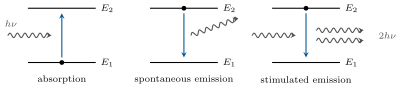
The three processes between two levels: absorption takes a photon away; spontaneous emission adds a photon of random phase and direction; stimulated emission adds a photon identical to the incident one — a copy.
Read in context →