University Physics — Year 2 · Bachelor Year 2
23The Laser: Stimulated Emission and Gaussian Beams
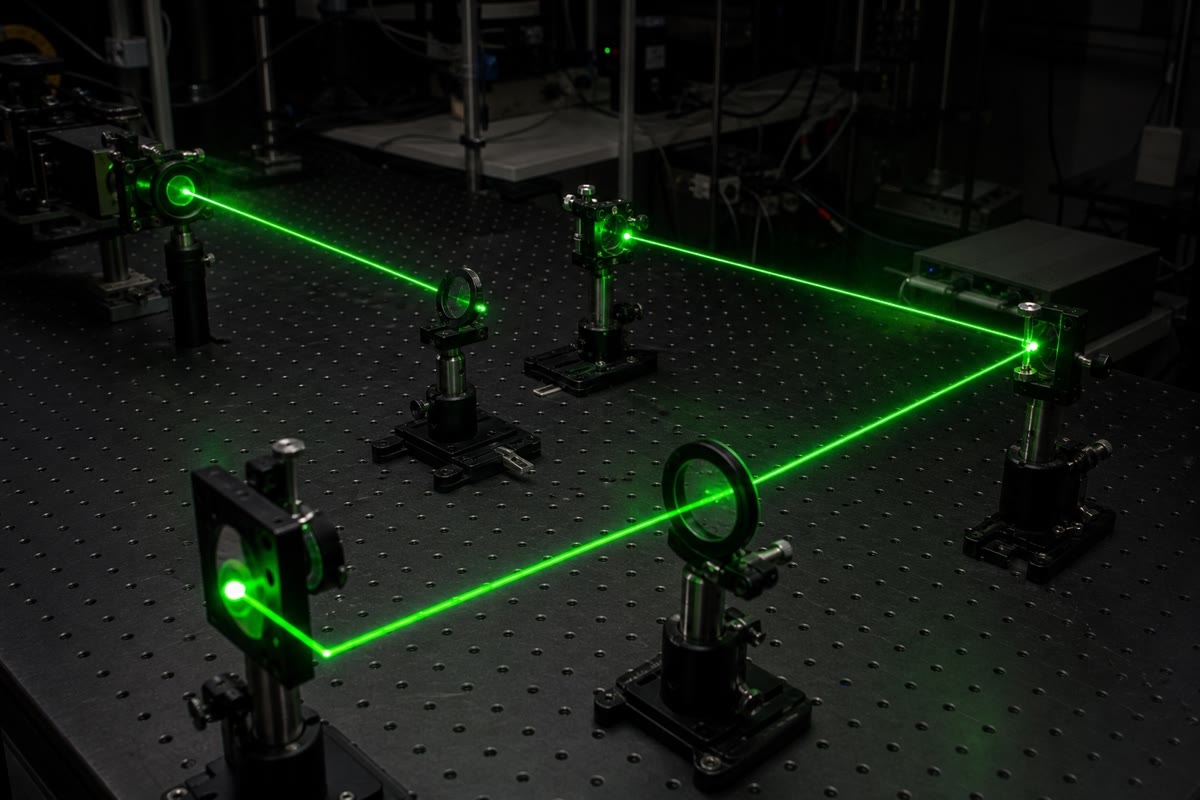
A red dot on a lecture screen, the bar-code reader at the checkout, the beam that reads a disc, welds a car body, carries the internet under the oceans, corrects a cornea and measures the distance to the Moon to a millimetre: every one of these is a laser, a source of light unlike any flame or lamp. Its light is a single colour to a part in a billion, stays in a beam of millimetres over a room, and can be focused to a spot a few wavelengths wide, where its irradiance exceeds that of the Sun’s surface a million times. None of this comes from a new kind of atom: it comes from a process Einstein identified in 1917 — stimulated emission, the emission of a photon identical to one already present — and from arranging matter so that this process wins over absorption, then placing the amplifier between two mirrors so that it feeds itself. This chapter builds the laser in three steps: how light and a population of atoms exchange energy (the Einstein coefficients), when the exchange amplifies (population inversion and gain), and when the amplifier becomes an oscillator (the cavity, its threshold and its modes). It ends with the shape of the beam that comes out, the Gaussian beam, whose waist and divergence decide what a laser can do at a distance and at a focus.
23.1 Light and matter: the three processes
Definition 23.1 (Absorption, spontaneous and stimulated emission)
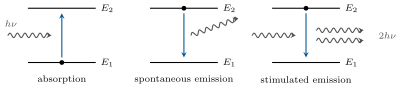
Consider atoms with two energy levels , populations (number densities) , , and light of frequency with and spectral energy density (energy per unit volume per unit frequency). Three processes exchange energy:
- absorption: an atom in absorbs a photon and rises to , at the rate per unit volume and time;
- spontaneous emission: an atom in falls to on its own, emitting a photon in a random direction with a random phase, at the rate — is the lifetime of the level;
- stimulated emission: a photon of frequency passing an atom in induces it to fall, emitting a second photon identical to the first (same frequency, direction, phase and polarization), at the rate .
, , are the Einstein coefficients of the transition.
Proposition 23.2 (Einstein relations)
For non-degenerate levels,
Stimulated emission and absorption have the same coefficient; the spontaneous rate grows as relative to the stimulated rate.
Proof. Put the atoms in equilibrium with radiation at temperature . Two facts are borrowed from later chapters: the populations of two levels at equilibrium are in the ratio (the Boltzmann factor, Chapter 29), and the equilibrium radiation has the Planck spectral density (Chapter 26). At equilibrium the level populations are steady: , hence
This must equal Planck’s expression at every : the limit (where ) forces , and the comparison then gives . The coefficients are properties of the atom, so the relations hold out of equilibrium too. ∎
Remark 23.3 (Why lamps do not amplify)
In a gas at , for a visible transition (, ), : essentially no atom is excited, and light is only absorbed. A discharge or a flame populates , but still with , and every emitted photon is outnumbered by absorptions; moreover the ratio of spontaneous to stimulated emission at equilibrium, , is astronomically large in the visible — a lamp’s light is spontaneous: random phases, all directions, the full width of the line. Only at radio and microwave frequencies () does stimulated emission compete naturally; the first device of this kind was indeed the maser, at (1954), before the optical laser (1960).
23.2 Amplification: population inversion and gain
Proposition 23.4 (Gain of a medium)
A beam of intensity at the frequency crossing the medium gains energy by stimulated emission and loses it by absorption (spontaneous emission goes in all directions and hardly contributes to the beam). Over a length ,
where (an area, the cross-section of the transition, ) measures the strength of the transition. The medium amplifies () only if
a population inversion. Without it (, the case of every medium at equilibrium) the beam is absorbed.
Proof. Per unit volume and time, transitions add (or remove) a photon to the beam; with (per unit frequency, over the width of the line), the power gained per unit volume is , and this is ; define (times the line-shape factor). ∎
Remark 23.5 (Why two levels cannot be inverted)
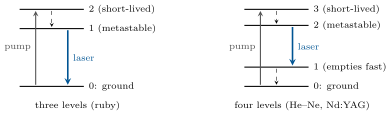
Pump a two-level system as hard as you like with light at : the pump absorbs when and stimulates emission when , and the populations tend at best to equality, , where the medium is transparent but gains nothing. An inversion needs at least three levels: pump from the ground level to a short-lived level that decays quickly into the upper laser level, which is long-lived (metastable) and therefore stores population. In a three-level scheme (ruby, the first laser) the lower laser level is the ground state, so more than half the atoms must be lifted before inversion: the pump is brutal. In a four-level scheme (He–Ne, Nd:YAG, most lasers) the lower laser level is an excited level that empties quickly to the ground state; it is nearly empty at all times, and a small population in the upper level is already an inversion — the threshold is low.
Proposition 23.6 (Saturation of the gain)
The inversion is maintained by a pump that supplies atoms to the upper level at the rate per unit volume, against the decay and the stimulated emission . In a four-level medium () the steady state is
the small-signal gain is reduced by the beam itself once approaches the saturation intensity — the amplifier is nonlinear, and this nonlinearity is what will fix the power of the laser.
Proof. . ∎
23.3 The oscillator: cavity, threshold and modes
Definition 23.7 (Laser cavity)
A laser is an amplifying medium of length placed between two mirrors (reflectances , ) a distance apart: a Fabry–Pérot cavity (Chapter 21). One mirror, the output coupler, is partly transmitting ( of a few per cent) and lets the beam out. Light that goes round the cavity is amplified twice by the medium and attenuated by the mirrors and by the other losses (scattering, absorption, diffraction).
Theorem 23.8 (Oscillation condition)
A wave of complex amplitude reproduces itself after one round trip if
(: the other losses per unit length). Hence two conditions.
Amplitude: , i.e. the gain must reach the threshold
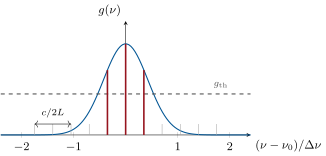
- Phase: , i.e. — the laser oscillates only on the longitudinal modes of the cavity, spaced by , and among them only on those lying under the gain curve where .
Proof. Amplitude and phase of the round-trip factor must both be trivial; the approximation uses for . ∎
Proposition 23.9 (Steady state above threshold)
Starting from the spontaneous emission of a single atom, any mode for which grows exponentially, round trip after round trip; as its intensity grows, the gain saturates (Proposition 23.6) until it equals exactly the losses:
The gain clamps to the threshold value; every additional atom pumped above threshold becomes an output photon, so the output power grows linearly with the pump above the threshold pump.
Remark 23.10 (The laser is a feedback oscillator)
Compare with the Wien-bridge oscillator of Chapter 9: an amplifier (the inverted medium), a frequency-selective feedback (the cavity, passing only its modes), a start-up condition (loop gain , i.e. ), start-up from noise (here spontaneous emission), and an amplitude fixed by the nonlinearity of the amplifier (gain saturation). The laser is the optical member of the family.
Example 23.11 (The helium–neon laser)
A glass tube long, bore , holding helium and neon at about a thousandth of an atmosphere, crossed by a discharge of a few milliamperes. Electrons excite helium to a metastable level at , which hands its energy by collision to a neon level at almost exactly the same height; from there neon decays to a lower level (emptying fast to the ground state — four-level) by emitting at . The small-signal gain is tiny, a few per cent per pass, so the mirrors must be excellent (, ) and the tube clean; the gain line is Doppler-broadened to , the modes are apart, so two or three modes oscillate at once. Output for several watts of discharge: efficiency ; but a wavelength defined to and a beam that stays wide across the laboratory.
23.4 The Gaussian beam
Proposition 23.12 (Gaussian beam)
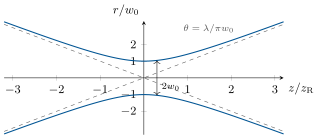
The beam that a stable cavity with curved mirrors emits is (in the fundamental transverse mode) a Gaussian beam: at the distance from its narrowest section (the waist, radius ) the intensity profile is
where is the total power and the Rayleigh length: over the beam stays within of its waist, and far beyond it spreads with the half-angle
The beam is a solution of the wave equation in the paraxial approximation; we admit its form and use it. Its wavefronts are plane at the waist and spherical far away.
Proof. Admitted at this level (the calculation is the Fourier-optics propagation of a Gaussian aperture distribution); its key property is the one diffraction already gave in Chapter 22: an aperture of size spreads over , here with the exact factor . ∎
Proposition 23.13 (Focusing and expanding a beam)
A Gaussian beam of radius (much larger than its far-field would have at the lens, i.e. nearly collimated) falling on a lens of focal length is focused to a waist
at the focus, with Rayleigh length . The peak irradiance there is . Conversely an afocal telescope of magnification turns a beam of radius into one of radius whose divergence is times smaller: to send a beam far, first make it wide.
Proof. The lens converts the plane wavefront into a sphere converging at ; the diffraction of an aperture of radius gives the angular spread , hence the focal spot — consistent with read backwards. ∎
Example 23.14 (Cutting, reading, pointing)
A carbon-dioxide laser at , beam radius , focused by : , peak irradiance — steel boils. A pointer, at : , a spot at , an irradiance of at the exit — above sunlight, which is why even a milliwatt must never enter an eye: the eye’s lens would focus it to a spot on the retina at millions of watts per square metre. A disc reader at with a lens of numerical aperture focuses to about , the size of a pit.
Remark 23.15 (What makes laser light special)
Directivity: one transverse mode, divergence at the diffraction limit. Monochromaticity: one or a few cavity modes, each narrower than a megahertz — coherence lengths of metres to kilometres (Chapter 18). Spatial coherence: the whole beam is one wave, so it interferes with itself anywhere (holography, interferometry). Brightness: a milliwatt in a diffraction-limited beam outshines the Sun per unit solid angle and bandwidth. Power in pulses: a joule in a nanosecond is a gigawatt, in a femtosecond a petawatt. And, since the beam is an oscillator’s output, it can be modulated at gigahertz — the carrier of the optical fibre (Chapter 16).
Method 23.16 (Laser estimates)
(1) Photon energy and the photon rate . (2) Threshold: ; compare with the small-signal gain of the medium. (3) Modes: against the gain width; count the oscillating modes. (4) Power: gain clamps at threshold; output (pump threshold pump). (5) Beam: , , focal spot , peak irradiance . (6) Safety: compare the retinal irradiance with the Sun’s.
23.5 Exercises
Exercise 23.1 ★
A He–Ne laser emits at . Frequency, photon energy in joules and electronvolts, photons per second. Cavity : mode spacing; how many modes fit under a gain curve wide?
Solution
Solution of Exercise 23.1.
; ; photons per second; ; three modes.
Exercise 23.2 ★
Two levels apart at : ratio (use ). At what temperature would the populations be equal? Show that an inversion corresponds to a formally negative temperature in the Boltzmann ratio. Same ratio for a microwave transition at .
Solution
Solution of Exercise 23.2.
; equality only as ; requires , i.e. formally. At , : .
Exercise 23.3 ★
Gaussian beam, , : Rayleigh length, divergence, radius after and at the Moon (). Same beam after a expander.
Solution
Solution of Exercise 23.3.
; ; ; at the Moon . After : , , , at , at the Moon.
Exercise 23.4 ★
Cavity with , , medium long, other losses per pass. Threshold gain coefficient. The medium’s small-signal gain is : does it lase? With ?
Solution
Solution of Exercise 23.4.
: it lases. With : : it does not.
Exercise 23.5 ★★
Einstein relations. (a) Write the balance of a two-level population in equilibrium with radiation and derive the two relations from Planck’s law (given). (b) Compute at for and for . (c) Why were masers invented before lasers? (d) A level’s lifetime is ; if at , what is for a transition of the same at ?
Solution
Solution of Exercise 23.5.
(a) See Proposition 23.2. (b) : , ratio ; : — stimulated emission dominates. (c) At microwave frequencies spontaneous emission is negligible and a small inversion already gives gain; the technology (cavities, wave guides) existed. (d) , so : .
Exercise 23.6 ★★
Saturation and output power. Four-level medium, , , . (a) Saturation intensity. (b) Pump rate for a small-signal gain . (c) The cavity’s threshold is : intracavity intensity in steady state; output through from a beam of area . (d) Show that the output power is linear in above threshold.
Solution
Solution of Exercise 23.6.
(a) . (b) . (c) ; . (d) : linear in above .
Exercise 23.7 ★★
Modes and stability. (a) Cavity length for single-mode operation under a gain curve. (b) A cavity expands by : shift of a mode’s frequency, compared with the mode spacing and the gain width. (c) Why do commercial stabilised He–Ne lasers lock the tube length by heating it? (d) The mode’s own width is a few kilohertz: coherence length?
Solution
Solution of Exercise 23.7.
(a) : . (b) : three mode spacings, the whole gain width — the mode sweeps across the gain curve and hands over to its neighbour. (c) A heater holds the length to a small fraction of , using the balance of two modes as the error signal. (d) .
Exercise 23.8 ★★
Focusing. (a) Beam , , : waist, Rayleigh length, peak irradiance for . (b) The same beam into an eye (focal ): retinal spot and irradiance; compare with the Sun’s image ( through a pupil into a image). (c) Why is a green pointer more dangerous than a bulb? (d) Depth of focus of the lens.
Solution
Solution of Exercise 23.8.
(a) , , . (b) , ; the Sun’s image: — the pointer is a hundred times worse. (c) The bulb’s power spreads over and its image on the retina is extended; the pointer’s whole power lands in a few micrometres, at the wavelength of maximum sensitivity. (d) .
Exercise 23.9 ★★
Three versus four levels. Ruby: chromium ions, upper-level lifetime , . (a) Minimum pump power per unit volume to hold half the ions in the upper level. (b) For a rod. (c) A four-level medium needs only with at : pump power per unit volume. (d) Comment on the flash lamp of the ruby laser versus the diode pumping of a Nd:YAG.
Solution
Solution of Exercise 23.9.
(a) . (b) — continuous is out of the question: a flash lamp. (c) : per cubic centimetre. (d) A hundred times less, and continuous: a few watts of diode light suffice.
Exercise 23.10 ★★★
The laser diode. The emitting region of a diode laser is about by , . (a) Divergence half-angles in the two directions. (b) Which direction diverges more, and why is the beam elliptical? (c) A lens of collimates it: beam sizes in the two directions. (d) How can the ellipse be made round (two ideas)?
Solution
Solution of Exercise 23.10.
(a) : () and (). (b) The narrow direction diverges more: the far-field ellipse is perpendicular to the emitter. (c) : and . (d) An anamorphic prism pair or a cylindrical lens; or couple into a single-mode fibre.
Exercise 23.11 ★★★
Start-up. (a) Write the round-trip amplitude condition with a net gain per round trip and a round-trip time with . (b) From one spontaneous photon to the steady state of intracavity (photon number in the cavity?), how many round trips and how long? (c) What limits the growth, and what happens to a mode whose ? (d) In a multimode laser the modes compete for the same atoms: explain mode hopping.
Solution
Solution of Exercise 23.11.
(a) Intensity every . (b) photons; round trips, about . (c) Gain saturation; a mode below threshold loses more per round trip than it gains and stays at the spontaneous level. (d) The modes share one inversion; the strongest saturates it and starves the others; drifts of length and gain change the winner — the output jumps from mode to mode.
Exercise 23.12 ★★★
Lunar ranging. Pulses of at , long, sent through a telescope (). (a) Photons per pulse, peak power. (b) Diffraction divergence and spot radius on the Moon (); the atmosphere spreads the beam to instead: spot radius. (c) A reflector array of on the Moon returns the light with its own diffraction ( with corner cubes): spot on Earth, fraction caught by the telescope, photons per pulse detected. (d) Timing to : distance precision per pulse, and after pulses.
Solution
Solution of Exercise 23.12.
(a) photons; . (b) , ; with seeing . (c) Fraction : photons; return spread , radius ; the telescope catches : about photons, a few after the optics. (d) ; : .
23.6 Problem: A helium–neon laser, from the tube to the Moon
Problem 23.1
Weekend problem — a laser built, characterised and used
The laser on the bench: glass tube , bore diameter , helium–neon mixture, discharge under ; mirrors , ; wavelength ; output . Data: the He metastable level lies at , the Ne upper laser level at with lifetime , the lower laser level at with lifetime ; gas temperature ; neon molar mass ; cross-section ; , , at .
Part I — The medium.
- Photon energy and frequency of the laser line.
- The He and Ne levels differ by : compare with and explain why the collision transfer He Ne is efficient.
- Boltzmann ratio of the Ne upper level to the ground state at without the discharge: comment.
- Explain, from the two lifetimes, why an inversion between the Ne levels is easy to maintain once the upper level is fed.
- Doppler width of the line: the most probable speed of neon at and in order of magnitude (precisely ).
- With : small-signal gain coefficient and gain per pass over .
Part II — The cavity.
- Threshold gain coefficient; margin with respect to question 6.
- Mode spacing; number of modes that can oscillate.
- Intracavity power and intracavity irradiance in the bore.
- What fixes the gain in steady state, and where does the extra pump energy go?
- Electrical power in and optical power out: efficiency; two reasons why it is so low.
- Start-up: net gain per round trip , number of photons in the cavity at steady state, number of round trips from one photon, and the start-up time.
- The tube warms and lengthens by : frequency shift of a mode; consequence for a single-mode laser.
- The tube is closed by windows at Brewster’s angle: what does this do to the polarization of the output, and why does it not add loss?
Part III — The beam.
- The cavity produces a waist : Rayleigh length, divergence, beam diameter away.
- Peak irradiance at the exit; compare with sunlight ().
- A lens of : waist and peak irradiance at the focus.
- The beam enters an eye (focal length ): retinal spot and irradiance; why a blink is not too slow for , and what “class 2” means.
- A beam expander: new divergence and spot diameter at .
- Coherence length if the laser runs on a single mode of width ; if it runs on three modes spanning .
Part IV — To the Moon. A ranging station fires pulses of at through a telescope; the atmosphere spreads the outgoing beam to ().
- Photons per pulse and peak power.
- Spot radius on the Moon (); compare with the diffraction-limited spot.
- A reflector array of intercepts what fraction of the pulse, how many photons?
- The array’s corner cubes return the light with the spread : spot radius on Earth, fraction caught by the telescope, photons detected per pulse (take an overall optical efficiency of ).
- The round-trip time is about , measured to : distance precision per pulse; after returns; compare with the per year at which the Moon recedes.
Solution
Solution of Problem 23.1.
1. , .
2. : the thermal motion supplies the small deficit; the transfer is nearly resonant, hence efficient.
3. : none; only the discharge feeds the level.
4. The lower level empties ten times faster than the upper one decays: it is always nearly empty — a four-level scheme.
5. ; ; the exact formula gives .
6. ; : per pass.
7. ; margin .
8. ; three.
9. ; .
10. The gain saturates to ; the surplus becomes output photons (and spontaneous emission, heat).
11. : most of the electron energy goes elsewhere than the helium metastable, and the photon carries of the invested.
12. ; ; round trips; .
13. : the mode crosses the whole gain curve — the laser hops to another mode unless the length is stabilised.
14. The polarization crosses a Brewster surface without reflection; the polarization loses some per surface and never reaches threshold: linearly polarised output at no cost.
15. ; ; : across.
16. : seven suns.
17. ; .
18. ; ; the retina survives for the of the aversion reflex — class 2: visible, , safe because one blinks.
19. ; , , : .
20. : ; .
21. ; .
22. ; diffraction alone: .
23. ; photons.
24. , ; : photons, two or three detected.
25. ; ; the recession is measured within weeks.