
Physics · Glossary

What is Astronomical unit and light-year?

Also known as: astronomical unit · light-year

Definition 1.13 High School Physics · Chapter 1 — Orders of Magnitude: Measuring the Universe

The astronomical unit (1au=1.496×10¹¹m1\,\mathrm{au} = 1.496 \times 10^{11}\,\mathrm{m}) is the average Earth–Sun distance. The light-year (ly\mathrm{ly}) is the distance light travels in one year. Light moves in vacuum at

c=3.00×10⁸m/s,c = 3.00 \times 10^{8}\,\mathrm{m}/\mathrm{s},

the fastest speed nature allows — so the light-year is a distance, not a time.
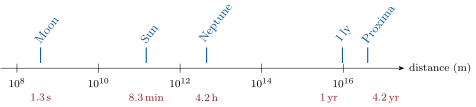
Distances from Earth on the multiplicative ruler, with light’s travel time in red beneath each: the Moon is light-seconds away, the planets light-hours, the stars light-years.

Examples

Example 1.14 (The light-year in metres)

A year holds 365.25×24×3600=3.156×10⁷s365.25 \times 24 \times 3600 = 3.156 \times 10^{7}\,\mathrm{s} (pleasantly close to π×107s\pi \times 10^{7}\,\mathrm{s}). Hence

1ly=c×3.156×10⁷s=3.00×10⁸m/s×3.156×107s=9.47×1015m.1\,\mathrm{ly} = c \times 3.156 \times 10^{7}\,\mathrm{s} = 3.00 \times 10^{8}\,\mathrm{m}/\mathrm{s} \times 3.156 \times 10^{7}\,\mathrm{s} = 9.47 \times 10^{15}\,\mathrm{m}.

Proxima Centauri, the nearest star after the Sun, lies 4.2ly4.0×1016m4.2\,\mathrm{ly} \approx 4.0 \times 10^{16}\,\mathrm{m} away: light, which crosses an Earth–Sun distance in eight minutes, needs over four years to arrive from there.

Read in context →