High School Physics · Grades 10–12
1Orders of Magnitude: Measuring the Universe
Physics begins where opinion ends: with a measurement. But the things physics measures span an absurd range — an atomic nucleus is about across, the observable universe about : a factor of , far beyond anything a mental picture can hold. This chapter installs the toolkit that tames the range — units, powers of ten, significant figures — and two habits used on every page after this one: write the unit, and check the order of magnitude.
1.1 Units: the grammar of measurement
Definition 1.1 (Physical quantities and SI units)
A physical quantity is a property of the world that can be measured: a length, a duration, a mass. Measuring it means counting how many times a reference quantity — the unit — fits into it. The International System of Units (SI) fixes seven base units, of which three run this whole volume: the metre () for length, the kilogram () for mass and the second () for time. (The other four — ampere, kelvin, mole, candela — will join when electricity, heat and chemistry enter the story.)
Remark 1.2 (A number without a unit is not a result)
“The distance is ” means nothing: , and are three different worlds (the last happens to be the distance to the Moon). In 1999, NASA lost the $327-million Mars Climate Orbiter because one program computed thruster forces in pounds-force while another read them as newtons. House rule, from this line to the end of the book: every measured or computed number carries its unit, on every line of the calculation.
Definition 1.3 (SI prefixes)
A prefix glued to a unit multiplies it by a fixed power of ten:
| femto | f | centi | c | ||
| pico | p | kilo | k | ||
| nano | n | mega | M | ||
| micro | giga | G | |||
| milli | m | tera | T |
Thus and .
Example 1.4 (Reading prefixes)
Green light has wavelength about ; a human hair is about thick; the Moon orbits at . One raindrop has mass about — note that the SI base unit of mass, alone among the seven, carries a prefix already.
1.2 Scientific notation and significant figures
Definition 1.5 (Scientific notation)
A number is in scientific notation when written as
The factor is the mantissa, the integer the exponent. Thus and .
Proposition 1.6 (Computing with powers of ten)
For all integers and :
Partial proof. For positive exponents, count the factors: is a product of tens, and chains groups of tens. Writing for is precisely the convention that keeps the first rule true for all integers: it forces . The companion mathematics volume studies the exponent rules in full. ∎
Example 1.7 (Multiplying in scientific notation)
How many Earths fit in the Sun, by mass? With and :
Mantissas and exponents are handled separately; the final answer is re-normalized so that the mantissa lands back in .
Definition 1.8 (Significant figures)
The significant figures of a measured number are the digits actually vouched for by the measurement: all written digits except the leading zeros. Trailing zeros count — (three significant figures) promises more than (two). Scientific notation shows the count at a glance: the mantissa carries exactly the significant figures.
Method 1.9 (How many digits to keep)
A computed result cannot be more precise than its ingredients.
- In a product or quotient, keep as many significant figures as the least precise factor.
- Round only the final answer, never the intermediate steps.
- When in doubt, three significant figures is the working precision of this book.
Example 1.10 (Earth’s circumference)
Earth’s diameter is (three significant figures), so its circumference is — three figures, not the eight the calculator displays. Writing would claim to know the planet to the metre.

1.3 The ladder of the universe
Definition 1.11 (Order of magnitude)
The order of magnitude of a quantity is the power of ten closest to it: write the quantity as with and take if , if . (The exact boundary convention never matters: an order-of-magnitude statement is only ever meant to within a factor of ten.)
Example 1.12 (Orders of magnitude)
A human life lasts about years, i.e. : order of magnitude — a few billion seconds, spend them well. A human is tall: order . Mount Everest, : order , since .
Stacking such estimates by exponent produces the master picture of this chapter: a ladder whose every rung is a world ten times wider than the one below.
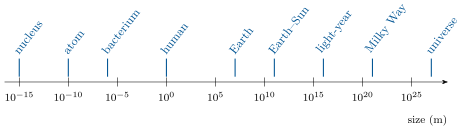
Above the Earth rung, metres stop being convenient; astronomy keeps its own units, both defined from the ladder itself.
Definition 1.13 (Astronomical unit and light-year)
The astronomical unit () is the average Earth–Sun distance. The light-year () is the distance light travels in one year. Light moves in vacuum at
the fastest speed nature allows — so the light-year is a distance, not a time.
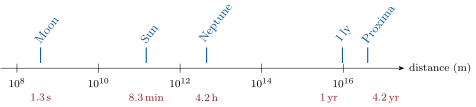
Example 1.14 (The light-year in metres)
A year holds (pleasantly close to ). Hence
Proxima Centauri, the nearest star after the Sun, lies away: light, which crosses an Earth–Sun distance in eight minutes, needs over four years to arrive from there.
Method 1.15 (Sanity check by order of magnitude)
Before trusting any computed result:
- round every input to its order of magnitude;
- redo the computation with powers of ten alone, using Proposition 1.6 — this takes seconds;
- compare: the precise answer must agree with the estimate to within a factor of ten or so, and its unit must be the right one. If either check fails, hunt down the error before moving on.
Remark 1.16 (Why bother)
A calculator will happily report that an apple has mass — it cannot know better. No formula flags the absurd; the habit does. Physicists estimate first and compute second: the estimate catches misplaced decimal points, swapped units and inverted fractions, the three errors behind most wrong answers at every level.
1.4 Measurement and uncertainty
No instrument reads the true value. A measurement is honest only when it also reports how far off it might be.
Definition 1.17 (Absolute and relative uncertainty)
A measurement of a quantity is stated as
where is the measured value and the absolute uncertainty , in the same unit, bounds the plausible error: the true value is claimed to lie between and . The relative uncertainty is the ratio , usually quoted in percent; it is what the word “precise” measures.
Method 1.18 (Reading a graduated instrument)
For a ruler, a measuring cylinder, a dial:
- read the graduation nearest the mark, eye perpendicular to the scale (a slanted eye shifts the reading);
- take at least half the smallest graduation as the absolute uncertainty — more if the object’s edge or the liquid’s surface is fuzzy;
- write the result as with its unit, and keep no digit beyond the uncertain one.
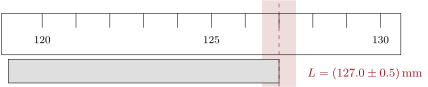
Example 1.19 (Relative precision)
The reading above has relative uncertainty . The same ruler measuring a bolt gives : the identical instrument is ten times less precise on the small object. Precision is a property of the measurement, not of the tool.
Remark 1.20 (Small absolute, huge relative — and conversely)
Laser stations measure the Earth–Moon distance, , to about : a relative uncertainty of , among the sharpest measurements ever made — with an absolute error no ruler would boast of. Always ask relative to what: the pair tells the whole story, and either number alone can mislead.
1.5 Exercises
Exercise 1.1 ★
Convert to metres, in scientific notation:
- (wavelength of red light);
- ;
- (a soil bacterium);
- (the Earth–Sun distance, in an unusual costume).
Exercise 1.2 ★
Write in scientific notation and give the number of significant figures:
- the Earth–Sun distance, , in metres;
- the diameter of a hydrogen atom, ;
- the world population, about ;
- a duration of .
Solution
Solution of Exercise 1.2.
1. : significant figures. 2. : significant figures (leading zeros never count). 3. : significant figures. 4. : significant figures (the trailing zero is a promise).
Exercise 1.3 ★
Compute without a calculator, giving each result in scientific notation:
Exercise 1.4 ★
Give the order of magnitude, with its unit, of: a human height of ; Mount Everest, ; an E. coli bacterium, ; the mass of the Earth, .
Solution
Solution of Exercise 1.4.
Human: , order . Everest: and : order . Bacterium: order . Earth: , order .
Exercise 1.5 ★
A ruler is graduated in millimetres. You measure a pencil at .
- State the result with its absolute uncertainty.
- Compute the relative uncertainty.
- The same ruler measures a eraser. Which of the two measurements is the more precise, and by what factor?
Solution
Solution of Exercise 1.5.
1. Half a graduation: . 2. . 3. Eraser: . The pencil measurement is about ten times more precise — same ruler, same absolute uncertainty, ten times longer object.
Exercise 1.6 ★★
Using and :
- Express in metres the distances to Proxima Centauri () and to Sirius ().
- The probe Voyager 1 is about from Earth. How long does its radio signal, travelling at , take to reach us? Express the answer in hours.
Solution
Solution of Exercise 1.6.
1. Proxima: . Sirius: (two significant figures, like the input). 2. , i.e. : almost a full day for every message from the probe.
Exercise 1.7 ★★
How long does light take to reach Earth from the Moon (), from the Sun () and from Neptune ()? Give each answer in a sensible unit, and complete the sentence: “When you look at Neptune, you see it as it was…”
Solution
Solution of Exercise 1.7.
each time. Moon: . Sun: . Neptune: . When you look at Neptune, you see it as it was about four hours ago — every telescope is a mild time machine.
Exercise 1.8 ★★
A ream of sheets of paper, measured with a millimetre ruler, is thick, with uncertainty .
- Deduce the thickness of one sheet, with its absolute uncertainty.
- What is the relative uncertainty of that thickness?
- Why is measuring the ream enormously better than measuring one sheet directly with the same ruler? Quantify.
Solution
Solution of Exercise 1.8.
1. One sheet: . The uncertainty divides too: , so . 2. . 3. Measuring one sheet directly would give : a relative uncertainty of about — the ruler cannot even prove the sheet exists. Stacking sheets multiplies the measured length by while the ruler’s absolute uncertainty stays fixed: the relative uncertainty shrinks by that same factor .
Exercise 1.9 ★★
Take as the diameter of an atom. How many atoms, side by side, span: a bacterium of ; a hair of ; a human of ? Give the last answer as an order of magnitude too.
Solution
Solution of Exercise 1.9.
Divide each length by . Bacterium: atoms. Hair: . Human: , order of magnitude : ten billion atoms head to toe.
Exercise 1.10 ★★
A scale model represents the Sun (diameter ) by a football of diameter .
- Compute the scale factor of the model.
- Find the model diameter of the Earth () and its model distance from the football (real distance ).
- How far from the model Earth is the model Moon (real distance )? And how far away is model Neptune (real distance )?
Solution
Solution of Exercise 1.10.
1. . 2. Earth: — a peppercorn — orbiting at from the football. 3. Moon: from the peppercorn. Neptune: : the model does not fit in the schoolyard.
Exercise 1.11 ★★
Significant figures at work.
- An A4 sheet measures by . Give its area with the correct number of significant figures.
- A sprinter covers in . Give the average speed correctly rounded.
- Explain in one sentence what would be dishonest about announcing the area as .
Solution
Solution of Exercise 1.11.
1. , rounded to the three significant figures of the inputs: . 2. (three figures, set by the time). 3. Five significant figures would claim the area to , a precision the millimetre-level inputs never delivered — a forged decimal is still a forgery.
Exercise 1.12 ★★★
A drop of oil of volume is deposited on still water and spreads into a circular film of diameter — a film that later chapters will show to be one molecule thick.
- Compute the area of the film, then its thickness.
- Deduce an order of magnitude for the size of a molecule, and check it against the atom rung of the ladder.
(This back-of-the-envelope experiment, first tried by Benjamin Franklin on a London pond, was one of humanity’s first honest measures of the molecular world.)
Solution
Solution of Exercise 1.12.
1. Radius , area . Volume , and a film is (area) (thickness), so
2. A molecule is of order — one rung above the atom’s , consistent with a molecule being a small cluster of atoms. Franklin’s teaspoon of oil calmed half an acre of pond and, without his knowing it, measured the nanometre.
Exercise 1.13 ★★★
Estimate the number of heartbeats in a human lifetime. State your assumptions (resting heart rate, life span), keep the arithmetic to powers of ten and one digit of mantissa, and give the final answer as an order of magnitude only. Why would quoting it to four significant figures be meaningless?
Solution
Solution of Exercise 1.13.
Assumptions: about beats per minute at rest, a life of years. Per day: beats. Per year: . Per life: — order of magnitude , a few billion heartbeats. Four significant figures would pretend to know a heart rate, minute by minute, for eighty years: the inputs are order-of-magnitude guesses, and no output can outrank its inputs (Method 1.9).
Exercise 1.14 ★★★
A sheet of paper is thick, and each fold doubles the thickness of the stack. Using :
- After how many folds would the stack overtop Mount Everest ()?
- After how many folds would it reach the Moon ()?
- In practice a sheet cannot be folded more than about seven times. Does that invalidate the arithmetic, or only the experiment?
Solution
Solution of Exercise 1.14.
After folds the thickness is . 1. Need . Since falls short and suffices: folds (stack ). 2. Need : is short, reaches — folds, stack , comfortably past the Moon. 3. Only the experiment: each fold halves the area, and after seven folds the stack is thicker than it is wide. The arithmetic of doubling is untouched — exponential growth simply outruns what paper (and intuition) can follow.
Exercise 1.15 ★★★
Laser ranging gives the Earth–Moon distance as ; a good ruler gives a table as .
- Compute both relative uncertainties. Which measurement is the more precise, and by what factor?
- With what absolute uncertainty would you need to measure the table to match the Moon measurement’s relative precision? Compare that length with the size of an atom, and conclude with due respect.
Solution
Solution of Exercise 1.15.
1. Moon: . Table: . The Moon measurement is more precise by a factor — over ten million. 2. Matching on a one-metre table means , smaller than one atom (): the table’s edge is not even defined that sharply. Relatively speaking, the Earth–Moon laser distance is one of the finest measurements our species owns.
1.6 Problem: From the atom to Andromeda
Problem 1.1
Weekend problem — a single grain of sand sizes the atom, the Solar System, the galaxy and the observable universe, and locates you on the ladder between them
A grain of sand is the humblest object in physics, and this weekend it works overtime: first we count its atoms, then we shrink the Sun to its size and pace out the cosmos, then we let light do the surveying, and finally we count the atoms in you. Data, used throughout: grain diameter ; atom diameter ; density of sand ; diameters: Sun , Earth , Milky Way , observable universe ; distances from us: Moon , Sun , Neptune , Proxima Centauri , Andromeda galaxy ; ; a water molecule has mass and contains three atoms.
Part I — Anatomy of the grain.
- Write the grain diameter and the atom diameter in metres, in scientific notation, and name the SI prefix each is closest to.
- How many atoms sit side by side across one grain diameter?
- Model the grain as a cube of side packed with atoms. Estimate the number of atoms in the grain, as an order of magnitude.
- Compute the volume of that cube, then the mass of the grain. Express the mass in milligrams.
- Sanity-check the model: divide the grain’s mass by its number of atoms and compare with the known order of magnitude of atomic masses (a few ). Verdict?
Part II — The Sun as a grain of sand. We build a scale model of the cosmos in which the Sun is the grain: every model size equals the real size times a factor .
- Compute the scale factor .
- In the model, find the Earth’s diameter and its distance from the grain-Sun. What object of Part I’s world has roughly the model Earth’s size?
- How far from the grain does model Neptune orbit? What piece of furniture would hold the entire planetary system?
- How far away is the model Proxima Centauri?
- Two grains of sand, apart, and almost nothing in between: state in one or two sentences what the model reveals about how empty the galaxy is.
Part III — Light does the surveying.
- How long does light take to cross the real grain of sand?
- How long does light take to reach us from the Moon, and from the Sun?
- Recompute the light-year in metres from and the length of the year, and verify that the Proxima distance in the data corresponds to about .
- Convert the Andromeda distance to light-years. Roughly when did the light now entering your eye leave Andromeda, and what was walking the Earth at the time?
- How far does light travel in one nanosecond? A processor clocked at starts an operation every third of a nanosecond: explain in one sentence why a fast computer must be a small computer.
Part IV — You, between atom and Andromeda.
- A human is roughly of water. Using the data, estimate the average mass of one atom in water, then the number of atoms in a human.
- Compare that count with the atoms in the grain (question 3) and with the roughly stars of the observable universe. Give both factors.
- On the ladder, are you nearer the atom or the observable universe? Compare the ratios and , taking for you.
- Find the size sitting exactly halfway up the ladder between the nucleus () and the observable universe: must satisfy (using ). What Solar-System object happens to have just that size?
- The punchline. Shrink the observable universe by the Part II factor , so that the Sun is a grain of sand. Give the model universe’s diameter in metres, then in astronomical units, and conclude in one sentence: even with every star turned to a sand grain, the universe overflows every human scale — only powers of ten hold it.
Solution
Solution of Problem 1.1.
1. Grain: , on the milli scale; atom: , on the nano scale.
2. : two million atoms across.
3. A cube of atoms per edge holds atoms: order of magnitude .
4. , so .
5. Mass per atom: — squarely in the “few ” range. The naive cube of atoms reproduces real atomic masses: the model passes the sanity check (Method 1.15) with honors.
6. .
7. Model Earth: diameter — the size of a bacterium — at distance from the grain: the Earth is a microbe five centimetres from a grain of sand.
8. : the entire planetary system orbits within a dining table.
9. .
10. The nearest star to our table-top Solar System is another grain of sand fourteen kilometres away, with essentially nothing in between: the galaxy is overwhelmingly empty space, which is why collisions between stars are almost unheard of.
11. — under two picoseconds.
12. Moon: . Sun: : sunlight is always eight minutes old.
13. One year is , so ; then : the data distance is indeed about .
14. : two and a half million light-years. That light left Andromeda about million years ago, when the first members of the genus Homo were learning to knap stones — and no Homo sapiens yet existed anywhere.
15. . In a third of a nanosecond a signal covers at most about , so any two parts of the machine that must talk within one clock tick have to sit within ten centimetres of each other: speed caps size.
16. Average atom in water: . Number of atoms: .
17. Against the grain: — you contain a billion grains’ worth of atoms. Against the stars: — your atoms outnumber all the stars of the observable universe thirty-five thousand to one.
18. , while . On the ladder you stand about ten rungs above the atom and nearly twenty-seven below the universe: multiplicatively, humans live very close to their atoms.
19. The condition gives , so — almost exactly the diameter of Ceres, the largest asteroid (). Halfway up the ladder between a nucleus and the cosmos sits a modest dwarf planet.
20. , i.e. astronomical units. Punchline: shrink the cosmos until the Sun is a grain of sand, and the observable universe still spans two thousand times the real Earth–Sun distance — no scale model brings the universe down to human size; only powers of ten can carry it.