Physics · Glossary

What is Control volume; open system?

Definition 5.1 University Physics — Year 2 · Chapter 5 — Momentum and Energy Balances in Flows

A control volume (or control surface) is a fixed region of space Σ\Sigma through which fluid flows; the fluid inside it at any instant is an open system, which exchanges mass with the outside through the inlets and outlets of Σ\Sigma. The closed system to which Newton’s laws apply is the fluid that is inside Σ\Sigma at time tt, followed to t+ ⁣dtt + \dd t: it then occupies Σ\Sigma minus what has left plus what has entered.
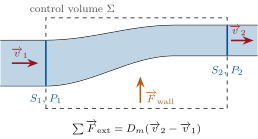
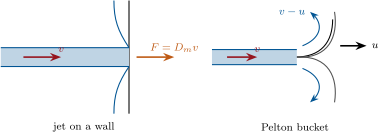
Left: a control volume in a steady flow — the momentum leaving through S_2 minus that entering through S_1 equals the sum of the external forces on the fluid inside, pressure forces on the two sections included. Right: a jet stopped by a wall pushes it with D_mv; a jet turned back by a Pelton bucket moving at u pushes with up to 2D_m(v - u). Left: a control volume in a steady flow — the momentum leaving through S_2 minus that entering through S_1 equals the sum of the external forces on the fluid inside, pressure forces on the two sections included. Right: a jet stopped by a wall pushes it with D_mv; a jet turned back by a Pelton bucket moving at u pushes with up to 2D_m(v - u).
Left: a control volume in a steady flow — the momentum leaving through S2S_2 minus that entering through S1S_1 equals the sum of the external forces on the fluid inside, pressure forces on the two sections included. Right: a jet stopped by a wall pushes it with DmvD_mv; a jet turned back by a Pelton bucket moving at uu pushes with up to 2Dm(vu)2D_m(v - u).
Read in context →