 Coach
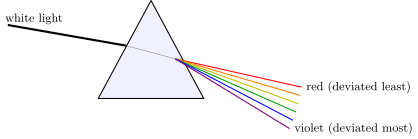
CoachWhen a narrow beam of sunlight crosses a glass prism, it emerges spread into a continuous band of colors, from red to violet. This band is the spectrum of the light. Light that contains all the visible colors, like sunlight or the light of an ordinary bulb, is called white light. Light of a single pure color, which no prism can split any further, is monochromatic (a laser beam, for instance); a mixture of several colors is polychromatic. An instrument that performs the decomposition and reads off the composition of a light is a spectroscope.
Examples
Example 2.17 (A flask of sodium vapor)
White light crosses a flask containing cool sodium vapor. The transmitted spectrum is a full rainbow with one dark line at — precisely where a sodium lamp shines brightest. Looking at the flask from the side in a dark room, one sees the stolen light re-emitted: a faint yellow-orange gleam at that same wavelength.
Example 2.20 (The Sun’s recipe)
The solar spectrum carries thousands of dark lines, mapped by Fraunhofer in 1814. Among the strongest: , , and — the full hydrogen fingerprint — together with the sodium line at and a calcium pair at and . The Sun’s atmosphere contains hydrogen above all, plus traces of elements familiar from Earth’s rocks. Modern measurements refine the headline: the Sun is roughly three quarters hydrogen by mass.