 Coach
CoachAn event is a point occurrence: a definite place and a definite instant — a spark, a detector click, a decay. Each inertial frame assigns an event its coordinates , using rulers at rest in the frame and synchronised clocks distributed through it. Two events are simultaneous in a frame when that frame’s clocks assign them the same — and the first casualty of the postulates is that this notion depends on the frame.
Examples
Example 4.4 (The train and the two lightning bolts)
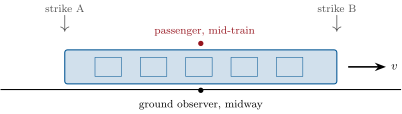
Lightning strikes both ends of a fast train, leaving marks on train and track. For the observer on the ground, midway between the marks, the two flashes arrive together: the strikes were simultaneous for her. The passenger seated at the train’s midpoint, however, is moving toward one flash and away from the other; travelling at in his frame too, the forward flash reaches him first — and since he sits equidistant from the two marks on the train, he must conclude the forward strike happened earlier. Neither is wrong: simultaneity of separated events is not a fact about the world but about the frame. Every relativistic “paradox” dissolves here.
Example 4.16 (The travelling twin)
One twin flies to a star light-years away at () and returns. Earth time: . The traveller’s proper time: — eight years younger, and no paradox: the twins’ situations are not symmetric, since one worldline is straight (inertial throughout) and the other has a kink at turnaround. Between two fixed events, the straight worldline is the one of longest proper time — in spacetime’s geometry, the detour is shorter-lived. The effect is measured routinely: atomic clocks flown around the world disagree with their stay-at-home siblings by exactly the predicted nanoseconds (Problem 4.1).