University Physics — Year 3 · Bachelor Year 3
4Relativistic Kinematics
Cosmic rays striking the upper atmosphere create muons fifteen kilometres up — unstable particles that live, on average, two microseconds. Two microseconds at nearly the speed of light is six hundred metres; yet muon detectors at sea level click steadily, counting particles that have crossed twenty times their allotted range. The resolution of this paradox is not a detail of particle physics but a revision of the concepts beneath all of physics: time elapses differently for the moving muon than for us, and distances shrink along its motion. This chapter builds that revision — special relativity (Einstein, 1905) — from its two postulates: the laws of physics are the same in every inertial frame, and light in vacuum has the same speed in all of them. Everything else follows by honest kinematics: the entanglement of space with time in the Lorentz transformation, the dilation of time, the contraction of lengths, the new rule for adding velocities, and the geometry — spacetime and its invariant interval — in which all of it becomes as natural as rotations.
4.1 Two postulates against absolute time
Remark 4.1 (Where the conflict comes from)
Mechanics has always had a relativity principle: inside a smoothly sailing ship, no experiment with balls and pendulums betrays the motion (Galileo), and Newton’s laws hold in every inertial frame, the frames in motion at constant velocity relative to one another. But the electromagnetism of the Year 2 volume derives a definite speed for light, , from constants of nature, with no mention of who measures it — and experiments agree: the speed of starlight arriving at the moving Earth, measured across the seasons, never varies (Michelson and Morley, 1887, and every successor since). Galilean kinematics, in which velocities add, cannot digest a speed that is the same for everyone. Something has to give, and it is our assumption that time and simultaneity are absolute.
Theorem 4.2 (The postulates of special relativity)
(i) Relativity: the laws of physics take the same form in every inertial frame; no experiment distinguishes rest from uniform motion. (ii) Light: light in vacuum propagates at the same speed in every inertial frame, whatever the motion of the source or the observer.
Proof. Admitted at this level. ∎
Definition 4.3 (Events and simultaneity)
An event is a point occurrence: a definite place and a definite instant — a spark, a detector click, a decay. Each inertial frame assigns an event its coordinates , using rulers at rest in the frame and synchronised clocks distributed through it. Two events are simultaneous in a frame when that frame’s clocks assign them the same — and the first casualty of the postulates is that this notion depends on the frame.
Example 4.4 (The train and the two lightning bolts)
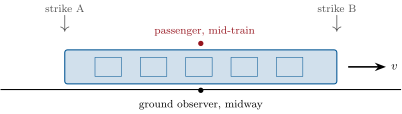
Lightning strikes both ends of a fast train, leaving marks on train and track. For the observer on the ground, midway between the marks, the two flashes arrive together: the strikes were simultaneous for her. The passenger seated at the train’s midpoint, however, is moving toward one flash and away from the other; travelling at in his frame too, the forward flash reaches him first — and since he sits equidistant from the two marks on the train, he must conclude the forward strike happened earlier. Neither is wrong: simultaneity of separated events is not a fact about the world but about the frame. Every relativistic “paradox” dissolves here.
4.2 The Lorentz transformation
Theorem 4.5 (Lorentz transformation)
Let the frame move at velocity along the axis of the frame , their origins coinciding at . An event of has in the coordinates
with , ; the inverse transformation is the same with . For , and one recovers Galileo’s , . The factor — barely at everyday speeds, at , at — measures every relativistic effect of this chapter.
Partial proof. Homogeneity of space and time forces the transformation to be linear; symmetry between the frames and the relativity postulate reduce it to , with one unknown function . Follow a light flash emitted at the common origin: postulate (ii) demands and . Substituting, and ; multiplying the two equations, , which is the stated . Eliminating between the two linear relations gives the time formula. (The step from “light agrees” to “the full transformation is fixed” — no residual stretching of transverse directions or rescaling — uses the symmetry arguments detailed in Exercise 4.11.) ∎
Proposition 4.6 (Time dilation)
A clock at rest in — ticking at fixed — is seen from to run slow: between two of its ticks separated by the proper time (the time of the frame where the clock rests), the frame measures
Moving clocks run slow — all of them, biological, atomic or subatomic, because it is time itself, not a mechanism, that dilates.
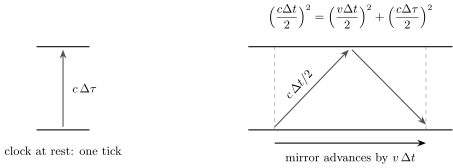
Proof. Two ticks at the same : the inverse transformation gives since . The light-clock picture (Exercise 4.2) gives the same from Pythagoras alone. ∎
Proposition 4.7 (Length contraction)
A rod of proper length (its length in its rest frame), moving lengthwise at , measures in the laboratory
Transverse dimensions are unchanged. Measuring a moving rod means locating its two ends at the same laboratory instant — and because simultaneity is frame-dependent, so is length.
Proof. Mark both ends at the same lab time : the transformation gives with , and : hence . ∎
Example 4.8 (The muon, twice explained)
A muon at has . In our frame, its internal clock runs ten times slow: its two microseconds of proper life stretch to twenty, and it covers six kilometres instead of six hundred metres. In the muon’s frame, its life is the ordinary — but the mountain rushing at it is contracted tenfold, and fits inside. Both frames agree on the one physical fact, whether the muon reaches the detector: relativity reshuffles times and lengths, never outcomes (Problem 4.1).
Method 4.9 (Keeping the effects straight)
(1) Identify the events (emission, arrival, tick, decay), not “objects”. (2) Proper time belongs to the one clock present at both events: every other frame measures more, . (3) Proper length belongs to the rod’s rest frame: every other frame measures less, . (4) When “paradox” strikes, find the two spatially separated events being silently called simultaneous, and ask: in which frame? (5) Check the limit , and remember at small speeds — the size of everyday relativistic corrections.
4.3 Composing velocities; Doppler
Proposition 4.10 (Relativistic composition of velocities)
If a body moves at along in the frame , itself moving at relative to , then measures not but
For everyday speeds the denominator is and Galileo returns; for the formula gives whatever — light is at for everyone, as built in; and no composition of speeds below ever reaches .
Proof. with the inverse transformation: , ; divide. ∎
Example 4.11 (Fresnel’s coefficient explained)
Light in still water travels at . In water flowing at , Fizeau measured (1851) the puzzling : not the full drag . Compose with :
to first order in . A nineteenth-century table-top result, inexplicable then, is the velocity-composition law read at first order — one of the quiet confirmations Einstein cited in 1905.
Proposition 4.12 (Longitudinal Doppler effect)
A source of proper frequency receding at speed along the line of sight is received at
Two effects compound: the classical stretching of arrival times as each crest starts farther away, and the relativistic slowing of the source’s clock — the that survives even at (the transverse Doppler effect, pure time dilation).
Proof. In the receiver’s frame the source emits crests every (dilation), each starting farther away, so crests arrive every . ∎
Example 4.13 (The recession of the galaxies)
The hydrogen line emitted at arrives from a distant galaxy at : , so — the galaxy recedes at . Applied across the sky, this one formula turned spectra into a map of the expanding universe; the final chapter of this book takes the story up.
4.4 Spacetime and the invariant interval
Theorem 4.14 (The invariant interval)
For any two events, the combination
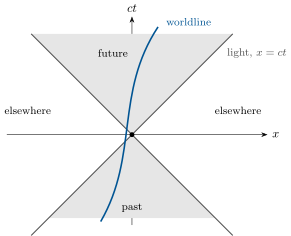
has the same value in every inertial frame — the quantity relativity conserves while times and lengths flex. Its sign classifies the pair: timelike (): some frame brings the events to the same place, and is the proper time between them; spacelike (): some frame makes them simultaneous, and no signal can connect them; lightlike (): only light connects them.
Proof. Direct substitution of the Lorentz transformation: . For the classification: bringing the events to the same place needs a frame of speed , possible when (timelike); making them simultaneous needs , possible when (spacelike). ∎
Remark 4.15 (Causality has a geometry)
Through every event runs its light cone: the events it can influence (future cone), those that can have influenced it (past cone), and the spacelike “elsewhere”, causally cut off. Because a spacelike pair has frame-dependent order — some frames see A before B, others B before A — any signal faster than light would let some observer watch an effect precede its cause. Relativity’s speed limit is not about engines; it is the price of a consistent history.
Example 4.16 (The travelling twin)
One twin flies to a star light-years away at () and returns. Earth time: . The traveller’s proper time: — eight years younger, and no paradox: the twins’ situations are not symmetric, since one worldline is straight (inertial throughout) and the other has a kink at turnaround. Between two fixed events, the straight worldline is the one of longest proper time — in spacetime’s geometry, the detour is shorter-lived. The effect is measured routinely: atomic clocks flown around the world disagree with their stay-at-home siblings by exactly the predicted nanoseconds (Problem 4.1).
4.5 Exercises
Exercise 4.1 ★
Compute for , , , , . For the ISS (), compute using the small-speed approximation, and the time its crew “gains” (or loses?) per six-month mission relative to a clock on the ground, ignoring gravity.
Solution
Solution of Exercise 4.1.
, , , , . ISS: , ; over six months () the crew’s clock runs slow by (velocity effect alone; at the ISS’s low altitude the gravitational effect reduces but does not reverse this).
Exercise 4.2 ★
The light clock of the figure: (a) write the tick of the clock at rest ( the mirror spacing); (b) from Pythagoras in the frame where it moves at , derive ; (c) why does the argument require the transverse distance to be the same in both frames? (d) Give the argument (two identical rulers passing each other) that transverse lengths cannot change.
Solution
Solution of Exercise 4.2.
(a) . (b) Each half-tick, the photon travels the hypotenuse: with ; solve: . (c) If changed with motion, the Pythagoras step would be wrong. (d) Let two identical rulers pass, each carrying a paintbrush at its tip pointing at the other. If motion contracted transverse lengths, each frame would predict its own ruler paints a mark beyond the other’s tip — two contradictory facts about the same brush strokes at the same passing event. Contradiction at one event is not allowed: transverse lengths cannot change.
Exercise 4.3 ★
A muon is created at altitude with . (a) Its and its mean life in our frame. (b) The mean distance it covers. (c) The atmosphere’s thickness in its frame. (d) What fraction of such muons reaches the ground, with and without relativity (decay law , )?
Solution
Solution of Exercise 4.3.
. (a) . (b) . (c) . (d) Lab time of flight : without relativity — none; with relativity the proper time is , fraction .
Exercise 4.4 ★
Two events on the axis: A at , B at . (a) Compute : timelike or spacelike? (b) Can A cause B? (c) Find the speed of the frame in which A and B occur at the same place, and the proper time between them there. (d) Same three questions for B at — which frame now exists, and which does not?
Solution
Solution of Exercise 4.4.
(a) , : , timelike. (b) Yes: a signal at suffices. (c) That same frame speed, ; proper time . (d) Now : spacelike; no causal link possible; no frame brings them to the same place, but the frame at makes them simultaneous.
Exercise 4.5 ★★
GPS satellites orbit at . (a) Compute . (b) By how much does a satellite clock lag a ground clock per day, from time dilation alone? (c) Positioning works by timing signals at : what position error corresponds to one day of uncorrected special-relativistic drift? (d) The full correction (with gravity, treated in the final chapter’s spirit) is per day, the gravitational blueshift winning over time dilation: what does the sign tell you about which effect is larger at altitude?
Solution
Solution of Exercise 4.5.
(a) : . (b) per day. (c) — navigation would die within a day. (d) The net means the gravitational blueshift () outweighs the kinematic slowing (): at , sitting higher in the Earth’s potential speeds a clock more than orbital speed slows it.
Exercise 4.6 ★★
(a) A ship at launches a probe forward at relative to itself: the probe’s speed for us? (b) Two ships approach each other, each at in our frame: their relative speed? (c) Show from the composition law that and imply (factor the expression ). (d) A laser pointer swept across the face of the Moon can paint a spot moving faster than : why does this break no law?
Solution
Solution of Exercise 4.6.
(a) . (b) . (c) : both factors positive, so . (d) The spot is a moving pattern, not a thing: no matter, energy or information travels from one point of the Moon’s face to the next — each photon went Moonward at .
Exercise 4.7 ★★
The sodium doublet at arrives from a star at . (a) Approaching or receding? At what speed? (b) At what speed would visible light () be shifted into the near infrared ()? (c) For , show and give the rule of thumb in km/s per at . (d) A source circling at constant distance shows a shift even with no radial motion: which effect is that, and of what order in ?
Solution
Solution of Exercise 4.7.
(a) Shorter wavelength: approaching. ; : , about . (b) Ratio : , . (c) Expanding the square root, ; at , gives : about per angström — the astronomer’s reflex. (d) The transverse Doppler effect: pure time dilation, of order — measurable only with atomic precision.
Exercise 4.8 ★★
The pole and the barn. A pole is carried at toward a barn with two doors. (a) The pole’s length in the barn frame: does it fit? (b) In the runner’s frame the barn is long: how can both be right? Identify the two events (“front door closes”, “back door opens”) and compare their time order in the two frames. (c) Compute the time between these events in each frame for simultaneous-in-the-barn closing. (d) State the moral in one sentence (which silent assumption did the “paradox” make?).
Solution
Solution of Exercise 4.8.
(a) : it fits, just, and both doors can be shut simultaneously (barn frame). (b) In the runner’s frame the events “front door shuts” and “back door opens” are not simultaneous: the exit opens before the entrance closes, and the pole threads a barn without ever being enclosed. (c) Barn frame: over . Runner frame: . (d) “The pole is enclosed” silently asserts that two separated events (both doors shut) are simultaneous — a frame-dependent statement, not a fact.
Exercise 4.9 ★★
A rocket of proper length passes a space station at . (a) How long does the station clock take between the nose’s passage and the tail’s? (b) Same question for a clock on the rocket watching the station (proper length ) go by. (c) The station fires two docking clamps simultaneously (in its frame), apart: what is the time between the two firings for the rocket, and which fires first? (d) Verify agrees between the frames for the pair of clamp events.
Solution
Solution of Exercise 4.9.
at . (a) Moving length at : . (b) . (c) ; from , the clamp at larger — the forward one — fires first for the rocket. (d) Station: . Rocket: , : — invariant.
Exercise 4.10 ★★★
The twins, in full. Stella flies at to a star away (Earth frame) and returns at ; Terra stays. (a) Compute each twin’s elapsed time. (b) In Stella’s outbound frame, how far away is the star, and how long does the outbound leg take her? (c) Just before and just after turnaround, what does Stella compute for “the time now on Earth” (use the term)? Show her accounting jumps by years at the kink — and that this jump is exactly what reconciles the totals. (d) Explain why no symmetric argument can be run from Stella’s side.
Solution
Solution of Exercise 4.10.
(a) Terra: ; Stella: . (b) The distance contracts to , covered in of her time — consistent with for the round trip. (c) Simultaneity with the turnaround event : outbound frame assigns Earth’s clock ; inbound frame, . Her “now on Earth” jumps by at the kink; her ledger matches Terra exactly. (d) Stella occupies two inertial frames joined by an acceleration she can feel; Terra occupies one. The straight worldline between the departure and reunion events carries the longest proper time; only Stella’s is bent.
Exercise 4.11 ★★★
Deriving Lorentz honestly. (a) Argue from homogeneity that the transformation must be linear. (b) Assuming and, by the relativity principle, , derive in terms of and without using light. (c) Show that requiring fixes to its stated value. (d) Where exactly did the argument use each postulate?
Solution
Solution of Exercise 4.11.
(a) If the map were nonlinear, a uniform motion would not look uniform in the other frame, distinguishing points of homogeneous space and time. (b) Substituting one relation into the other: . (c) Setting , : , which solves to . (d) Relativity gave the same for the two directions (no preferred frame); the light postulate turned the remaining free function into the definite .
Exercise 4.12 ★★★
Rapidity. Define by . (a) Show the Lorentz transformation reads , : a “rotation” by an imaginary angle, preserving as rotations preserve . (b) Show that composing velocities adds rapidities: , and recover the composition law from . (c) A rocket accelerates at in its own frame: admitting that its rapidity grows as , find and how much proper time it takes to reach . (d) Why can rapidity grow forever while cannot?
Solution
Solution of Exercise 4.12.
(a) With , , the transformation is exactly the hyperbolic rotation stated, and preserves . (b) : precisely the composition law — velocities do not add, rapidities do. (c) , so ; gives years of ship time. (d) ranges over all reals while saturates at : one can accelerate forever, gaining rapidity linearly, while the speed only creeps toward .
4.6 Problem: The experiment in the sky
Problem 4.1
Weekend problem — muons, mountain clocks and the proof that time dilates
The cleanest early test of time dilation used no laboratory apparatus: nature supplies relativistic clocks by the thousand, raining on every mountain. This problem reconstructs the Frisch–Smith experiment (1963), then brings the same physics down to airliners and navigation satellites. Data: muon mean proper life ; decay is exponential, a fraction of muons surviving a proper time ; ; Mount Washington: altitude difference between the two detectors.
Part I — Clocks that rain from the sky.
- Cosmic protons strike nuclei high in the atmosphere and the debris decays into muons around up. Why is a population of identical unstable particles a clock?
- Compute , the natural range of a muon’s mean life.
- Without relativity, what fraction of muons born at and travelling at essentially would reach the ground? (Give the exponent; the number itself is absurd.)
- Detectors at sea level count muons abundantly: state the contradiction in one sentence.
- The sea-level flux is about one muon per square centimetre per minute: estimate how many muons cross your outstretched hand each second, and your body between two heartbeats.
- The experiment selected muons of speed : compute their .
- Frisch and Smith counted muons per hour at the mountaintop. Why measure at two altitudes of the same shower rather than trust the creation story?
Part II — The mountain measurement.
- How long does the trip of at take in the mountain frame?
- Without time dilation, what fraction survives that trip, and how many per hour should reach the bottom detector?
- With time dilation, how much proper time elapses for the muon during the trip?
- Predict the surviving fraction and the count per hour with relativity.
- The measured bottom count was per hour. Compare both predictions with the data, and state which theory survives its encounter with the mountain.
- From the measured ratio , extract the experimental dilation factor and compare it with . (The muons slow slightly in the rock-like shielding, so the effective is a little below the top-of-mountain value — Frisch and Smith found .)
Part III — The muon’s own story.
- In the muon’s frame, how tall is Mount Washington?
- How long does the mountain take to stream past, and what fraction of muons decays in that time? Check it matches Part II’s prediction.
- The two frames disagree about what dilated (our time? its mountain?) yet agree on the count: which kind of quantity is the count, and why must all frames agree on it?
- Compute the interval between creation at the top and arrival at the bottom, in the mountain frame, and check that equals the muon’s proper time of Part II.
- A sceptic objects: “maybe altitude, not speed, changes decay rates.” What control does the measured -dependence (slower muons dilate less) provide?
- Modern storage rings hold muons at and measure lifetimes to : what do they find, and what does a circular orbit add to the test (which twin is the muon)?
Part IV — Down to Earth: planes and satellites.
- An airliner cruises at for a round-the-world flight. Using , compute the special-relativistic lag of its clock, in nanoseconds.
- Caesium clocks resolve nanoseconds easily; the 1971 flights confirmed the prediction (once gravity’s opposite push, larger at altitude, was included). Why must the two effects be separated by flying both eastward and westward?
- A GPS satellite () accumulates what special-relativistic clock lag per day, in microseconds?
- Uncorrected, how many kilometres of ranging error would one week of that drift alone produce?
- The complete GPS correction, per day with gravity included, is engineered into the satellite clocks before launch: what would a navigator observe within hours if it were not?
- Summarise the named result: a mountain, two counters and clocks measured time dilation at within in 1963 — and the same physics is corrected for, every second, in every phone that knows where it is.
Solution
Solution of Problem 4.1.
1. All muons are strictly identical and decay at a fixed statistical rate: the surviving fraction of a population measures elapsed proper time as surely as a clock hand. 2. . 3. : fraction . 4. Particles that “cannot” travel more than a kilometre cross fifteen of them and arrive in force. 5. A hand : a couple of muons per second; a body horizontal cross-section: of order fifteen between two heartbeats — relativity rains through everyone, always. 6. . 7. Comparing two counts of the same selected population over a known height difference removes every assumption about where and how many muons are born. 8. . 9. : about per hour. 10. . 11. : about per hour. 12. Measured : relativity’s agrees within the muons’ slight slowing in the detectors’ absorber; classical physics’ is off by a factor thirteen. The mountain decides. 13. : , so — squarely in Frisch and Smith’s . 14. . 15. : the same decay — the muon’s account of the same count. 16. A count of clicks is a set of local coincidence events; events and their tallies are frame-invariant — frames may disagree about times and lengths, never about what a counter read. 17. : — the proper time, computed without ever leaving the mountain frame. 18. Decay rates would depend on altitude for every speed alike; instead the survival tracks — slower selections dilate less, exactly as prescribes. 19. Lifetimes of to a part in a thousand (CERN muon storage rings); the ring makes the muon a perpetually accelerated traveller — the “travelling twin” stays young even when the journey is one endless turnaround. 20. : . 21. The aircraft’s speed adds to or subtracts from the rotating Earth’s, while the altitude (gravitational) effect is the same both ways: the eastward and westward flights split the two contributions cleanly (the 1971 result matched both). 22. From Exercise 4.5: per day. 23. 24. Positions would drift by hundreds of metres within hours, kilometres within a day — navigation would visibly break the first morning. 25. In 1963 a mountain, two counters and clocks measured against a predicted (with slowing, ): time dilation confirmed within — and the identical physics is silently corrected, every second, in every navigation satellite above your head.