
Physics · Glossary

What is Gravitational field?

Definition 14.13 High School Physics · Chapter 14 — Electric and Gravitational Fields

If a test mass mm placed at a point feels a gravitational force (a weight) P\vect P, the gravitational field there is

g=Pm(in N/kg),\vect g = \frac{\vect P}{m} \qquad \text{(in $\mathrm{N}/\mathrm{kg}$)},

and conversely P=mg\vect P = m \vect g. An earlier chapter introduced the number gg; g\vect g adds the direction a dropped stone starts to move.
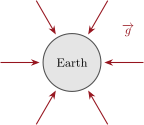
The Earth’s gravitational field: radial, pointing at the center, of magnitude GM/d2 — the exact portrait of the field of a negative point charge.
The Earth’s gravitational field: radial, pointing at the center, of magnitude GM/d2GM/d^2 — the exact portrait of the field of a negative point charge.

Examples

Example 14.15 (The field where the Moon lives)

At the Moon’s distance d=3.84×10⁸md = 3.84 \times 10^{8}\,\mathrm{m}:

g=6.67×1011×5.97×1024/(3.84×108)22.7×103N/kg.g = 6.67 \times 10^{-11} \times 5.97 \times 10^{24} / (3.84 \times 10^{8})^2 \approx 2.7 \times 10^{-3}\,\mathrm{N}/\mathrm{kg}.

Earth’s field never stops — it only thins out as 1/d21/d^2; this is the field that holds the Moon on its orbit.

Read in context →