High School Physics · Grades 10–12
14Electric and Gravitational Fields
How does the Earth pull an apple it never touches? Newton himself called action at a distance “so great an absurdity” that he refused to defend it. The modern answer: a mass, or a charge, modifies the space around it — it creates a field — and whatever is placed there responds to the field at its own location. We build the two great examples side by side, until the analogy becomes an identity of form.
14.1 From action at a distance to the field
Definition 14.1 (Field)
A field assigns to every point of space a vector. A source (a charge, a mass) creates its field everywhere around it, whether or not anything is there to feel it; a test object then feels a force determined by the field at its own location alone. This two-step picture replaces action at a distance.
Remark 14.2
The field is not a bookkeeping trick: it carries energy, and changes in the source travel outward through it at finite speed — light itself is such a traveling field (Chapter 22). Here we study fields that do not change in time.
14.2 The electric field
Definition 14.3 (Electric field)
If a small test charge placed at a point feels an electric force , the electric field at is
depends only on the sources and on , not on the test charge: doubling doubles , leaving the quotient unchanged.
Proposition 14.4 (Force on a charge)
A charge placed where the field is feels the force : along if , opposite to if , of magnitude .
Proof. Rearrange the definition; the sign rule is the algebra of a negative multiple. ∎
Example 14.5 (Reading a field)
A test charge at feels a force of pointing east. The field at is , pointing east; placed at the same point feels — pointing west.
Proposition 14.6 (Field of a point charge)
A point charge creates, at distance , a field along the line joining charge to point — away from if , toward it if — of magnitude
Proof. Coulomb’s law (Chapter 13) gives the force on a test charge at distance : magnitude , along the joining line, repulsive for like signs. Divide by and apply Proposition 14.4. ∎
Example 14.7 (A charged sphere)
A Van de Graaff sphere carries (a small charged sphere acts like a point charge at its center). At :
pointing radially away from the sphere. At it has dropped to a quarter of this: the of the force survives in the field.
Definition 14.8 (Field lines)
A field line is a curve everywhere tangent to the field, an arrow giving the field’s direction. Three rules:


14.3 The uniform field of a capacitor
Definition 14.9 (Parallel-plate capacitor)
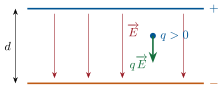
Two facing parallel metal plates, close together and carrying opposite charges, form a capacitor. Between the plates the field is uniform: same magnitude and direction everywhere — perpendicular to the plates, from the positive plate to the negative.
Proposition 14.10 (Field between the plates)
If the voltage between the plates (Chapter 12) is and their separation is , the field between them has magnitude
Proof. Admitted at this level. ∎
Remark 14.11
Uniformity and are derived honestly in the Year 1 volume; the formula explains the unit . Thin gaps make strong fields: across a millimetre is already .
Example 14.12 (Steering an electron beam)
In an oscilloscope, the beam passes between plates with and : , and each electron feels toward the positive plate — times its weight of , so the beam deflects visibly (the curved path is Chapter 25’s business).
14.4 The gravitational field
Definition 14.13 (Gravitational field)
If a test mass placed at a point feels a gravitational force (a weight) , the gravitational field there is
and conversely . An earlier chapter introduced the number ; adds the direction a dropped stone starts to move.
Proposition 14.14 (Field of the Earth)
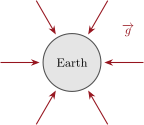
At distance from the Earth’s center (mass ), the gravitational field points toward the center and has magnitude
Proof. Universal gravitation (Chapter 4) gives the force on a test mass : magnitude , toward the center; divide by . At the surface, and this is the of the earlier chapter. ∎
Example 14.15 (The field where the Moon lives)
At the Moon’s distance :
Earth’s field never stops — it only thins out as ; this is the field that holds the Moon on its orbit.
Remark 14.16 (Uniform near the surface)
Over a laboratory or even a mountain, barely changes compared with , so is uniform to high accuracy: vertical lines, constant — the Earth’s field looks like the capacitor’s, just as the round Earth looks flat from a garden.
14.5 One idea, two forces
The two fields of this chapter are the same mathematics in two costumes:
| electric | gravitational | |
|---|---|---|
| source | charge | mass |
| field | ||
| unit | = | |
| point source | ||
| constant | ||
| force on a test | ||
| field lines | out of , into | always into the mass |
Every formula on the left becomes the one on the right under the dictionary , , .
Remark 14.17 (Where the analogy breaks)
Charge comes in two signs; mass in one. So electric fields can be canceled: the rearranged charges of a metal box wipe out any external field inside it (a Faraday cage — why an elevator kills your phone signal), and bulk matter, with balanced and , is electrically silent. Gravity can be neither screened nor neutralized: every kilogram adds its pull — which is why the force weaker by (Exercise 14.10) runs the universe at large scales.
14.6 Exercises
Exercise 14.1 ★
A test charge at a point feels a force of pointing north. Give the field at (magnitude and direction), then the force on placed at .
Solution
Solution of Exercise 14.1.
, pointing north. On : , pointing south ().
Exercise 14.2 ★
A point charge sits at .
Solution
Solution of Exercise 14.2.
1. , pointing away from ().
2. Halving needs doubled: .
Exercise 14.3 ★
A capacitor has across plates apart. Compute the field, then the force on one electron there ().
Solution
Solution of Exercise 14.3.
; .
Exercise 14.4 ★
On Mars, a probe weighs . Compute the Martian surface field , then the weight of an astronaut there.
Solution
Solution of Exercise 14.4.
. Astronaut: (about on Earth).
Exercise 14.5 ★
True or false, with one reason each: (a) two field lines may cross where the field is strong; (b) field lines leave negative charges and arrive at positive ones; (c) bunched field lines signal a strong field.
Solution
Solution of Exercise 14.5.
(a) False: the field has one direction at each point, so lines never cross. (b) False: they leave and arrive at . (c) True: crowding codes strength.
Exercise 14.6 ★★
The International Space Station orbits at altitude (, ).
- Compute at the station; what fraction of the surface value?
- Astronauts float. Reconcile this with your answer in one sentence.
Solution
Solution of Exercise 14.6.
1. , so — of the surface value.
2. They float because station and astronaut fall together (free fall), not because gravity is absent.
Exercise 14.7 ★★
What field magnitude would balance an electron’s weight ()? Compare with the of Example 14.12; conclude about the place of gravity in electron physics.
Solution
Solution of Exercise 14.7.
: some times weaker than the oscilloscope’s field. Gravity is utterly negligible in electron physics.
Exercise 14.8 ★★
A dust grain of mass floats at rest between horizontal plates apart with across them.
- Compute the field, then the magnitude of the grain’s charge.
- The grain’s charge is positive: which plate is the positive one?
- How many elementary charges does the grain carry?
Solution
Solution of Exercise 14.8.
1. ; at rest , so .
2. The force on the positive grain must point up, so points up: the lower plate is positive.
Exercise 14.9 ★★
Charges and sit apart. Where on the segment joining them is the total field zero? Explain first why the point must lie between the charges, closer to the smaller one.
Solution
Solution of Exercise 14.9.
Outside the segment both fields point the same way; between, they oppose — and balance needs the point nearer the weaker source . With the distance to : , so and from .
Exercise 14.10 ★★
In a hydrogen atom, the proton (, charge ) and the electron (, charge ) are apart. Compute the electric and the gravitational forces between them, and their ratio.
Solution
Solution of Exercise 14.10.
; . Ratio .
Exercise 14.11 ★★
At a point , one source alone would create a field of pointing east; a second, pointing north. Fields add as vectors: give the total field at (magnitude and direction), then the force on placed there.
Exercise 14.12 ★★★
At what altitude has the Earth’s field dropped to half its surface value? And at altitude , to what fraction?
Solution
Solution of Exercise 14.12.
gives , so (about ). At , : one quarter of the surface value.
Exercise 14.13 ★★★
Charges of sit at and , apart. is on the perpendicular bisector of , from its midpoint.
- Compute the distance , then the magnitude of the field each charge creates at .
- Add the two fields as vectors (use the symmetry) and give the total field at , magnitude and direction.
Solution
Solution of Exercise 14.13.
1. ; each charge creates .
2. The components along cancel by symmetry; each field contributes along the bisector, away from the segment: , directed along the bisector, away from .
Exercise 14.14 ★★★
Explain, using the two signs of charge, how the free charges of a metal box cancel an external electric field everywhere inside it — and why no arrangement of masses can do the same for gravity. What impossible ingredient would a gravity shield require?
Solution
Solution of Exercise 14.14.
The box’s free charges move under the external field: piles up on one face, on the other, and these displaced charges create an internal field opposing the external one. They keep moving until the total field inside is exactly zero — then equilibrium. Gravity offers only one sign of source: every mass adds an attracting field, none can oppose it. A gravity shield would need negative mass, which does not exist.
Exercise 14.15 ★★★
A small ball (, ) hangs from a thread in a horizontal uniform field . At rest, the thread makes an angle with the vertical.
14.7 Problem: Millikan’s droplet
Problem 14.1
Weekend problem — weighing the electron’s charge: an oil droplet parked in mid-air between two plates reveals that charge comes in indivisible steps of coulombs
In 1909, Robert Millikan sprayed oil droplets between the horizontal plates of a capacitor. By tuning the voltage until a chosen droplet hung motionless — electric force exactly balancing weight — he could weigh its charge. Our droplet has mass (measured from its slow fall with the field off; we take it as given); the plates are apart, the upper one positive; the droplet’s charge is negative.
Part I — The stage.
- Describe the field between the plates; what does “uniform” buy?
- For , compute .
- In which direction is the electric force on the droplet? Why did the upper plate have to be the positive one?
- Compute the droplet’s weight.
- Write the at-rest condition as an equality of two force magnitudes.
Part II — The balance.
- From it, express in terms of , , and .
- The droplet hangs at rest for : compute .
- Divide by . How many excess electrons does the droplet carry?
- The voltage is nudged up to . In which direction does the net force now point?
- Show that the balancing voltage is : the bigger the charge, the smaller the voltage.
Part III — The steps. A burst of radiation can knock electrons onto or off the droplet; after each change, Millikan re-tunes the voltage to balance.
- After one burst, balance requires . Compute the new . Did the droplet gain or lose an electron?
- Successive balances are found at , , , and . Compute the five charges.
- Show that all five are integer multiples of one quantity; give its value.
- Between consecutive balances, by how much does the charge change? Interpret.
- Explain why this droplet can never hang at rest at , however patiently one tunes.
- Millikan repeated this on hundreds of droplets: every measured charge was an integer multiple of the same value. State the conclusion, and name the quantity measured.
Part IV — Why there is no gravitational Millikan.
- In this chapter’s dictionary, what plays the roles of , and in the balance of Part II?
- Could a mass overhead hold the droplet up instead? Compute the field of a lead sphere above the droplet, the force on the droplet, and compare with its weight.
- The balance needs an upward pull strong enough to fight the whole Earth. Why can a plate of charge provide it and no arrangement of masses can?
- The droplet’s mass also changes in steps (one oil molecule: about ). Compare the relative jumps in and in when one electron lands, and conclude: why does this balance see the atoms of electricity but not the molecules of oil? Punchline: charge is quantized, and its atom is .
Solution
Solution of Problem 14.1.
1. Uniform, perpendicular to the plates, pointing down (from the upper plate to the lower one); uniformity means the force on the droplet is the same wherever it drifts. 2. . 3. The charge is negative, so the force is opposite : upward. Only with the plate on top does point down and the electric force fight the weight. 4. . 5. . 6. . 7. . 8. excess electrons. 9. grows, so : the net force points up. 10. From , — inversely proportional to the charge. 11. : down from , the droplet lost one electron. 12. : , , , , . 13. They are with . 14. Each step changes by exactly : one electron lands at a time. 15. It would need — not a whole number of electrons, so no burst of radiation can ever produce it. 16. Charge is quantized: it comes in integer multiples of the elementary charge — the quantity Millikan measured. 17. , , and : the weight itself. 18. ; force on the droplet — about times smaller than its weight. Hopeless. 19. Because is so small, only a planet-sized mass overhead could rival the Earth’s pull — and no mass repels. The enormous and the two signs of charge let a bench-top plate out-pull the planet in either direction. 20. One electron: ; one oil molecule: . The charge staircase moves the balancing voltage by hundreds of volts; the mass staircase is invisible at any voltage. The balance therefore resolves the atom of electricity — — while the molecules of oil blur into a continuum.