Physics · Glossary

What is Inductance?

Definition 29.5 University Physics — Year 1 · Chapter 29 — Electromagnetic Induction and Applications

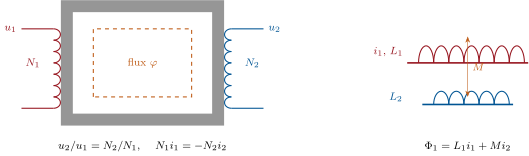
The flux of a circuit’s own field through itself is proportional to its current: Φown=Li\Phi_{\text{own}} = Li, with L>0L > 0 its self-inductance (henry, H\mathrm{H}). The flux that circuit 1 sends through circuit 2 is Φ12=Mi1\Phi_{1 \to 2} = Mi_1, and symmetrically Φ21=Mi2\Phi_{2 \to 1} = Mi_2, with MM their mutual inductance (sign fixed by the orientations). The total flux of circuit 1 is then Φ1=L1i1+Mi2\Phi_1 = L_1i_1 + Mi_2.

Left: a transformer — two coils on a closed iron core share the same flux; the voltages scale with the turns, the currents inversely. Right: two coupled coils in air and their mutual inductance M; a coil’s own flux is Li.
Left: a transformer — two coils on a closed iron core share the same flux; the voltages scale with the turns, the currents inversely. Right: two coupled coils in air and their mutual inductance MM; a coil’s own flux is LiLi.
Read in context →